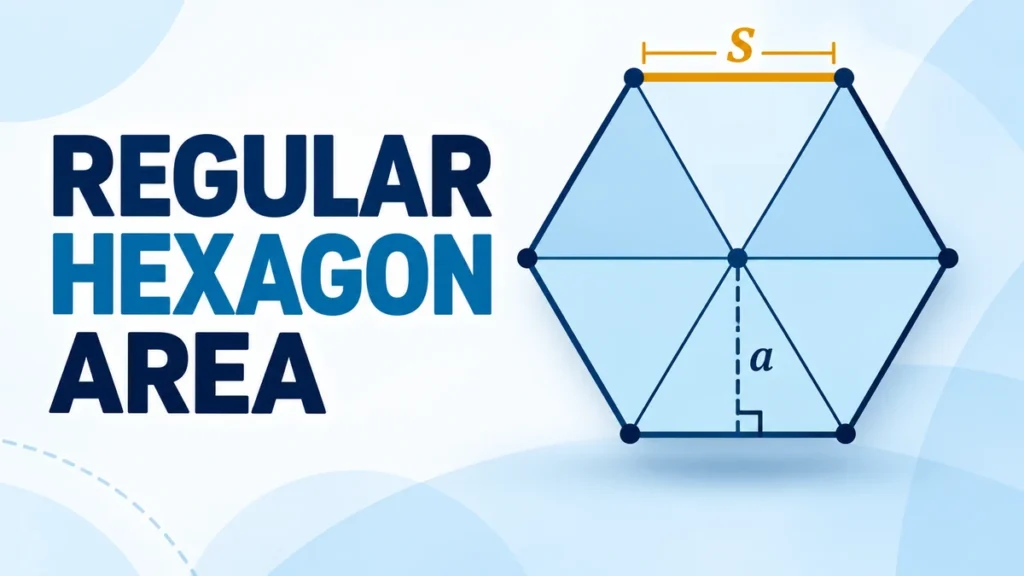
A regular hexagon has area A = (3√3/2)s² because lines from its center to its six vertices divide it into six equilateral triangles. Each triangle has area (√3/4)s². Multiplying by six gives 6(√3/4)s² = (3√3/2)s².
What Does The Regular Hexagon Area Formula Mean?
A hexagon has six sides, but the coefficient is not simply 6. The OpenStax regular-polygon method gives A = (1/2)ap, where a is the apothem and p is the perimeter. For a regular hexagon, p = 6s and a = (√3/2)s, producing the coefficient 3√3/2.
In the formula, s is the length of any side. The symbol s² tells you that the result is an area, so its unit must be square centimeters, square feet, or another square unit. The coefficient 3√3/2 is about 2.598. Therefore, a regular hexagon covers about 2.598 times the area of a square whose side is also s.
The exact form is usually better than the decimal form. Keep 3√3/2 during the work, then round only if the problem requests a decimal. That choice prevents small rounding errors from growing when the side length is large.
Use the Hexagon Calculator to check an area, apothem, perimeter, or diagonal. The calculator gives the value; the sections below explain why the area formula is true.
Why Does A Regular Hexagon Split Into Six Equilateral Triangles?
The six central angles total 360°, so each one measures 360° ÷ 6 = 60°. A University of Texas mathematics solution confirms that a regular hexagon of side 1 breaks into six equilateral triangles of side 1. The same reasoning works for every positive side length s.
Connect the center O to every vertex. A regular polygon has equal sides and equal central angles. The six radii are equal because they belong to one circumcircle. In a regular hexagon, the chord between neighboring vertices has the same length as the radius.
You can prove that last statement without assuming it. Take one center triangle. Its two radii have length R, and its included angle is 60°. The Law of Cosines gives s² = R² + R² − 2R² cos 60°. Since cos 60° = 1/2, s² = R², so s = R for positive lengths.
Each center triangle now has three sides of length s. That makes every one equilateral. This is the special feature that makes a regular hexagon easier than most other regular polygons. In a regular pentagon or octagon, the center triangles are isosceles but not equilateral.
The formula is really an equilateral-triangle formula repeated six times. The hexagon does not introduce a new kind of area. It packages six familiar areas around one point without gaps or overlaps.
The Source Of The √3 Factor
An equilateral triangle of side 1 has height √3/2 and area √3/4, as shown in the same University of Texas solution. Replacing 1 with s scales the height to (√3/2)s and the area to (√3/4)s². Six copies create the regular hexagon formula.
Drop a perpendicular from the top vertex of one equilateral triangle to its base. Symmetry cuts the base into two pieces of length s/2. The new right triangle has hypotenuse s, one leg s/2, and height h.
Apply the Pythagorean Theorem:
h² + (s/2)² = s²
h² = s² − s²/4 = 3s²/4
h = (√3/2)s
The triangle’s area is one-half base times height. Therefore, its area is (1/2)(s)(√3/2)s = (√3/4)s². Multiply by the six triangles:
A = 6(√3/4)s² = (6√3/4)s² = (3√3/2)s²
The radical is not a decoration added at the end. It comes from the exact height of a 30°-60°-90° triangle. A decimal such as 1.732 for √3 hides that geometric origin and introduces rounding.
How Does The Apothem Proof Confirm The Formula?
OpenStax defines a regular polygon’s apothem as the perpendicular segment from its center to a side and gives A = (1/2)ap. For a regular hexagon, the perimeter is 6s and the apothem is (√3/2)s. Substitution independently returns A = (3√3/2)s².
The formula A = (1/2)ap works because the polygon is divided into triangles whose bases are its sides and whose shared height is the apothem. Adding their areas gives (1/2)a(s + s + s + s + s + s) = (1/2)a(6s).
OpenStax uses a regular hexagon with side 4 and apothem 2√3 as an example. Its perimeter is 24, so A = (1/2)(2√3)(24) = 24√3, or about 41.57 square units. This matches the six-triangle method exactly.
The apothem method is more flexible when a problem gives the apothem or perimeter instead of a side. The six-equilateral-triangle method is more direct when only s is known. Both methods measure the same region, so their agreement is a strong check.
Worked Example With s = 4
OpenStax’s side-4 regular hexagon has exact area 24√3 and decimal area about 41.57 square units. Substituting s = 4 into (3√3/2)s² reproduces that result. The exact value is useful for algebra, while the decimal value is useful for measurement.
- Square the side: s² = 4² = 16.
- Substitute: A = (3√3/2)(16).
- Simplify exactly: A = 24√3 square units.
- Approximate if needed: A ≈ 24(1.7320508) ≈ 41.569 square units.
Check the answer by finding one triangle. Its area is (√3/4)(16) = 4√3. Six triangles have area 6(4√3) = 24√3. The independent count reaches the same exact result.
A rough reasonableness check also helps. The hexagon fits inside a rectangle 8 units wide and 4√3 units high, whose area is about 55.43. The hexagon’s area of about 41.57 is smaller, as it must be.
How Does The Area Change When The Side Changes?
The formula contains s², so multiplying the side by a factor k multiplies the area by k². If s doubles from 4 to 8, area grows from 24√3 to 96√3, exactly four times larger. This follows the standard area scaling rule, not a special hexagon exception.
| Side Length | Exact Area | Change From s = 4 |
|---|---|---|
| 2 | 6√3 | One-fourth |
| 4 | 24√3 | Original |
| 8 | 96√3 | Four times |
| 12 | 216√3 | Nine times |
The coefficient 3√3/2 controls the shape, while s² controls the scale. Every regular hexagon is similar to every other regular hexagon, so the coefficient never changes. Only the square of the side changes.
This pattern can catch an error quickly. If the side doubles but your area only doubles, you probably forgot to square s. If your area becomes eight times larger, you may have used a volume scaling rule by mistake.
When Can You Use This Formula?
The formula requires a regular hexagon: all six sides are equal and all six interior angles are 120°. The University of Houston regular-polygon notes split such a hexagon into six equal triangles with 60° central angles. An irregular six-sided figure does not satisfy those conditions.
- Use it when one side length is known: all six sides must share that length.
- Use positive lengths: s must be greater than zero for a real geometric hexagon.
- Keep units consistent: convert every length to one unit before calculating.
- Report square units: an input in centimeters produces square centimeters.
- Do not use it for irregular hexagons: divide those figures into measurable shapes or use coordinates instead.
A flat-top and a point-up regular hexagon have the same area. Rotation changes only the drawing’s orientation. It does not change any side, central angle, apothem, or triangle area.
If you know the apothem and perimeter instead, use A = (1/2)ap. If coordinates are given, the shoelace formula may be more appropriate. Browse the Geometry and Trigonometry hub to compare related shape tools, or use the triangle area calculator to check one of the six component triangles.
What Common Mistakes Should You Avoid?
A regular hexagon with s = 4 has area 24√3, not 12√3 and not 24. OpenStax’s worked example reaches about 41.57 square units. Most incorrect answers come from missing the six triangles, using s instead of s², or applying the formula to an irregular figure.
Using The Perimeter As s
The variable s is one side, not all six sides. If the perimeter is P, first compute s = P/6. Substituting P directly makes the answer 36 times too large because the input is squared.
Forgetting The Square
Area changes with s². The expression (3√3/2)s is not dimensionally an area. Write the units during substitution to see that length times length must produce square units.
Rounding √3 Too Early
Keep √3 exact through the algebra. If a decimal is required, round the final value once. Using 1.7 too early makes the side-4 example 40.8 instead of about 41.57.
Assuming Every Hexagon Is Regular
Six sides alone do not guarantee six equilateral center triangles. An irregular hexagon can have unequal sides, unequal angles, or both. Its area depends on more measurements than one side length.
Frequently Asked Questions
A regular hexagon has six 120° interior angles, six 60° central angles, and six equal sides. The University of Houston notes use these facts to build its area from equal center triangles. The short answers below connect the formula to radius, apothem, perimeter, and irregular cases.
Why Is The Radius Equal To The Side?
Adjacent radii form a 60° central angle. Two equal radii with that included angle create an equilateral triangle, so the chord between their endpoints equals the radius. Therefore, the regular hexagon’s circumradius is R = s.
What Is The Apothem Of A Regular Hexagon?
The apothem is a = (√3/2)s. It is the height of an equilateral center triangle. You can derive it by splitting that triangle into two 30°-60°-90° right triangles.
Can I Find The Area From The Perimeter?
Yes. Since P = 6s, substitute s = P/6 into the side formula. The result is A = (√3/24)P². This version still assumes the hexagon is regular.
Does The Formula Work For A Hexagonal Prism?
It finds one regular hexagonal base only. A prism’s volume is base area times prism height, so V = (3√3/2)s²H. Its surface area also includes two bases and six rectangular side faces.
How Do I Find An Irregular Hexagon’s Area?
Divide it into nonoverlapping triangles or other simple shapes, then add their areas. If all vertex coordinates are known in order, use the shoelace formula. One side length is not enough.