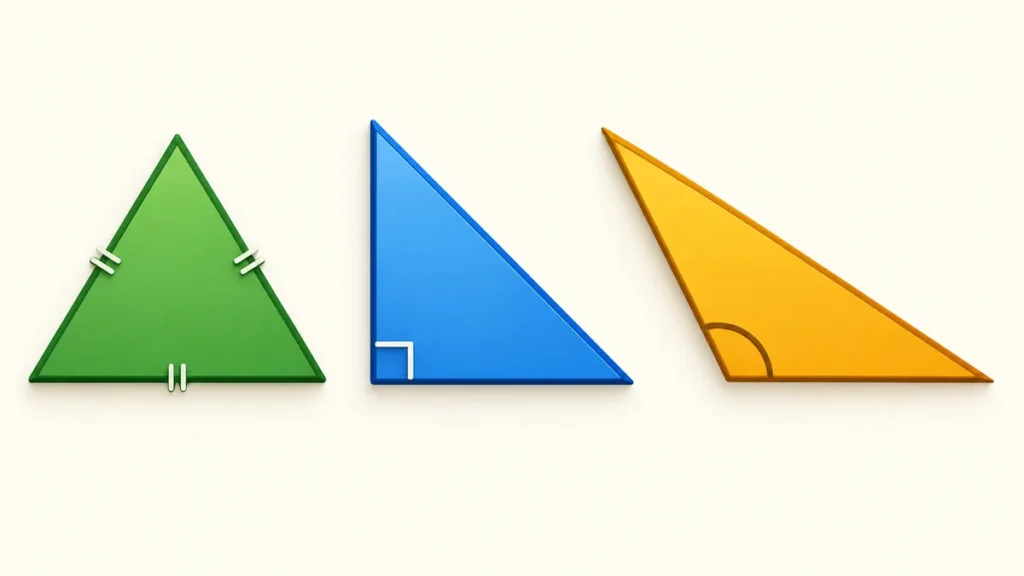
Geometry · Triangle Classification
Every triangle has two useful descriptions: one for its side-length pattern and one for its angles. Keeping those two tests separate makes classification much easier.
By sides, a triangle is equilateral (three equal sides), isosceles (two equal sides in the usual classroom classification), or scalene (three different sides). By angles, it is acute (all angles below 90°), right (one 90° angle), or obtuse (one angle above 90°). Give both labels when you can: a 3–4–5 triangle is scalene and right. OpenStax describes both classification systems.
Why Are There Two Ways To Classify A Triangle?
Side labels answer “which lengths match?” Angle labels answer “is every angle acute, or is one right or obtuse?” These describe different properties, so one triangle can have one label from each group. For example, a triangle with sides 3, 4, and 5 has three different lengths (scalene). Because 3² + 4² = 5², it is also right.
Calling it only “scalene” leaves out its angle type.
An equilateral triangle has three equal angles of 60°, so it is always acute. Isosceles and scalene triangles can be acute, right, or obtuse depending on their measurements. The exact meaning of “isosceles” varies by convention: some textbooks say at least two equal sides, which includes equilateral; classroom comparison charts often use exactly two to keep the three side categories distinct.
Check the convention your course uses.
What Are The Three Types By Side Length?
Equilateral means all three side lengths match. Isosceles usually means two match for a distinct classroom category; the angles opposite those sides match too. Scalene means no sides match, so its three angles also differ. Measure carefully: a sketch can look symmetric while its recorded lengths are not equal. OpenStax illustrates the side categories.
| Side lengths | Side type | Reason |
|---|---|---|
| 6, 6, 6 | Equilateral | All three equal |
| 5, 5, 6 | Isosceles | Two equal |
| 3, 4, 5 | Scalene | All different |
What Are The Three Types By Angle?
An acute triangle has three angles below 90°. A right triangle has exactly one 90° angle. An obtuse triangle has exactly one angle greater than 90° and less than 180°.
The interior angles of any valid triangle in the flat Euclidean plane total 180°, so it cannot contain two right angles or two obtuse angles. OpenStax demonstrates the 180° angle sum.
Example: Find The Missing Angle First
If two angles are 50° and 60°, the third is 180° − 50° − 60° = 70°. All three are below 90°, so the triangle is acute. Because the three angles differ, the opposite side lengths differ too, making it scalene.
Finding the missing angle lets you justify both labels without measuring the sides.
How Do You Classify A Triangle From Its Measurements?
If side lengths are provided, first check whether they form a valid triangle. Then compare lengths for the side label. To find the angle label from sides, compare the square of the longest side c with the sum of the squares of the other two: a² + b².
Equality means right; a² + b² greater than c² means acute; less means obtuse. Use exact lengths where available, because rough drawings and rounded measurements can hide a right angle.
Example: Compare Two Side Sets
For 3, 4, 5, all lengths differ, so the triangle is scalene. Since 3² + 4² = 9 + 16 = 25 = 5², it is right. For 5, 5, 6, two lengths match, so it is isosceles.
Because 5² + 5² = 50 is greater than 6² = 36, it is acute. A single shape can therefore carry both a side label and an angle label.
If you already know the angle measures, classify by the largest one after checking that all three are positive and sum to 180°. If you know only two, subtract them from 180° to find the third. For numeric side/angle solving beyond simple classification, use the Triangle Calculator; use the Right Triangle Calculator when a 90° angle is given.
When Do Three Lengths Fail To Make A Triangle?
Before naming a triangle, check the triangle inequality: the sum of the two shorter lengths must be greater than the longest length. Lengths 2, 3, and 6 fail because 2 + 3 = 5, which is less than 6. Lengths 2, 3, and 5 also fail: 2 + 3 = 5 gives a straight, flattened arrangement rather than a triangle.
Do not classify an impossible side set as acute, right, or obtuse.
Why Do Equal Sides Match Equal Opposite Angles?
The side-angle relationship connects the two descriptions. Equal sides in a triangle have equal opposite angles, and equal angles have equal opposite sides. This lets one measurement type supply information about the other.
If two angles are 40° and 40°, the third is 100°. Their equal opposite sides make the triangle isosceles, while the 100° angle makes it obtuse. It has two labels, not a conflict between classifications.
Three equal sides force three equal angles. Since the angles sum to 180°, each is 60°. That explains why an equilateral triangle is acute rather than simply asking you to memorize the pairing.
Does Scaling Or Rotating Change The Triangle Type?
Multiplying every side by the same positive factor preserves side equality and the angles. A 3, 4, 5 triangle becomes 6, 8, 10 when doubled. Both are scalene and right.
Rotation also preserves the type. A right angle can appear at the top, bottom, or side of a diagram. Do not identify it merely by which line seems horizontal or vertical.
Changing only one side is not uniform scaling and may change the angles. The equality test for sides alone does not establish that two drawings are similar. All relevant measurements must be considered.
Why Is The Largest Angle The Best Angle-Type Check?
If the largest angle is below 90°, all three are acute. If it equals 90°, the triangle is right. If it exceeds 90°, the triangle is obtuse.
For 20°, 70°, and 90°, checking only 20° could wrongly suggest an acute triangle. The largest angle supplies the classification. First confirm the three positive angles total 180°.
Why Do Textbooks Sometimes Classify Equilateral As Isosceles?
The difference comes from whether isosceles means at least two equal sides or exactly two. Under the inclusive definition, an equilateral triangle meets the isosceles condition too. Under an exclusive comparison chart, the categories are kept separate.
Neither convention changes the side measurements. State the definition being used when a question depends on the distinction. This article’s separate side-category chart uses the exclusive convention.
Do not carry that convention into a claim that an equilateral triangle lacks equal-side properties. It still has equal angles, equal sides, and the corresponding symmetries. Category names must not override the geometry.
Can Rounded Measurements Hide The Classification?
Yes. Two displayed lengths both rounded to 5.0 may have different exact values. Their appearance alone does not prove that the triangle is exactly isosceles.
Similarly, a calculated angle rounded to 90° may not be exactly right. Use exact given values in classroom problems, or the stated measurement tolerance in practical work. Explain the uncertainty rather than inventing a precise category from a rough sketch.
FAQs About Triangle Types
Can A Triangle Be Both Scalene And Obtuse?
Yes. Scalene describes different side lengths, while obtuse describes its largest angle. Those labels refer to different attributes of the same triangle.
Can A Triangle Have Two Right Angles?
No. Two right angles already total 180°, leaving no positive third interior angle. The figure would not be a genuine triangle in the flat Euclidean plane.
Can You Classify These Without A Picture?
Try 4, 4, 4; 6, 8, 10; and angles 30°, 30°, 120°. State every label you can justify and explain what measurement supplies it.
Use The Right Triangle Tool For The Next Step
This guide helps you identify the type. The calculators can solve unknown sides or angles once you have valid measurements.
Triangle CalculatorRight Triangle CalculatorBrowse Geometry Tools