Geometry · Boundary and Coverage
Perimeter measures the distance around a shape. Area measures the region inside it. Holding one measurement constant does not usually determine the other.
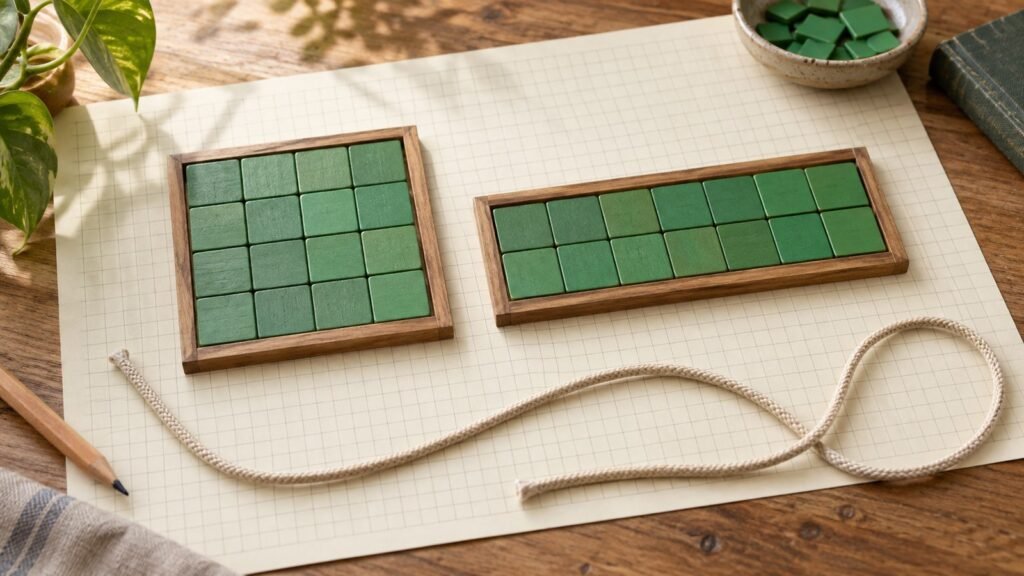
Shapes can have the same perimeter but different areas because the same boundary length can be arranged differently. A 1 × 5 rectangle and a 3 × 3 square both have perimeter 12 units, but their areas are 5 and 9 square units. Among rectangles with a fixed perimeter, the square encloses the greatest area.
Why Do Area and Perimeter Use Different Units?
Perimeter adds lengths, so it uses linear units such as metres or centimetres. Area counts coverage, so it uses square units such as m² or cm². A square metre is the area of a square one metre on each side—not another way of writing a metre.
OpenStax distinguishes boundary length from surface coverage and gives the rectangle formulas P = 2L + 2W and A = LW. One depends on a sum; the other depends on a product. That difference allows equal sums to produce unequal products.
How Can a Twelve-Unit Boundary Enclose Different Areas?
For a rectangle with perimeter 12, twice the length plus twice the width equals 12. Divide by two: L + W = 6. Several positive pairs meet this condition. The pairs (5,1), (4,2), and (3,3) all have the same sum.
Their products are different: 5 × 1 = 5, 4 × 2 = 8, and 3 × 3 = 9. Imagine reshaping a twelve-unit loop into these rectangles without changing its total length. The space it surrounds changes even though the loop length does not.
Why Does a Square Have the Greatest Area Among These Rectangles?
With a fixed sum of the sides, moving the sides closer together increases their product. For perimeter 12, write the sides as 3 + d and 3 − d, where |d| < 3 keeps both lengths positive. Their sum remains 6.
A = (3 + d)(3 − d) = 9 − d².
Since d² is never negative, A ≤ 9.
Equality occurs only when d = 0: both sides are 3.
For any positive fixed perimeter P, let the sides be P/4 + d and P/4 − d. The area is P²/16 − d². The square, with side P/4, reaches the maximum P²/16 among rectangles. This argument includes non-integer side lengths, not just pairs listed in a table.
Can Equal Areas Have Different Perimeters?
Yes. A 2 × 6 rectangle and a 3 × 4 rectangle each have area 12 square units. Their perimeters are 16 and 14 units. The first is longer and narrower, so its boundary length is greater despite equal coverage.
For a fixed positive rectangle area A, the square has the least perimeter among rectangles. One compact check is (L − W)² ≥ 0, which gives (L + W)² ≥ 4LW = 4A. Thus P = 2(L + W) ≥ 4√A, with equality when L = W.
Knowing only a rectangle’s area therefore leaves many possible side pairs. Knowing only its perimeter leaves many possible products. An additional dimension or relationship is needed to determine a unique rectangle.
Why Does Doubling the Sides Quadruple the Area?
Scaling every length by a positive factor k multiplies a rectangle’s perimeter by k but its area by k². Each of the two area dimensions receives the factor. For a 2 × 3 rectangle, the perimeter is 10 and the area is 6. Doubling both sides gives a 4 × 6 rectangle: perimeter 20, area 24.
This is a different situation from reshaping a fixed boundary. Scaling preserves proportions but changes the boundary length; reshaping a fixed-perimeter rectangle changes proportions. Keeping these two operations separate avoids the mistaken rule that doubling perimeter must always quadruple area for unrelated shapes.
Which Measurement Should You Use in a Word Problem?
Use perimeter for an idealized boundary task, such as finding the length of edging around a rectangular garden. Use area for coverage, such as finding how much surface lies inside that garden. Practical material estimates may need extra allowances for openings, overlaps, or waste; the geometric measurement alone does not specify those.
- Identify whether the task concerns the edge or the interior.
- Convert side lengths to the same unit before calculating.
- Use the corresponding formula and preserve linear or square units.
- Check whether the given information actually determines a unique result.
Try rectangles with perimeter 20: 1 × 9 has area 9, 2 × 8 has area 16, and 5 × 5 has area 25. Verify each pair in the Rectangle and Square Calculator. Equal boundary length does not mean equal usable space.
Compare Two Rectangles
Keep the side sum fixed, change the proportions, and compare the calculated areas.
Rectangle and Square CalculatorPerimeter CalculatorGeometry ToolsReference
OpenStax: Properties of Rectangles, Triangles, and Trapezoids supports the definitions and rectangle formulas. The fixed-perimeter proof and worked comparisons are independently calculated.