Ratios · Choosing the Right Comparison
These words describe related but different jobs. Before simplifying numbers, decide whether you are comparing quantities, describing an amount per unit, or asserting that two comparisons are equal.
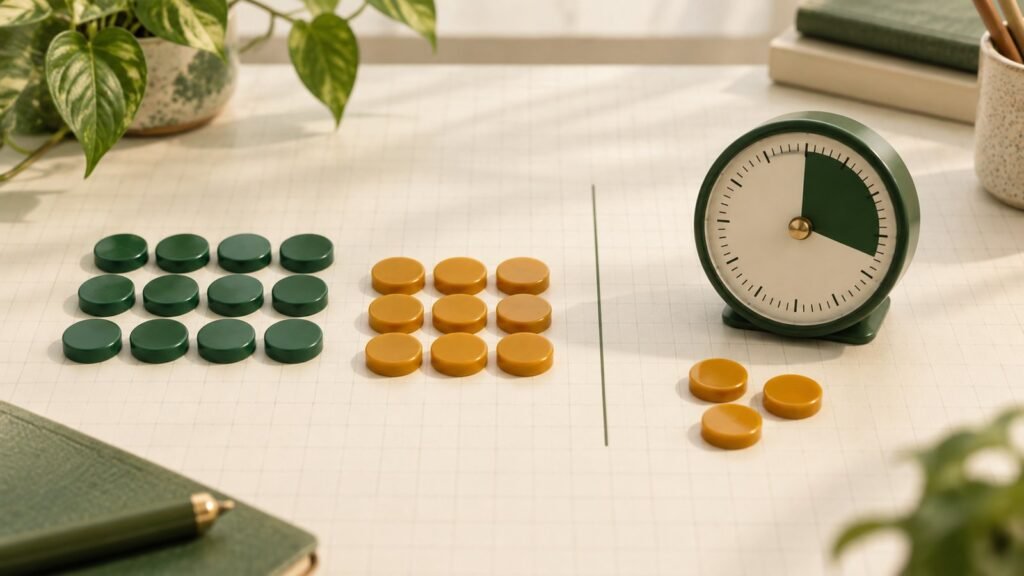
A ratio compares quantities, such as 12 green counters to 9 amber counters: 12:9 = 4:3. A rate is a ratio with unlike units, such as 120 kilometers in 2 hours = 60 kilometers per hour. A proportion states that two ratios or rates are equal, such as 4:3 = 8:6. In school arithmetic, this unit-based distinction helps select the right operation. OpenStax distinguishes ratios, rates, and unit rates.
What Does a Ratio Actually Compare?
A ratio records one quantity relative to another, in a specified order. With 12 green and 9 amber counters, green:amber is 12:9, which reduces to 4:3 after dividing both parts by 3. Amber:green is 9:12 = 3:4, a different statement. The written fraction 4/3 represents the same first-to-second comparison, but keep labels attached so readers know which part is first. The Ratio Calculator simplifies a two-part comparison; it does not decide which two quantities your question meant.
Why Is Part-to-Part Not the Same as Part-to-Whole?
There are 21 counters altogether: 12 green plus 9 amber. Green:amber is 12:9 = 4:3, a comparison between two parts. Green:total is 12:21 = 4:7, the share of all counters that are green. That share is 4/7, or about 57.14%, not 4/3. If a question asks “what fraction of the whole is green?”, use the total as the second quantity. Switching from amber to total silently changes the question, even though the first number stays 12.
When Does a Comparison Become a Rate?
A rate compares different kinds of units. A trip of 120 kilometers in 2 hours has rate 120 kilometers/2 hours; dividing both numerical quantities by 2 gives the unit rate 60 kilometers per hour. The units do not cancel because distance and time are different kinds of measurement. By contrast, a length ratio such as 1 meter to 50 centimeters should first be converted to matching units: 100 centimeters:50 centimeters = 2:1. In broader mathematics, every rate is a ratio, but the word rate highlights that different units remain in the result.
When Do Two Comparisons Form a Proportion?
A proportion is an equality between two ratios or rates. The equation 4/3 = 8/6 is true because both sides represent the same comparison; cross-products agree, 4×6 = 3×8 = 24. If one term is unknown, a proportion can express the missing-value problem: 4/3 = x/9 gives x = 12. Do not confuse a single ratio, 4:3, with the whole equation comparing that ratio with another. The Proportion Calculator is the appropriate tool for an unknown term; the Ratio Calculator is for simplifying a given pair.
How Do You Choose the Correct Comparison and Tool?
Read the labels before the numbers. For “green to amber,” keep the order and simplify a ratio. For “kilometers per hour,” retain the units and compute a rate. For “is 4:3 equivalent to 8:6?” test a proportion. For “what percent of all counters are green?” compare 12 with the total 21, then convert 12/21 to a percent if needed. The Percent Calculator answers the last task; replacing the intended denominator with a convenient one will not.
Choose the Next Calculation
Use the ratio tool for a labeled pair, or the proportion tool when two comparisons are set equal and one term is missing.
Open the Ratio CalculatorOpen the Proportion Calculator