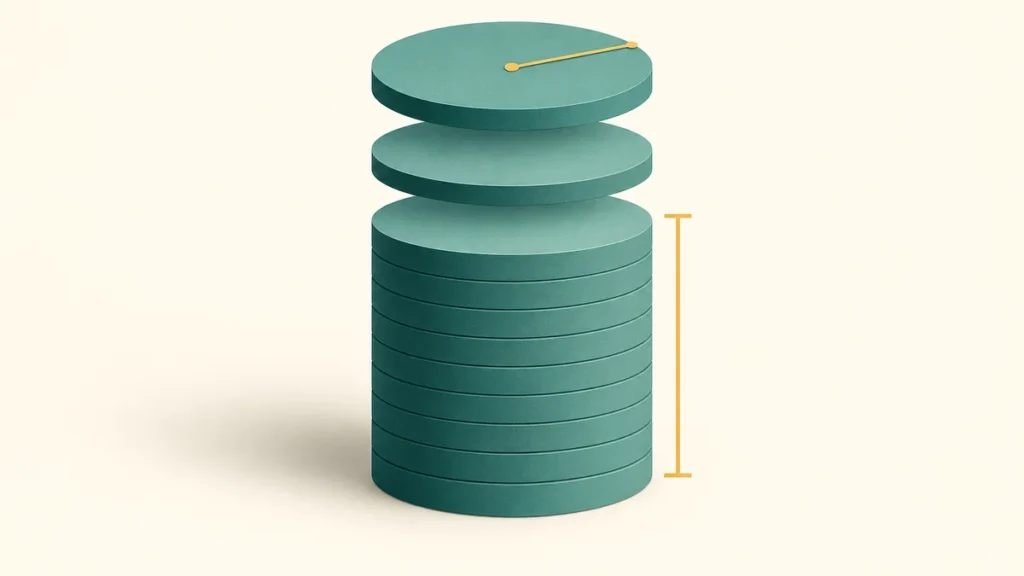
A cylinder’s volume is base area times height because the same circular area continues through its height. Each thin layer contributes the base area multiplied by that layer’s thickness. Adding all the layers gives the base area multiplied by their total thickness, which is the cylinder’s perpendicular height.
For a circular cylinder, the base area is πr², so the formula becomes V = πr²h. The squared radius accounts for the circular cross-section. Height tells you how far that cross-section extends. This guide explains the layer model, checks the dimensions, and separates solid volume from wall material and usable container capacity.
Why Does Stacking Equal Layers Give V = Bh?
A constant cross-section means every layer has the same area B. If each layer has thickness Δh, its volume is BΔh. With n equal layers, the total is nBΔh. Since their combined thickness nΔh is h, the expression becomes Bh. This explains the formula instead of treating it as an unrelated rule.
The OpenStax lesson on volume and surface area gives the base-area-times-height formula for cylinders and prisms. A cylinder uses a circular base rather than a polygonal one. The shape of the base changes how you find B, but not the constant-layer multiplication.
Do not imagine that whole square tiles must fit exactly inside a circular layer. Area can include fractional units along a curved boundary. The layer explanation uses the circle’s full area, not a count of only the complete tiles that happen to fit inside it.
A rectangular prism follows the same reasoning. A prism with base area 9π cm² and height 8 cm has the same volume as a cylinder with that base area and height. Equal constant cross-sectional areas and equal heights produce equal volumes, even when the outlines differ.
You can explore the separate polygonal-base task with the rectangular prism calculator. The comparison shows what is universal about Bh: the constant area, not a requirement that every base be circular.
How Do Radius, Diameter, And Units Enter Cylinder Volume?
Square the radius to calculate the base area, then multiply by height. Radius is the distance from the circle’s center to its edge. Diameter crosses the whole circle through the center, so it is twice the radius. Treating a diameter as a radius makes the computed volume four times too large.
For an invented cylinder with radius 3 cm and height 8 cm, the base area is π × 3² = 9π cm². Multiplying by 8 cm gives 72π cm³. Its decimal approximation is 226.1947 cm³, or about 226.19 cm³ to two decimal places.
If a cylinder instead has diameter 10 cm and height 4 cm, first use r = 5 cm. Its volume is π × 5² × 4 = 100π cm³, approximately 314.1593 cm³. Substituting 10 as the radius would incorrectly give 400π cm³.
The units show why the result is volume. The base contributes cm², and height contributes cm. Their product is cm³. Surface area stays in square units and answers a different question about the covering or boundary of the solid.
For a closed right circular cylinder, surface area is 2πrh + 2πr². That expression includes the curved exterior and two circular ends. It does not replace πr²h when you need enclosed space. Choosing a formula by its letters rather than the quantity can mix up these tasks.
Do not add two base areas to the volume because the cylinder has two ends. Those ends bound the same stack of layers. Adding them belongs to a surface-area calculation and would mix square units with the cubic units of volume.
Use the cylinder calculator after identifying the dimensions and requested quantity. Make sure a value labeled diameter is converted before using a radius-based formula, even if the numbers themselves look reasonable.
Which Height Should You Use For A Tilted Cylinder?
The height in Bh is the perpendicular distance between the parallel base planes. For a right cylinder, its straight side runs perpendicular to the base, so that side length equals height. For an oblique cylinder, the slanted side is longer than the perpendicular separation and must not replace it.
You can picture sliding equal circular layers sideways while keeping their thickness and area unchanged. The stack becomes slanted, but none of its layers gains volume. As long as the parallel cross-sections keep the same area and the perpendicular height stays fixed, the volume remains Bh.
This equal-cross-section comparison is the idea behind Cavalieri’s principle. It is a way to compare solids through corresponding layers. It does not say every object with a circular bottom has volume πr²h, because the cross-sectional areas may change as you move upward.
A cone is an important contrast. Its circular layers shrink toward the tip, so using the largest base area for every layer overcounts its space. Before applying Bh directly, check that the object actually has a constant cross-section through the relevant height.
Why Does Doubling Radius Quadruple Cylinder Volume?
Radius appears squared, while height appears once. If you double radius and keep height fixed, the base area becomes four times as large, so volume does too. If you double only height, you stack twice as much of the same base area, producing twice the volume.
For our radius-3, height-8 cylinder, doubling radius to 6 gives 288π cm³. Doubling only height to 16 gives 144π cm³. Doubling both gives 576π cm³, eight times the original 72π cm³.
Physical enlargement differs from unit conversion. Converting the original dimensions from centimeters to millimeters changes their numerical labels, but the cylinder itself stays the same size. Enlarging its radius and height in the same unit changes the actual space it occupies.
How Can You Find A Missing Cylinder Height Or Radius?
Use the base area to separate the missing dimension from the known ones. If volume and radius are known, divide volume by πr² to find height. If volume and positive height are known, divide volume by πh and take the nonnegative square root to find radius.
For V = 72π cm³ and r = 3 cm, h = 72π/(9π) = 8 cm. The units also cancel correctly: cubic centimeters divided by square centimeters gives centimeters. That makes the rearranged formula a useful check on the original volume.
For V = 100π cm³ and h = 4 cm, r = √[100π/(4π)] = √25 = 5 cm. The squared quantity inside the square root is 25 cm². Radius is a physical length, so you use the nonnegative root rather than reporting both +5 and −5 cm.
A positive volume requires a positive radius and height in this model. A height of zero cannot be used as a divisor in the radius formula. If supplied inputs are inconsistent with those conditions, explain the problem instead of forcing an ordinary cylinder answer.
How Does A Hollow Cylinder Change The Volume Question?
A hollow cylinder can involve outer volume, inner space, or wall material. These are different quantities. If outer radius is R and inner radius is r, the wall volume over the same height is π(R² − r²)h. Interior capacity uses the inner dimensions, not the outside radius.
For an invented tube with R = 5 cm, r = 3 cm, and h = 4 cm, the outer volume is 100π cm³. The inner space is 36π cm³. Subtracting gives 64π cm³ of wall material, assuming the stated uniform cylindrical wall and no added end pieces.
For an upright interior cylinder with radius 3 cm, liquid filled to a depth of 2 cm occupies 18π cm³. Use the fill depth for the height of the liquid layers, not the full container height. The unfilled space is not part of the liquid volume.
A cylinder resting on its side needs a different partial-fill calculation. Liquid depth then describes only part of a circular cross-section, not a full circle extended through that depth. Substituting water depth directly into πr²h can give the wrong volume.
Once volume is known, the volume converter handles the unit-label task. It cannot decide whether your dimensions describe outside space, inside space, or a partially filled region. Establish the geometry before converting the result.
FAQs About Cylinder Volume And Layers
Does The Circular Base Need To Be At The Bottom?
No. Orientation does not change the solid’s volume. The formula still uses the area of a circular end and the perpendicular distance to the parallel circular end. Changing which side rests on a table does not change those geometric measurements.
Should I Use 3.14 Or The Calculator’s Pi Value?
Keep π symbolically when an exact answer is requested. For a decimal answer, use the calculator’s pi value and round at the end unless instructions specify another approximation. Using 3.14 early can add rounding error, especially when the radius and height are large.
Does A Detailed Decimal Answer Mean The Measurements Are Exact?
No. A calculator may display many digits even when radius and height were rounded measurements. Extra output digits do not create better input accuracy. Report the final volume according to the task’s precision requirements rather than copying every displayed digit.
Think in layers first: identify the constant base area and the perpendicular extent of the space. Then check radius, units, and whether you need interior or exterior volume. The trigonometry hub connects this explanation with related shape calculations.