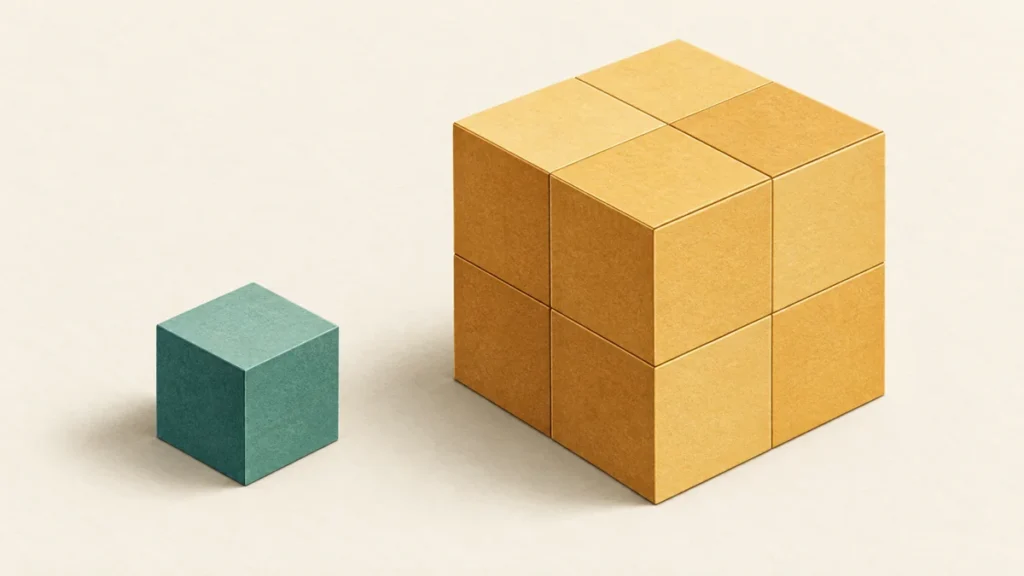
Similar shapes multiply every corresponding length by the same positive scale factor, k. Area grows by k² because two length factors change, while volume grows by k³ because three length factors change. Doubling every length therefore makes area four times as large and volume eight times as large.
The powers describe how a figure changes size while keeping its shape. A bigger rectangle covers more space across and more space up, and a bigger solid also extends farther back. Those changes multiply together rather than adding together.
This lesson keeps the measurement unit fixed while physically enlarging or shrinking figures. All example lengths use centimeters, so you can compare the objects directly. Find related tools in the geometry and trigonometry hub.
What Makes Two Shapes Similar?
Similar shapes have matching angles and proportional corresponding lengths. Every matching length must use the same factor, including widths, heights, and diagonals. The scale factor is the new length divided by the original length, and this lesson uses k greater than zero.
A rectangle measuring 3 by 5 becomes a similar rectangle measuring 6 by 10. Both ratios equal 2: 6 ÷ 3 = 2 and 10 ÷ 5 = 2. Its proportions stay the same even though each side becomes longer.
A 3 by 5 rectangle and a 6 by 5 rectangle fail this check. One matching side doubles while the other stays unchanged. Both figures are rectangles, but that shared name doesn’t make them similar; the second rectangle looks wider relative to its height.
Turning or moving a figure doesn’t affect similarity. You may need to rotate a drawing mentally to match the right sides. Compare corresponding sides, rather than whichever edges happen to sit at the top of the page.
A scale factor of 1 keeps the same size, a factor above 1 enlarges it, and a factor between 0 and 1 shrinks it. A factor of zero would collapse the figure, so it doesn’t produce a similar shape with positive lengths.
Why Does Area Scale By k²?
Area scales by k² because a similar enlargement changes two directions together. For a rectangle, area equals length times width. Replacing both lengths with k times their original values gives (k × length) × (k × width), which equals k² times the original area.
Start with the 3 by 5 rectangle, whose area is 15 cm². Doubling its sides gives a 6 by 10 rectangle with area 60 cm². The ratio 60 ÷ 15 is 4, exactly the same as 2².
Why isn’t the area merely doubled? Doubling only the width would create two copies side by side. Doubling the height as well creates another complete row, giving 2 × 2 = 4 copies altogether.
Triangles follow the same reasoning because their area is half the base times the height. Both base and height gain a factor of k, while the one-half stays fixed. Splitting a polygon into triangles extends that reasoning to other similar polygons.
For a known area, you can multiply directly by k² without finding every new side first. If k = 3 and the original area is 15 cm², the new area is 9 × 15 = 135 cm². The area calculator can check an example when you know the dimensions.
Why Does Volume Scale By k³?
Volume scales by k³ because a similar solid changes in three directions. A rectangular prism has volume length × width × height. Multiplying each dimension by k places three factors of k in that product, making the new volume k³ times the original volume.
A prism measuring 2 by 3 by 4 has volume 24 cm³. Double every dimension to get a 4 by 6 by 8 prism, whose volume is 192 cm³. Dividing 192 by 24 gives 8, matching 2³.
Imagine arranging copies of the original prism inside the enlarged one. Two fit along its length, two along its width, and two along its height. Each layer holds four copies, and two layers hold eight copies in all.
Doubling only one dimension gives a different result. Change 2 by 3 by 4 to 4 by 3 by 4, and the volume becomes 48 cm³, just twice the original. The new prism isn’t similar because its three length ratios don’t match.
The same distinction matters when someone says a box is “twice as big.” Twice the height, twice the volume, and twice every length describe different changes. State which measurement doubles before choosing a power or using the volume calculator.
The Same Rule For Curved Shapes
Curved boundaries don’t change the scaling rule. A circle has area πr², so replacing radius r with kr gives π(kr)² = k²πr². The constant π stays the same; the two radius factors provide the two factors of k.
For example, increasing a circle’s radius from 3 cm to 6 cm changes its area from 9π cm² to 36π cm². The area is four times as large, although the radius and diameter are only twice as large. You don’t need to round π to compare them.
A cylinder has volume πr²h. In a similar cylinder, both radius and height multiply by k, so its volume becomes π(kr)²(kh) = k³πr²h. Increasing only its height would multiply its volume by k instead.
For the general rule, CCBC’s mathematics lesson on similar figures states that corresponding lengths share factor k, areas and surface areas share factor k², and volumes share factor k³. The worked examples here show those relationships through direct calculations.
How Do You Find The Length Factor From Area Or Volume?
Take the positive square root of an area factor or the positive cube root of a volume factor to recover k. These operations undo squaring and cubing. First divide the new measurement by the original measurement, keeping their units the same.
If similar figures have an area ratio of 9, their corresponding lengths have ratio √9 = 3. If similar solids have a volume ratio of 27, their lengths have ratio ∛27 = 3. Neither 9 nor 27 is the length factor.
You can also move from volume to surface area through the shared length factor. A volume ratio of 8 gives k = ∛8 = 2, so the surface area ratio is 2² = 4. Taking the intermediate step makes the reason for the answer visible.
These reverse steps require similarity, not just a known area or volume. Two rectangles can have equal areas but different side lengths. An area ratio by itself doesn’t determine corresponding lengths unless you already know the figures keep the same shape.
Shrinking And Comparing In Reverse
The powers also work when k is a fraction. Halving every corresponding length gives k = 1/2, so area becomes (1/2)² = 1/4 of the original. Volume becomes (1/2)³ = 1/8 of the original.
The 6 by 10 rectangle therefore shrinks back to 3 by 5 with one-quarter of its area. The 4 by 6 by 8 prism shrinks back to 2 by 3 by 4 with one-eighth of its volume. All dimensions still use centimeters.
The direction of comparison decides which ratio to use. Going from a small solid to its doubled copy uses 2 for lengths and 8 for volume. Going back uses 1/2 and 1/8, so label the original and new figure before dividing.
A factor doesn’t have to be a whole number or a simple fraction. If every length grows by 1.5, area grows by 1.5² = 2.25 and volume grows by 1.5³ = 3.375. Counting whole copies helps explain doubling, but the formulas apply to any positive scale factor.
When Do Paint And Capacity Follow These Rules?
Painted surface area follows k² when the entire surface keeps the same shape under scaling. Paint quantity follows that factor only if the coverage per unit area and number of coats stay the same. Surface area measures the amount of surface, rather than the space inside.
Capacity follows k³ when the usable inside space also scales in every direction. Doubling a container’s outer dimensions doesn’t guarantee eight times the capacity if its walls keep their original thickness. The inner shape must satisfy the same similarity test.
Holes and openings need the same care. If every hole, wall thickness, and inner length scales together, the relevant regions retain the usual factors. If a redesign changes those features separately, calculate the actual exposed area or interior volume instead.
A similar solid’s surface area divided by its volume changes by 1/k, since k² ÷ k³ = 1/k. Larger copies have less surface per unit of volume. Use the surface area calculator to compare actual surfaces when dimensions are available.
Mass follows volume only when density stays constant. A solid made from the same material at the same density gains a mass factor of k³. A hollow model, different material, or changed density breaks that shortcut even when the outside shapes look similar.
A Reliable Scaling Check
Begin by matching corresponding lengths and checking that all their ratios agree. Use that common positive ratio as k, then choose k for length, k² for area or surface area, and k³ for volume. Multiply the original measurement by the appropriate factor.
Finally, check the result against the direction of change. An enlargement should increase each measurement, while a shrink should decrease it. Keeping the same unit and clearly naming the measurement helps you separate a change in shape size from a change in how you record it.