You can’t usually split a square root across addition because adding two square roots changes the number you get when you square the result. For example, √(9 + 16) = √25 = 5, while √9 + √16 = 3 + 4 = 7. The expressions ask for different calculations.
The rule applies to nonnegative real numbers: √(a + b) does not generally equal √a + √b. There is a small exception when at least one input is zero. Understanding that exception also helps explain exactly why the rule fails when both inputs are positive.
This lesson focuses on addition inside and outside a radical. The principal square root lesson explains why the square-root symbol selects a nonnegative answer. For other number concepts and tools, visit the numbers hub.
What Does The Radical Cover?
The expression √(9 + 16) tells you to add first and take one square root afterward. The parentheses make the full input clear. In handwritten math, a radical bar extending over both numbers serves the same purpose: everything beneath that bar belongs inside the root.
Follow the operations in order: 9 + 16 = 25, then √25 = 5. You can check the answer by squaring it. Since 5² = 25 and 5 is nonnegative, it is the square root of the combined input.
The expression √9 + √16 gives a different instruction. Take each square root first, then add the answers. That calculation gives 3 + 4 = 7, and there is nothing wrong with it when those separate radicals are the original expression.
The mistake is changing one expression into the other while claiming their values stay equal. Both calculations are valid on their own. They simply produce different answers because the addition happens at a different point in the calculation.
| Expression | First step | Result |
|---|---|---|
| √(9 + 16) | Add 9 and 16 to get 25 | 5 |
| √9 + √16 | Find the roots 3 and 4 | 7 |
A useful reading habit is to say the expression aloud before calculating. “The square root of the sum” means one root with a sum inside. “The sum of the square roots” means two roots with addition outside. That wording keeps the grouping visible.
Why Does Squaring Reveal The Mistake?
Squaring the proposed answer shows the extra terms that splitting creates. If √a + √b were the square root of a + b, its square would have to be exactly a + b. Instead, multiplying the sum by itself adds two more pieces.
Write the square as (√a + √b)(√a + √b). Each term in the first pair multiplies each term in the second pair. That gives a, √a√b, another √a√b, and b.
For nonnegative a and b, the two middle terms combine into 2√(ab). The full result is (√a + √b)² = a + b + 2√(ab). That extra term explains why adding separate square roots usually produces a larger answer.
Use a = 9 and b = 16 to see each part. The square of 3 + 4 is 9 + 12 + 12 + 16 = 49. But the input under the original radical was only 9 + 16 = 25.
Why isn’t (3 + 4)² just 3² + 4²? Squaring means multiplying the whole sum by itself. The products 3 × 4 and 4 × 3 are part of that multiplication, so dropping them changes the result.
This check doesn’t depend on whether the individual roots are whole numbers. If both inputs are positive, both roots are positive, and their product is positive. The extra term remains, even when the roots must stay in radical form.
How Does A Square Show The Extra Area?
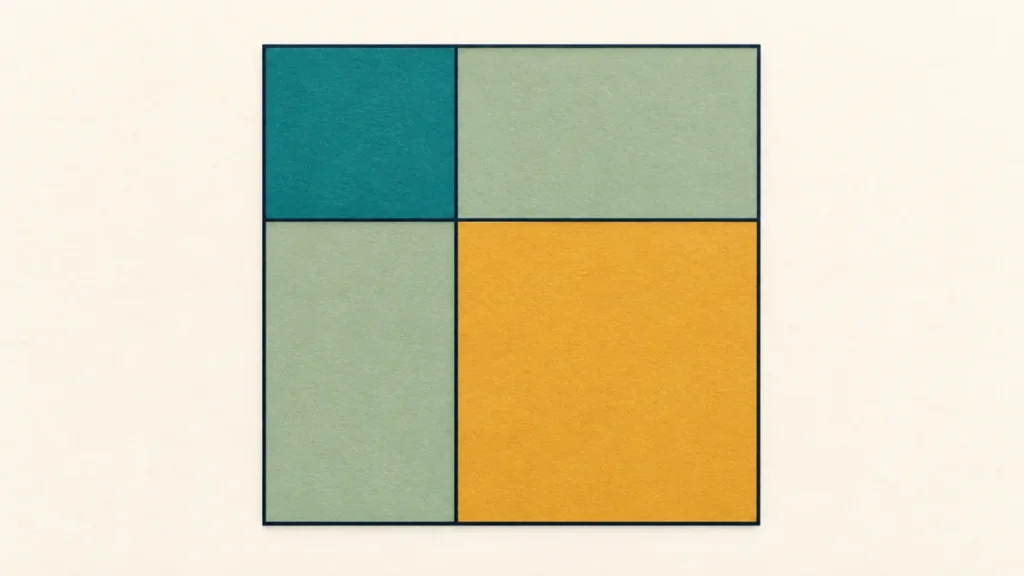
A square with side length 3 + 4 has area 49, not 25. Split each side into lengths 3 and 4, and the square breaks into four regions. Two are squares with areas 9 and 16; two are rectangles with area 12 each.
Adding the areas 9 and 16 gives 25 square units. A square with that area needs side length 5 because 5 × 5 = 25. Adding the old side lengths instead gives 7, which describes a much larger square.
This is the difference between adding areas and adding lengths. A square root converts an area into the side length of a square. It doesn’t promise that adding areas will have the same effect as adding their original side lengths.
The rectangles match the algebra’s two middle products. One has sides √a and √b, and so does the other. Together they have area 2√(ab), which is exactly the extra term found by squaring the proposed split.
When Does The Split Actually Work?
The equality √(a + b) = √a + √b works for nonnegative real inputs exactly when a = 0 or b = 0. In those cases, the extra term 2√(ab) is zero. There is no added rectangle area to change the square.
For example, √(0 + 25) = 5 and √0 + √25 = 0 + 5 = 5. Reversing the inputs gives the same result. When both inputs are zero, both expressions also equal zero.
If both inputs are positive, their product cannot be zero. The extra term is then positive, so √a + √b is larger than √(a + b). An example that includes zero therefore doesn’t establish a general addition rule.
The word “generally” matters here. Saying the split never works would overlook these boundary cases. Saying it is a valid rule would overlook every case with two positive inputs. A rule must come with the conditions under which it holds.
How Do You Add Square Roots Correctly?
To add separate square roots, simplify each one and combine matching radical parts. You don’t combine their inputs beneath a new radical. For example, √8 + √18 becomes 2√2 + 3√2, which equals 5√2.
Start by finding square factors: 8 = 4 × 2 and 18 = 9 × 2. Taking the roots of 4 and 9 leaves two copies of √2 in the first term and three copies in the second. Together, they make five copies.
Combining the inputs would give √26, which is a different number. Check by squaring: (5√2)² = 25 × 2 = 50, while (√26)² = 26. Since their squares differ, the two positive results cannot be equal.
Some sums have no matching radical parts after simplification. For instance, √2 + √3 stays as written in exact form. Leaving the sum alone is a complete answer; a shorter expression isn’t automatically a correct one.
The same idea handles coefficients that are already visible. In 4√5 + 2√5, add the counts to get 6√5. But 4√5 + 2√7 has different radical parts, so those terms do not combine through that step.
Why Does The Product Rule Work?
Multiplication has a valid square-root rule for nonnegative real inputs: √(ab) = √a × √b. The product on the right is nonnegative, and squaring it gives ab. There are no cross terms because you’re multiplying two factors rather than squaring a sum.
For example, √(9 × 16) = √144 = 12. Taking the separate roots gives √9 × √16 = 3 × 4 = 12. This is also the rule used above to simplify √8 as √4 × √2.
Paul’s Online Notes on radicals presents radical product properties and explains how like radicals combine. Keep the operation in view when choosing a property. A rule involving products doesn’t turn into an addition rule just because the same radical symbol appears.
Sign conditions still matter when variables are involved. For any real a, √(a²) = |a|, where |a| is the nonnegative distance from zero. If a = −3, the expression equals √9 = 3, rather than −3.
This lesson uses real square roots of nonnegative inputs. A negative input such as −9 has no real square root. Even when a sum is nonnegative, splitting it could create separate negative inputs, giving another reason to keep the original grouping.
Does Subtraction Work Differently?
You can’t generally split a square root across subtraction either. With a ≥ b ≥ 0, both √(a − b) and √a − √b are real and nonnegative, but they usually differ. For example, √(25 − 9) = 4, while √25 − √9 = 2.
Squaring the second expression gives a + b − 2√(ab). That must equal a − b for the proposed split to work. Rearranging gives b = √(ab), and squaring gives b² = ab.
Under these conditions, equality occurs when b = 0 or a = b. The first case subtracts zero; the second makes both expressions zero. Those special cases don’t justify distributing the radical across other differences.
How Can You Check A Radical Step?
Read the grouping, identify the operation, and test any proposed answer by squaring it. For √(a + b), the answer must be nonnegative and its square must equal the entire sum. Both requirements matter because a negative number may have the same square.
Try √(4 + 5). Adding first gives √9 = 3. Splitting would give 2 + √5, whose square is 9 + 4√5, larger than 9. The check exposes the mistake without needing a decimal approximation.
Use the square root calculator to check the combined input after doing the addition. For 9 + 16, enter 25. Keep separate roots separate when the original problem asks for their sum.
The safest habit is to preserve the radical’s grouping until a valid property allows a change. Add inside one radical first, simplify separate radicals separately, and combine only matching parts. Then square the result when you need to confirm that it answers the original question.