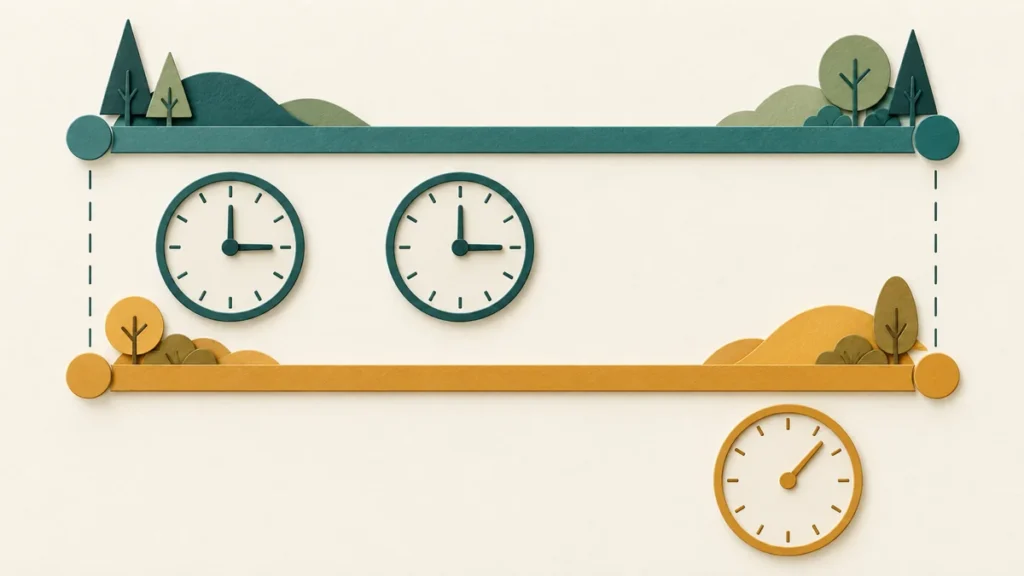
Average speed is total distance divided by total time. You can average two speeds by adding them and dividing by two only when each speed lasts for the same amount of time. Equal distances don’t meet that condition: the slower part takes longer and has more weight in the answer.
Imagine two 60-kilometer legs, one at 30 kilometers per hour and one at 60 kilometers per hour. The trip’s average speed is 40 kilometers per hour, even though the average of the two speed numbers is 45. The missing fact is how long each speed lasts.
We’ll use invented trips to work through that difference, then handle unequal distances, stops, and direction. These examples explain rates; they aren’t travel predictions. Explore other unit relationships in the measurement tools hub.
What Does Average Speed Actually Measure?
Average speed measures the distance traveled per unit of time across a chosen interval. Add all the distance covered, add all the time included, and divide the first total by the second. The result describes the whole interval, even if the speed changes within it.
Average speed = total distance ÷ total time
OpenStax’s explanation of speed and velocity defines average speed using distance and time. It distinguishes this from instantaneous speed, which describes motion at one moment. A single reading doesn’t tell you the distance covered during an entire trip.
A rate of 40 kilometers per hour means 40 kilometers for each hour at that rate. Covering 120 kilometers in three hours has that same average. You don’t need to have traveled at exactly 40 at any particular moment for the overall rate to equal 40.
The basic formula is also a unit check. Kilometers divided by hours gives kilometers per hour, written km/h. If your distances use miles, your answer uses miles per hour instead. The numbers must describe matching units before you combine them.
Why Do Equal Distances Give 40 Instead Of 45?
Equal distances give more time to the slower speed. For the invented trip, 60 kilometers at 30 km/h takes two hours. The next 60 kilometers at 60 km/h takes one hour. That makes 120 kilometers in three hours, so the average is 40 km/h.
| Part | Distance | Speed | Time |
|---|---|---|---|
| First leg | 60 km | 30 km/h | 60 ÷ 30 = 2 h |
| Second leg | 60 km | 60 km/h | 60 ÷ 60 = 1 h |
| Total | 120 km | 120 ÷ 3 = 40 km/h | 3 h |
Why doesn’t (30 + 60) ÷ 2 work? That calculation gives each speed half the weight. But the slower speed fills two of the trip’s three hours. The faster speed fills only one. Equal distance is a different condition from equal time.
Another check starts with the proposed answer of 45 km/h. Traveling 120 kilometers at that constant rate would take 120 ÷ 45, or about 2.67 hours. Our two legs took three hours. Since the proposed rate doesn’t match the totals, it cannot be this trip’s average.
For two equal, positive distances traveled at positive speeds a and b, the formula simplifies to 2ab ÷ (a + b). This is the harmonic mean. Substituting 30 and 60 gives 3,600 ÷ 90 = 40. Its different denominator accounts for the unequal times.
You don’t need to memorize that shortcut. Start with distance divided by speed to find each time, then use total distance divided by total time. That method makes the assumptions visible and works when the distances aren’t equal.
When Can You Average The Two Speed Numbers?
The arithmetic average works when both speeds last for equal amounts of time. Spend one hour at 30 km/h and one hour at 60 km/h. You cover 30 kilometers and 60 kilometers, respectively. The total is 90 kilometers in two hours, giving 45 km/h.
(30 km + 60 km) ÷ (1 h + 1 h) = 45 km/h
Equal time is what lets you simplify the calculation to (30 + 60) ÷ 2. Each speed describes the same-sized time block. You can give those two blocks equal weight because neither speed lasts longer than the other.
The same rule holds for other equal durations. Fifteen minutes at each speed still gives an equal-time average of 45 km/h. Each interval is one-quarter of an hour, so the distances are 7.5 and 15 kilometers. Their total, 22.5 kilometers, takes half an hour.
Don’t assume that two reported readings represent equal durations. A reading taken near the start and another near the finish may leave most of the trip unknown. You need the time spent at each rate, or the complete distance and time totals.
Time Weights And Unequal Distances
When you know each speed and its duration, weight each speed by its time. Multiply speed by time to get distance. Add those distances, then divide by the sum of the times. Longer intervals contribute more because they represent more of the elapsed time.
Average speed = (v₁t₁ + v₂t₂ + …) ÷ (t₁ + t₂ + …)
Here, v means a segment’s speed and t means its duration. For the equal-distance example, the numerator is 30 × 2 + 60 × 1 = 120 kilometers. The denominator is 2 + 1 = 3 hours. The weighted average is 40 km/h.
These weights are time amounts, not distance amounts. Weighting 30 and 60 by their equal distances would reproduce 45 and miss the longer slow interval. What does each weight stand for? Answer that before entering numbers in a weighted average calculator.
When you know unequal distances instead, find each time using distance ÷ speed. For example, travel 30 kilometers at 30 km/h and 90 kilometers at 60 km/h. The times are one hour and 1.5 hours. The average is 120 ÷ 2.5 = 48 km/h.
Average speed = (d₁ + d₂ + …) ÷ (d₁/v₁ + d₂/v₂ + …)
This formula works for any number of moving segments when each distance is paired with a positive segment speed. The equal-distance harmonic mean is one special case. Use the total-distance method for mixed lengths; don’t apply the equal-distance shortcut to an unequal-distance problem.
How Do Stops Change The Average?
A stop lowers the average when the measured interval includes it. Add a half-hour stop to our 120-kilometer, three-hour trip. The distance stays 120 kilometers, but journey time becomes 3.5 hours. Average speed over that full journey is 120 ÷ 3.5, or about 34.29 km/h.
The unrounded result is 34.285714… km/h. Rounding it to two decimal places gives 34.29. Keep extra digits during the calculation and round the final answer so early rounding doesn’t alter the result.
Average speed while moving and full-journey average speed describe different intervals. Excluding the stop gives an average speed while moving of 40 km/h. Including it gives a journey average of about 34.29 km/h. Neither label is complete unless you say which time the denominator includes.
A rest interval fits the time-weighted formula as speed zero over a positive time. Its contribution to distance is 0 × 0.5 = 0 kilometers. Its half-hour still enters the time total. That’s why the denominator grows while the numerator stays fixed.
Don’t represent a stop as a positive distance traveled at zero speed. The expression distance ÷ zero cannot give a finite travel time. Record the stop as zero distance with its known duration, then add that duration separately to the journey total.
Speed, Direction, And Zero Time
Average speed uses distance, so turning around doesn’t erase the distance already covered. Average velocity uses displacement, the change from starting position to ending position. Return to your starting point, and displacement is zero even though you may have traveled a long distance.
For an invented out-and-back walk, cover one kilometer away from home and one kilometer back in half an hour. Total distance is two kilometers, giving an average speed of 4 km/h. Displacement is zero, so average velocity over that same interval is zero.
Use positive speeds for the moving legs when finding average speed. Direction belongs in a velocity calculation. Giving the return leg a negative speed would cancel distance that the walker actually covered and answer a different question.
The time denominator must be positive. A zero-duration interval has undefined average speed because division by zero is undefined. If you remain at rest for a positive interval, the distance is zero and the average speed is zero. Those are distinct cases.
How Can You Check Your Answer?
Check the units, the total time, and the condition behind your formula. Convert minutes to hours before combining them with km/h: 60 minutes equals one hour, and 30 minutes equals half an hour. The unit rate calculator can help check a distance-per-time division.
For positive time weights, the average falls between the lowest and highest included speeds. Our moving average of 40 lies between 30 and 60. Include a stop at speed zero, and the full-journey average still lies within the wider range from zero to 60.
A final check reverses the calculation: average speed × total time should recover total distance, apart from rounding. Here, 40 × 3 = 120. Keep the question simple: how much distance was covered, and how much time belongs in the interval? Those totals settle the answer.