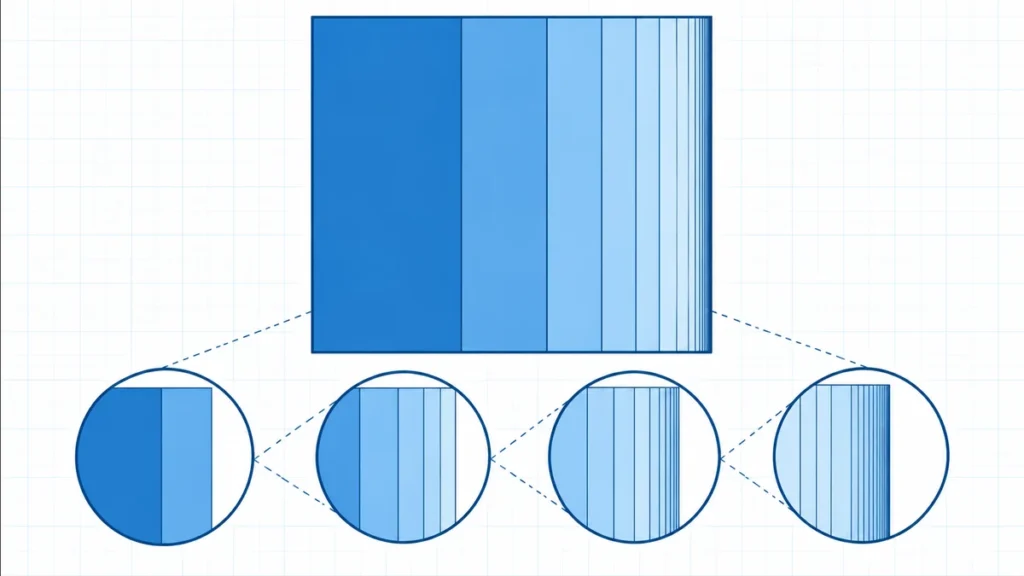
The infinite decimal 0.999… equals 1 exactly. It is not a rounded version of 1 and does not sit a tiny distance below 1. The dots mean the digit 9 continues forever, and the sequence of finite decimals 0.9, 0.99, 0.999, and so on has 1 as its limit.
The result can feel wrong because every finite decimal made only of 9s is less than 1. For example, 0.999 is 0.001 below 1. Yet 0.999… is not a finite decimal. There is no last 9, so there is no final decimal place where a positive gap can remain.
This lesson proves the equality in several connected ways. It also explains why two decimal strings can name the same real number. If you want a wider introduction to repeating decimals, start with why some fractions terminate while others repeat.
What Does 0.999… Actually Mean?
The notation 0.999… means a decimal expansion with infinitely many 9s. The dots do not mean “approximately” and do not tell you to stop after a convenient number of places. They describe one exact real number through an endless place-value process.
Each 9 has a place value. The first contributes 9/10, the second contributes 9/100, and the third contributes 9/1000. Continuing this pattern gives the infinite sum 9/10 + 9/100 + 9/1000 + ….
Harvey Mudd College’s Math Fun Facts explanation describes a decimal expansion as a sum of digits multiplied by powers of 10. Under that definition, the decimal string and its infinite sum are two ways to write the same object.
The notation matters. A bar over the 9, written as 0.9 repeating, has the same meaning as 0.999…. In plain text, the three dots are common. Whichever notation is used, the repetition must continue without an endpoint.
Why Is 0.999 Different From 0.999…?
The finite decimal 0.999 equals 999/1000, so it is exactly 0.001 less than 1. The infinite decimal 0.999… has no last digit and no fixed final gap. Confusing those two objects is the main reason the equality seems impossible.
After one 9, the gap from 1 is 0.1. After two 9s, the gap is 0.01. After three, it is 0.001. After n digits, the gap is 1/10n. The gap is always positive at a finite stage, but it can be made smaller than any chosen positive amount.
There is no contradiction here. A sequence can have every term below its limit. For example, 1/2, 2/3, 3/4, and 4/5 are all below 1, while the general term n/(n + 1) approaches 1. A limit describes the value approached by the whole infinite process.
How Does A Limit Prove That 0.999… Equals 1?
Let an be the finite decimal with n copies of 9. Then an = 1 − 1/10n. As n grows without bound, 1/10n approaches 0. Therefore, the limit of an is 1.
an = 0.99…9 = 1 − 10−n
The infinite decimal is defined by that limit, not by an imaginary last member of the sequence. There is no largest n. Instead, the definition asks which real number the finite truncations approach as the number of digits grows.
You can test the definition with any tolerance. Suppose you want the gap below 1 to be less than one millionth. Seven 9s are enough because 10−7 is smaller than 10−6. No matter how small a positive tolerance you choose, a sufficiently long finite decimal gets closer than that tolerance.
If 0.999… were some number x less than 1, the gap 1 − x would be positive. But the finite truncations eventually get within less than that proposed gap while still being no greater than x. That is impossible. The only real number that fits every stage of the process is 1.
How Does An Infinite Series Give The Same Answer?
Place value turns 0.999… into a geometric series: 9/10 + 9/100 + 9/1000 + …. Its first term is 9/10, and each later term is one tenth of the term before it. The sum of this convergent series is 1.
9/10 + 9/100 + 9/1000 + … = (9/10) / (1 − 1/10) = 1
OpenStax defines the sum of an infinite series as the limit of its finite partial sums. This matters because the dots do not ask us to perform infinitely many additions one at a time. They identify the limit of a sequence of ordinary finite sums.
The geometric-series formula is a compact version of the limit argument. After n terms, the sum is 1 − 10−n. Letting n grow sends the leftover term to 0, so the partial sums converge to 1.
This proof also explains why 0.333… equals 1/3. Its place-value series is 3/10 + 3/100 + 3/1000 + …, which sums to (3/10)/(1 − 1/10) = 1/3. Multiplying both sides by 3 then gives 0.999… = 1.
Why Does The Short Algebra Proof Work?
Let x = 0.999…. Multiplying by 10 shifts every digit one place left, so 10x = 9.999…. Subtracting the first equation from the second makes the identical infinite tails cancel, leaving 9x = 9 and therefore x = 1.
x = 0.999…
10x = 9.999…
9x = 9
x = 1
The subtraction is valid because 0.999… already represents a real number defined by a convergent limit. The proof is not treating infinity as a final digit. It applies normal algebra to two convergent decimal representations whose values are well defined.
You can also perform the step on finite decimals. Let xn contain n copies of 9. Then 10xn − xn = 9 − 9/10n, so xn = 1 − 1/10n. Taking the limit gives x = 1. This longer version exposes the shrinking remainder.
The short proof is persuasive, but the limit and series proofs explain why it is allowed. Together, they show that the result is not a trick created by careless notation.
Is There A Tiny Number Between 0.999… And 1?
No positive real number lies between 0.999… and 1 because their difference is 0. A finite decimal has a visible gap, but the infinite decimal has no final place at which a smallest positive decimal unit could remain.
Suppose the difference were a positive number d. Because powers of 10 become arbitrarily large, some 10−n would be smaller than d. Yet the nth finite truncation is only 10−n below 1, and 0.999… is at least as large as that truncation. The proposed gap d cannot survive.
Sometimes people suggest a number written as 0.000…1. That notation is not a real decimal expansion. If the 1 appears at a finite place, there are only finitely many zeros before it. If it appears after infinitely many zeros, there is no numbered decimal place where it can occur.
How Can One Number Have Two Decimal Representations?
Decimal notation is not always unique. Every nonzero terminating decimal has a second representation ending in infinitely many 9s. For example, 0.5 = 0.5000… = 0.4999…, and 2.75 = 2.7500… = 2.7499….
The pattern works because one unit in a decimal place equals ten units in the next place. The last nonzero terminating digit can decrease by 1, while every later place becomes 9. The total value does not change.
For 0.35, subtracting 0.000… is not the explanation. Instead, compare 0.35000… with 0.34999…. The second string replaces the final hundredth by one fewer hundredth and then restores exactly that missing 0.01 through 0.009 + 0.0009 + 0.00009 + ….
Harvey Mudd’s explanation gives this same example: 7/20 can be written as 0.35 or 0.34999…. These are two codes for one real number, much as 1/2 and 2/4 are two fraction names for the same value.
What Does 0.999… Show About Fractions And Decimals?
The equality shows that a decimal representation is a name for a number, not the number itself. Fractions and decimals can use different symbols while representing the same point. A repeating decimal often comes from division, and its exact value can be written as a fraction.
The algebra method for converting a repeating decimal uses the same shift-and-subtract idea. For x = 0.272727…, multiplying by 100 gives 100x = 27.272727…. Subtracting x leaves 99x = 27, so x = 27/99 = 3/11.
Use the fraction-to-decimal calculator to inspect how a fraction’s digits repeat. To reverse the process for a finite decimal, use the decimal-to-fraction converter. The special decimal 0.999… needs the repeating-decimal algebra above, not a finite-decimal conversion rule.
The broader lesson is about exact notation. A calculator display may round a value to several digits, but the dots in 0.999… make an exact mathematical claim. Finite 0.999 is an approximation to 1. Infinite 0.999… is another exact representation of 1.
What Should You Remember About 0.999…?
Remember the boundary first: 0.999 is less than 1, while 0.999… equals 1. The finite decimal has a last digit and a gap of 0.001. The repeating decimal has no last digit and is defined by a limit whose gap is 0.
The limit proof, geometric-series proof, algebra proof, and number-line argument all reach the same answer for the same reason. Each describes how the finite truncations approach one exact real number. None requires a last 9 or a “smallest” positive gap.
Finally, decimal strings are representations. Numbers with a terminating decimal expansion also have a second expansion ending in repeating 9s. In that system, 1.000… and 0.999… are different strings that name the same number.