Geometry · Triangle angle proof
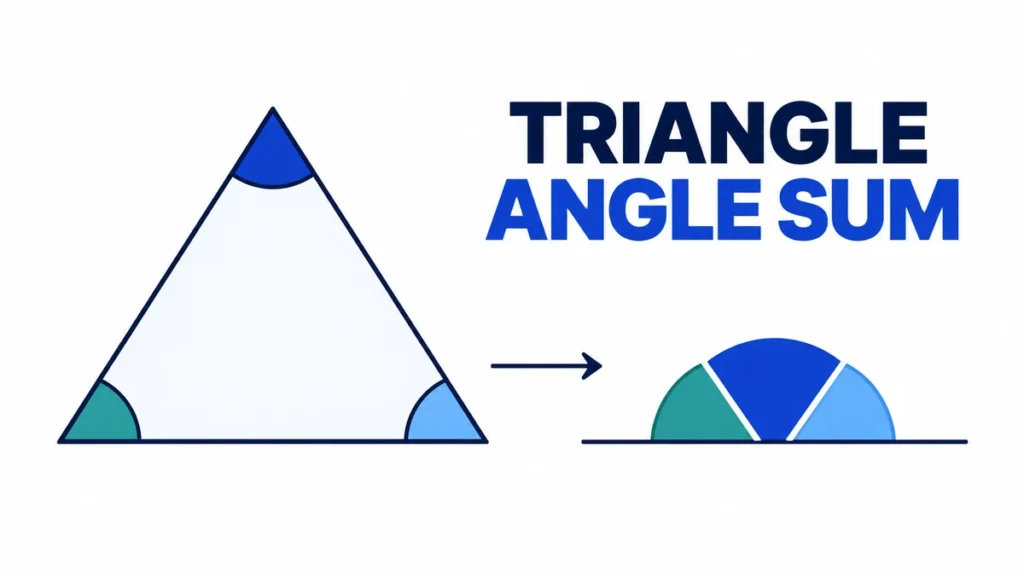
The three interior angles of a triangle add to 180 degrees because a line drawn through one vertex parallel to the opposite side moves the other two angles beside the top angle. Together, the three angles form one straight angle.
On a flat Euclidean plane, draw a line through the triangle’s top vertex parallel to its base. Alternate interior angles copy the two base angles onto that line. Those copies and the top angle sit side by side on a straight line, so their measures total 180 degrees.
What Does 180 Degrees Mean?
A straight angle measures exactly 180 degrees, which is one half of a complete 360-degree turn. The triangle angle-sum theorem says its three interior angles combine to make that same half turn, even though the angles sit at different vertices (OpenStax, accessed October 14, 2026).
An interior angle is the smaller angle inside the triangle where two sides meet. If the angles are called A, B, and C, the theorem is written A + B + C = 180°. In radians, the same statement is A + B + C = π.
The number 180 does not come from the triangle having three sides. It comes from the geometry of a flat plane and the relationship between parallel lines. The proof connects three separated angles to one straight angle whose measure is already known.
Measuring several drawings can suggest the rule, but measurements cannot prove it for every possible triangle. Pencil thickness, a bent ruler, or rounding on a protractor can change a reading by a degree or more. A proof explains why the exact total must be 180°.
How Does The Parallel-Line Proof Work?
The standard proof needs one construction: draw a line through the top vertex parallel to the base. OpenStax presents the argument in six steps, using two equal pairs of alternate interior angles and one 180-degree straight angle (OpenStax, accessed October 14, 2026).
- Start with triangle ABC, with A at the top and BC as the base.
- Draw line DE through A so DE is parallel to BC.
- Side AB crosses both parallel lines, so it acts as one transversal.
- Side AC crosses both parallel lines, so it acts as another transversal.
- The angle beside A on the left equals angle B. The angle beside A on the right equals angle C.
- Those two copied angles and angle A form a straight angle: B + A + C = 180°.
The important move is not changing the angles. It is transporting equal copies of B and C to the vertex A, where all three can be compared on one line. This avoids relying on how wide, tall, or tilted the triangle looks.
Why Do Alternate Interior Angles Matter?
When a transversal crosses two parallel lines, alternate interior angles are equal. In the triangle proof, sides AB and AC are the two transversals, so they reproduce the two base angles at the top parallel line without changing their measures (OpenStax, accessed October 14, 2026).
Think of AB as a slanted path cutting two horizontal tracks. The acute angle it makes with the lower track matches the alternate interior angle it makes with the upper track. The same reasoning applies separately to AC on the other side.
Both equalities depend on the lines being parallel. If the line through A tilts toward or away from BC, the copied angles change and no longer fit the proof. A diagram should therefore include arrow marks or a written statement showing the lines are parallel.
This dependence also explains why the result belongs to Euclidean geometry. The parallel-line rule is not a decorative shortcut. It carries the main logical weight of the proof.
Does Rearranging The Three Corners Prove The Rule?
Cutting off a paper triangle’s three corners and placing them side by side usually produces a 180-degree straight angle. Mathematics LibreTexts uses this activity to reveal the pattern, while also warning that drawings and physical tests alone cannot establish the result for every triangle (LibreTexts, accessed October 14, 2026).
The activity is valuable because it turns an abstract sum into a visible half turn. It also works with acute, right, and obtuse paper triangles. The three pieces change shape, but their joined opening still appears straight.
However, cutting and arranging is a demonstration, not a fully exact proof. Paper can stretch, corners can overlap, and the pieces may leave a tiny gap. The model builds intuition; the parallel-line argument establishes the result from accepted geometric rules.
What Does An Exterior Angle Reveal?
Euclid’s Proposition 32 states that an exterior angle of a triangle equals the sum of the two nonadjacent interior angles. It also states that the three interior angles equal two right angles, which is 2 × 90° = 180° (Euclid’s Elements, accessed October 14, 2026).
Extend side BC beyond C. The interior angle C and its neighboring exterior angle form a linear pair, so they total 180°. If the exterior angle equals A + B, then A + B + C must equal 180°.
For example, suppose the two remote interior angles are 48° and 67°. The exterior angle is 115°. Its adjacent interior angle is 180° − 115° = 65°, and the triangle check is 48° + 67° + 65° = 180°.
This is not a separate coincidence. The exterior-angle theorem and the interior angle sum express the same relationship from two viewpoints. One compares the outside angle with two remote angles; the other adds all three inside angles.
How Do You Use The Triangle Angle Sum?
If two interior angles are known, subtract their sum from 180 degrees to find the third. OpenStax writes the relationship as A + B + C = 180°, so a missing angle C is C = 180° − A − B (OpenStax, accessed October 14, 2026).
Suppose A = 42° and B = 73°. Then C = 180° − 42° − 73° = 65°. Check by adding all three: 42 + 73 + 65 = 180.
The rule can also solve algebraic angle labels. If the angles are x, x + 20, and 2x, write x + (x + 20) + 2x = 180. Then 4x + 20 = 180, so x = 40. The angles are 40°, 60°, and 80°.
A right triangle already has one 90° angle. Its other two angles must total 90°, so they are complementary. If one acute angle is 34°, the other is 56°.
An equilateral triangle has three equal angles. Dividing 180° by 3 gives 60° for each angle. An isosceles triangle has two equal base angles, but their value depends on the third angle.
Use the right triangle calculator when a problem gives a 90° angle and suitable side or angle measurements. For broader shape and input choices, the geometry and trigonometry hub keeps calculation intent separate from this proof.
Does Every Triangle In Every Geometry Total 180 Degrees?
No. The 180-degree theorem applies to triangles made from straight segments on a flat Euclidean plane. A spherical triangle formed by great-circle arcs has an angle sum between 180° and 540°, with the amount above 180° called spherical excess (Wolfram MathWorld, accessed October 14, 2026).
A clear spherical example starts at the North Pole, follows one meridian to the equator, moves one quarter around the equator, and returns along another meridian. Each corner is 90°, so the total is 270°. That does not contradict the flat-plane theorem because the triangle’s sides lie on a curved surface.
Hyperbolic geometry moves in the other direction: its triangle angle sums are less than 180° (Wolfram MathWorld, accessed October 14, 2026). Curvature changes how lines spread apart, so the parallel-line proof cannot be copied without changing its assumptions.
For ordinary school diagrams, construction plans, and small objects, Euclidean geometry is the intended model. The curved-surface exception matters because it reveals the theorem’s hidden condition: the surface must be flat.
What Common Mistakes Break The Calculation?
The most common error is mixing an exterior angle with the three interior angles. A straight line still measures 180°, but an exterior angle must first be related to its adjacent interior angle or to the two remote interior angles (OpenStax, accessed October 14, 2026).
- Using a reflex angle: Use the smaller interior angle inside an ordinary triangle, not the larger turn around the vertex.
- Trusting the drawing: A sketch that looks isosceles does not prove two angles are equal. Use only marked or stated facts.
- Rounding too early: Keep exact angle values until the final step when trigonometry produces decimals.
- Forgetting units: Degrees and radians describe the same angles with different numbers. Do not add them before converting.
- Ignoring impossible results: Three positive interior angles cannot include two right or obtuse angles because their total would reach or exceed 180° before the third angle is added.
A fast check catches many errors: every ordinary triangle must have three positive interior angles, and their total must be exactly 180°. If your result fails either condition, review whether you copied an exterior angle, assumed an equality, or made an arithmetic mistake.
Use the theorem to understand and check angle relationships. When you need numerical help from known sides or angles, choose the calculator that matches the given measurements.
Calculate a triangle’s areaBrowse geometry and trigonometry tools