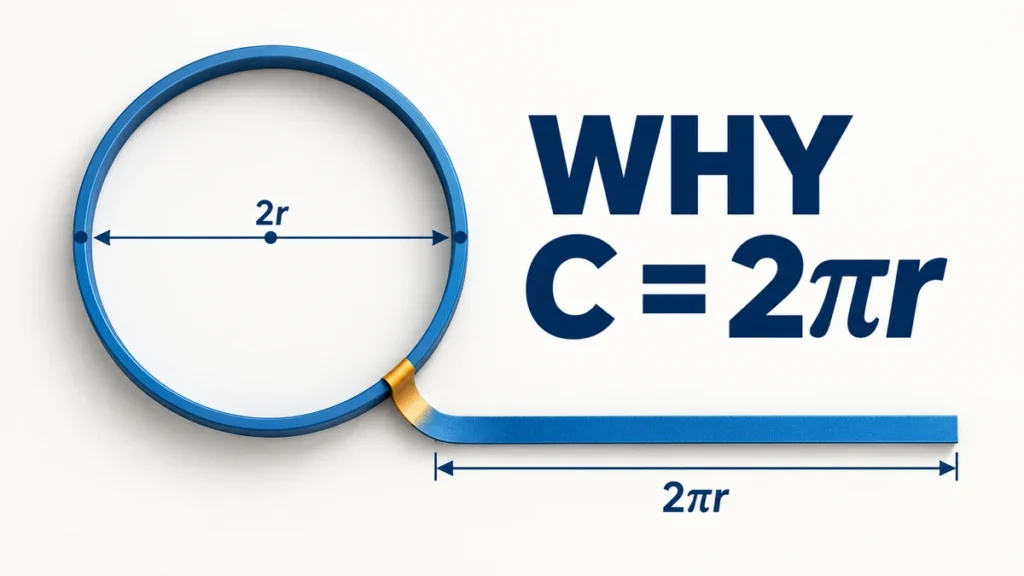
A circle’s circumference is 2πr because π is the constant ratio of circumference to diameter, and every diameter is twice the radius. Starting with π = C/d, multiply by d to get C = πd. Then replace d with 2r, which gives C = π(2r) = 2πr.
The π tells us how many diameters fit around a circle, while the 2 converts one radius into one diameter. The formula is exact for an ordinary Euclidean circle: C = πd = 2πr.
What Does C = 2πr Actually Mean?
The formula says that a circle’s distance around is about 6.283 times its radius. The letter C means circumference, r means radius, and 2π is the exact multiplier. Since π is irrational, its decimal form never ends or repeats, so 6.283 is only a useful approximation.
Circumference is a length, not an area. If the radius is measured in centimeters, the circumference is also measured in centimeters. Squared units belong to area, where the different formula A = πr2 applies.
The OpenStax discussion of circumference gives both equivalent forms, C = πd and C = 2πr. It also defines π as the ratio of a circle’s circumference to its diameter.
Why Is π The Same For Every Circle?
Every Euclidean circle has the same shape, even when its size changes. If a circle is enlarged by a scale factor k, its diameter becomes kd and its circumference becomes kC. The new ratio is kC/kd, and the factor k cancels, leaving C/d unchanged.
This scaling idea explains why one constant can serve every circle. The Ohio State University lesson The Meaning of Pi shows that the ratio stays fixed because any circle is a scaled version of any other circle.
A more careful proof must also define the length of a curved boundary. An Illinois Institute of Technology note about why π is constant defines a circle’s circumference as a limit of lengths of inscribed polygonal paths. Similar polygons in circles of different sizes scale in the same ratio as their radii, so their limiting circumferences do too.
This is why measuring several household circles gives roughly the same value for C/d. Real measurements may differ slightly because string stretches, rulers have limited markings, and objects are not perfect mathematical circles. Those differences are measurement error, not evidence that π changes.
How Does C = 2πr Follow From The Definition Of π?
The derivation needs only the definition π = C/d and the relationship d = 2r. It does not require memorizing a second independent circle rule. Each algebra step keeps the same equality while changing the form into one that uses radius.
- Start with the definition: π = C/d.
- Multiply both sides by d: πd = C.
- Rewrite it in the usual order: C = πd.
- Use the diameter relationship d = 2r.
- Substitute: C = π(2r) = 2πr.
The factor 2 is not part of π. It appears because the formula is written with radius instead of diameter. If the diameter is already known, C = πd is usually the shorter form.
Another exact viewpoint uses radians. A full turn is 2π radians, and arc length satisfies s = rθ. Letting θ = 2π for the entire circle gives C = r(2π) = 2πr. This is the same relationship expressed through angular measure.
For readers interested in foundations, a University of Illinois at Chicago paper develops a formal Euclidean-geometry justification of C = 2πr. The school-level derivation above is shorter because it begins with π already defined as C/d.
How Do Polygons Support The Circumference Formula?
Regular polygons give a way to approach a curved circumference using straight segments. An inscribed polygon lies inside the circle, so its perimeter is less than the circumference. A circumscribed polygon lies outside, so its perimeter is greater.
As both polygons gain more sides, their boundaries fit the circle more closely. The lower and upper perimeter estimates close in on one length. OpenStax describes this method of exhaustion and reports that Archimedes used polygons with up to 96 sides to bound π.
The important point is not that a many-sided polygon becomes a circle. It remains a polygon. Instead, the sequence of polygon perimeters approaches the circle’s circumference as the side lengths become smaller.
How Is C = 2πr Used In Worked Examples?
The formula works best when the known measurement is clearly identified as a radius or diameter. Keep π in the answer for an exact value, then calculate a decimal only when the problem asks for an approximation.
Example 1: A Circle With Radius 7 Centimeters
Substitute r = 7 into C = 2πr. The exact result is C = 2π(7) = 14π centimeters. Using a calculator, 14π is approximately 43.9823, so the circumference is about 43.98 centimeters.
This result passes a quick reasonableness check. The diameter is 14 centimeters, and a circumference should be a little more than three diameters. Three diameters equal 42 centimeters, so 43.98 centimeters is sensible.
Example 2: A Circle With Diameter 10 Meters
Because the diameter is given, use C = πd directly. The exact result is 10π meters, or approximately 31.4159 meters. Converting to radius first would also work: r = 5, then C = 2π(5) = 10π meters.
For a numeric check or a value from a different known measurement, use the Circle Calculator. If a problem asks for only part of the boundary, use the Arc Length Calculator instead of treating the arc as a complete circle.
Example 3: Doubling The Radius
A circle with radius 4 has circumference 8π. A circle with radius 8 has circumference 16π. Doubling the radius doubles the circumference because C = 2πr is linear in r. It does not quadruple the circumference.
Area behaves differently because A = πr2. Doubling r multiplies area by four, but it multiplies circumference by two. Keeping this distinction clear prevents one of the most common circle-formula errors.
When Does The Formula Need Extra Care?
C = 2πr describes a full Euclidean circle. A semicircle’s curved edge is only half the circumference, or πr. If the perimeter of a semicircular region is required, the straight diameter must also be added, giving πr + 2r.
A radius cannot be negative in ordinary geometry. At the boundary value r = 0, the circle collapses to a single point and C = 0. For any positive radius, the circumference is positive and grows in direct proportion to r.
Use one unit throughout the calculation. If r = 2 meters, C is 4π meters, not square meters. When measurements mix centimeters and meters, convert them before substituting.
Approximations also need labels. The values 3.14 and 22/7 are convenient estimates for π, but neither equals π exactly. The Ohio State lesson reports Archimedes’ bounds 223/71 < π < 22/7, so 22/7 is an upper bound in that classical result, not the exact value.
The formula assumes a circle on a flat Euclidean plane. On a curved surface, such as a sphere, the circumference of a geodesic circle does not generally equal 2πr when r is measured along the surface. School geometry problems normally use the flat-plane meaning unless stated otherwise.
Common Questions About Why Circumference Is 2πr
Is π Exactly 3.14?
No. The value 3.14 is a two-decimal approximation. Keeping π in an answer, such as 14π centimeters, preserves the exact value. Convert to a decimal at the end when a measured or rounded result is needed.
Why Is There A 2 In 2πr?
The 2 comes from the diameter, not from π. One diameter equals two radii, so replacing d with 2r in C = πd creates C = π(2r) = 2πr.
Can Circumference Be Found From Area?
Yes, if the area is known and the figure is a circle. First solve r = √(A/π), then use C = 2πr. Keep enough decimal places during the square-root step so early rounding does not noticeably change the final circumference.
Does A Larger Circle Have A Larger Value Of π?
No. A larger circle has a larger circumference and diameter, but both lengths grow by the same scale factor. Their ratio C/d remains π. The size changes; the ratio does not.
What Is The Main Idea To Remember?
The circumference formula is not an isolated rule. It is the definition of π rewritten in terms of radius: π = C/d, so C = πd, and d = 2r, so C = 2πr. This chain explains both the π and the 2.
Use exact π when possible, distinguish radius from diameter, and keep circumference in linear units. For more circle, arc, and geometry resources, browse the Geometry and Trigonometry Calculators hub.