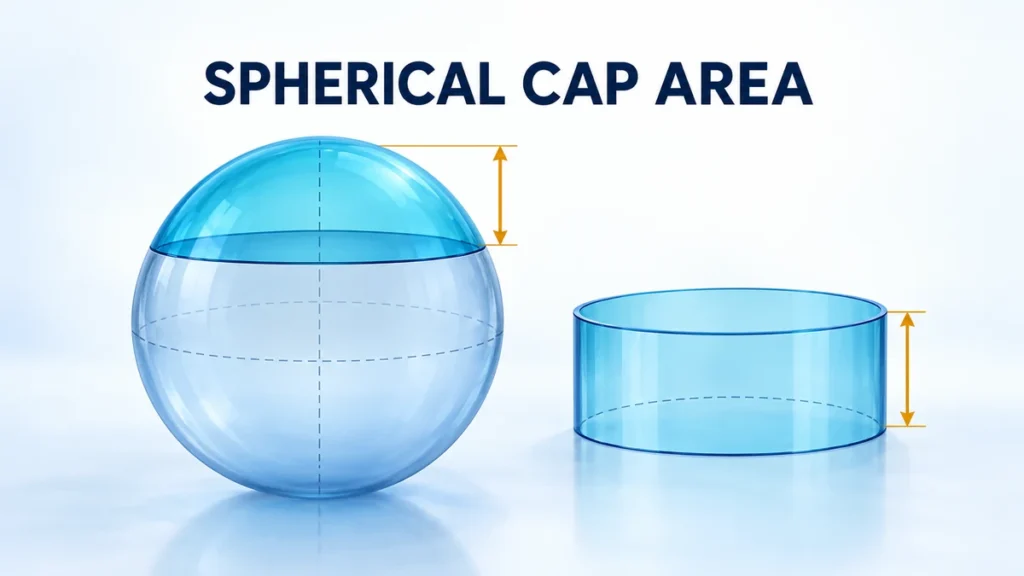
A spherical cap’s curved surface area is 2πRh because every thin horizontal band on a sphere has area 2πR times its vertical height. Adding those bands through a cap of height h gives 2πRh. Here, R is the sphere’s radius, and h is measured vertically from the cap’s base plane to its top.
Why Is A Spherical Cap’s Surface Area 2πRh?
The direct reason is local: a horizontal spherical band with vertical thickness dz has area 2πR dz. OpenStax gives the standard surface-of-revolution area element that produces this result. Integrating from one edge of a cap to the other covers vertical height h, so the curved area is 2πRh.
A spherical cap is the portion of a sphere cut off by a plane. Picture slicing the top from an orange, but using a perfectly flat cut. The curved peel above that cut is the cap’s curved surface. Its height is not the sloping distance along the peel. It is the straight vertical distance from the cutting plane to the top.
The formula is surprising because the cap’s base radius does not appear directly. A wider cap has a larger circumference near its lower edge, but its bands also sit at different slopes. Those two effects balance in a sphere. The result depends only on the parent sphere’s radius R and the cap’s vertical height h.
This relationship is sometimes called the spherical zone rule. A zone between any two parallel planes also has area 2πRh when its vertical height is h. A cap is the special zone that reaches a pole. Use the spherical cap calculator when you need the numerical result rather than the proof.
Does 2πRh Include The Circular Base?
No. The formula 2πRh measures only the curved spherical surface. The MathWorld spherical cap reference lists the cap area as 2πRh and gives the base-radius relationship. If a problem asks for the total exposed area of a closed solid cap, add the flat base area πa².
Let a be the radius of the cap’s circular base. A right-triangle slice through the sphere gives a² = h(2R − h). Therefore, the total surface area of the closed cap is:
Atotal = 2πRh + πa² = 2πRh + πh(2R − h).
The wording decides which answer is correct. “Surface area of a spherical cap” often means its curved area. “Total surface area,” “including the base,” or “closed cap” means curved area plus the circular disk. State which interpretation you use so a correct calculation is not marked wrong because of an unstated base.
A sphere calculator measures the full parent sphere, while a hemisphere calculator helps check the special case h = R. Those tools solve related shapes, but neither replaces the cap-specific distinction between curved and total area.
How Does The Surface-Of-Revolution Proof Work?
OpenStax states that rotating y = f(x) creates a surface area element based on circumference times slanted arc length. For a sphere, that general rule simplifies to dA = 2πR dz. The factor is constant, so integrating through a vertical interval of length h immediately gives 2πRh.
Place the sphere’s center at the origin and use z as the vertical coordinate. At height z, the horizontal circle has radius ρ(z) = √(R² − z²). Rotating that profile around the z-axis produces the sphere. A narrow strip has circumference 2πρ and slanted width ds.
The surface-of-revolution element is dA = 2πρ ds. Because ds = √(1 + (dρ/dz)²) dz and dρ/dz = −z/ρ, the slope factor becomes:
√(1 + z²/ρ²) = √((ρ² + z²)/ρ²) = R/ρ.
Substitution cancels ρ: dA = 2πρ(R/ρ) dz = 2πR dz. This cancellation explains the geometry. Near the top, a band has a small circumference, yet the sphere is steep and gives that band a greater slanted width. Lower down, the circumference grows while the surface becomes less steep.
If the cap runs from z = R − h to z = R, then:
A = ∫R−hR 2πR dz = 2πR[R − (R − h)] = 2πRh.
The integral covers a cap at the top for convenience. A matching calculation works from the bottom, and the same band rule works for any spherical zone. The formula depends on vertical height, not the band’s location on the sphere. The related spherical zone calculator uses that broader result.
What Do R And h Mean?
The sphere radius R runs from the sphere’s center to any point on its surface. The cap height h runs perpendicular to the cutting plane, from that plane to the cap’s pole. The MIT spherical-cap problem uses the same vertical height idea when connecting a cap to a cylindrical band.
For an ordinary sphere, R must be positive and the complete range is 0 ≤ h ≤ 2R. Heights below R describe minor caps, which are smaller than a hemisphere. Height h = R gives a hemisphere. Heights above R describe major caps that cover more than half the sphere.
Do not confuse h with the base radius a or the curved distance from the base circle to the pole. They are different measurements. If a problem supplies a instead of h, solve a² = h(2R − h) for the suitable cap. The same base circle can bound a minor cap and a major cap, so the diagram or wording must identify which region is intended.
How Do You Check The Formula With An Example?
Take a sphere with R = 5 units and a cap with h = 2 units. The formula gives a curved area of 2π(5)(2) = 20π ≈ 62.83 square units. This value is smaller than the sphere’s full 4πR² = 100π, which is sensible for a minor cap.
- Find the curved area: Acurved = 2πRh = 20π.
- Find the base radius: a² = h(2R − h) = 2(10 − 2) = 16, so a = 4.
- Find the base area: πa² = 16π.
- Add only when the base is included: Atotal = 20π + 16π = 36π ≈ 113.10 square units.
Keep exact π values until the final step. Rounding 20π before adding 16π can create a small avoidable error. Also write square units because the calculation measures area, not length or volume.
What Do The Limiting Cases Show?
Three clean checks confirm the formula across the allowed height range. At h = 0, it gives zero area. At h = R, it gives 2πR², the curved area of a hemisphere. At h = 2R, it gives 4πR², the surface area of the complete sphere.
- h = 0: 2πR(0) = 0, so a cap with no height has no curved area.
- h = R: 2πR(R) = 2πR², which matches one hemisphere’s curved surface.
- h = 2R: 2πR(2R) = 4πR², which matches the whole sphere.
These checks also show that the formula handles both minor and major caps. For example, h = 1.5R describes a major cap, and 2πR(1.5R) = 3πR². Nothing breaks after the cap passes the equator. The vertical band argument simply continues across more of the sphere.
The area grows linearly with h when R stays fixed. Doubling a valid cap height doubles the curved area. However, the base radius does not grow linearly because a² = h(2R − h). That distinction matters when comparing curved material with the size of the opening.
Which Assumptions And Mistakes Matter?
The derivation assumes a true sphere cut by a plane. It does not apply unchanged to an ellipsoid, an irregular dome, or a paraboloid. It also assumes h is perpendicular to the cutting plane and R is the radius of the original sphere.
- Adding the base automatically: 2πRh is curved area only. Add πa² only when the problem includes the flat disk.
- Using the base radius for R: R belongs to the parent sphere; a belongs to the cap’s boundary circle.
- Using a slanted height: h is vertical height, not distance measured along the curved surface.
- Assuming every cap is minor: the formula remains valid for R < h ≤ 2R.
- Mixing units: convert R and h to the same length unit before multiplying, then report square units.
If you need to compare the cap with the entire sphere, calculate both in exact form first. The curved cap occupies the fraction (2πRh)/(4πR²) = h/(2R) of the sphere’s surface. This simple ratio follows directly from the formula and provides another useful reasonableness check.
Frequently Asked Questions
Is A Spherical Cap The Same As A Spherical Segment?
A cap has one circular boundary and reaches a pole of the sphere. A spherical segment or zone lies between two parallel cutting planes and usually has two circular boundaries. Both curved surfaces follow the band rule 2πRh, but their enclosed volumes and flat-base areas are different.
Can The Cap Height Be Greater Than The Sphere Radius?
Yes. A cap with R < h ≤ 2R is a major cap and covers more than half the sphere. The formula 2πRh still works. When h = 2R, the cap becomes the complete sphere and its area becomes 4πR².
Why Does The Base Radius Disappear From The Curved-Area Formula?
The circumference and slope factor cancel during the surface-of-revolution derivation. The base radius still describes the boundary circle, but the combined areas of all spherical bands depend only on the sphere radius and total vertical height.
How Do I Find h From R And The Base Radius?
Use a² = h(2R − h). Solving gives h = R ± √(R² − a²). Choose the minus sign for a minor cap and the plus sign for the corresponding major cap. A diagram or the problem’s wording should identify the intended region.
What Is The Fastest Way To Check A Spherical-Cap Answer?
Confirm 0 ≤ h ≤ 2R, verify the units are squared, and compare the result with 4πR². A curved cap area cannot exceed the full sphere’s area. For h = R, your result should be exactly 2πR².