Fractions · Decimals · Percents
These three forms can describe one quantity. The useful question is which form makes a comparison or calculation easiest—and whether the converted answer is exact or rounded.
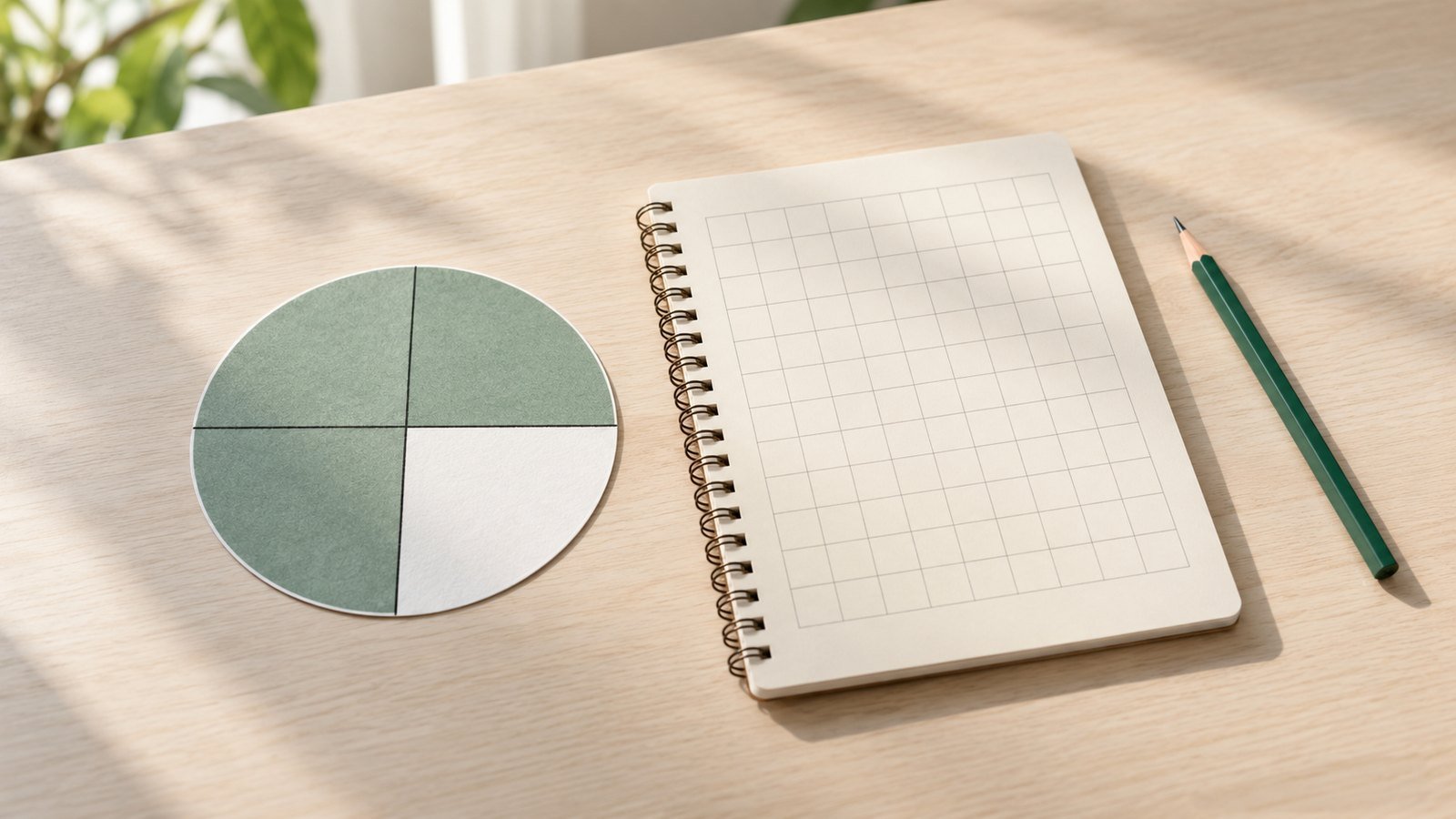
Divide a fraction’s numerator by its denominator to get a decimal; multiply the decimal by 100 and add % to get a percent. For example, 3/4 = 0.75 = 75%. To go backward, divide a percent by 100 for a decimal, or write it over 100 and simplify for a fraction. These are equal values in different notation, not three different amounts. OpenStax explains the fraction–decimal steps.
How Can Three Forms Represent the Same Value?
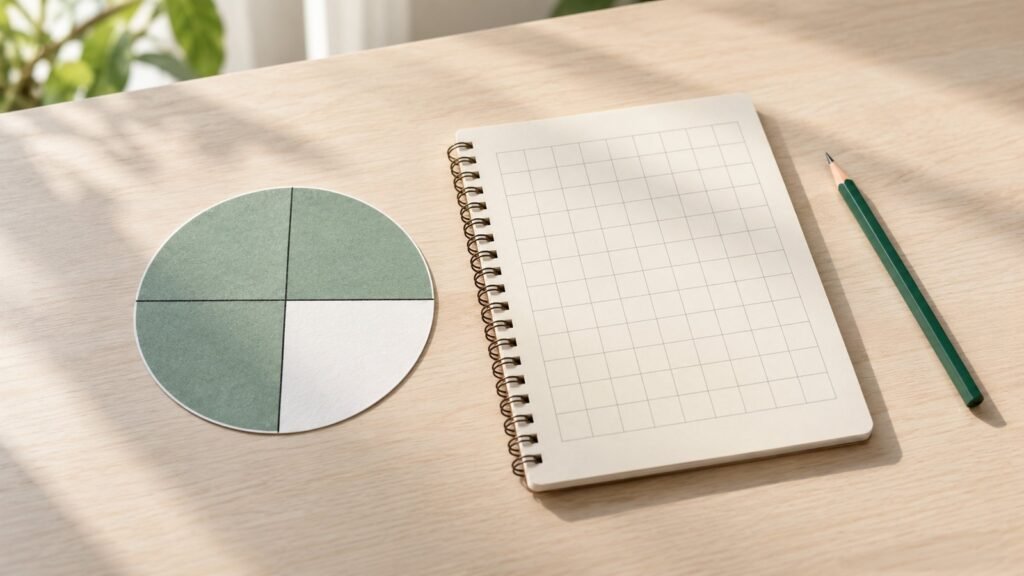
A fraction compares a part with a whole: 3/4 means three of four equal parts. A decimal uses base-ten place value: 0.75 means seventy-five hundredths. A percent means “per hundred”: 75% means seventy-five of every hundred. Because 3 ÷ 4 = 0.75 and 0.75 × 100 = 75, all three describe the same portion. OpenStax defines percent as a ratio per hundred.
What Is the Shortest Conversion Path?
Choose a route based on your starting form. For fraction to decimal, divide the numerator by the denominator. For decimal to percent, multiply by 100. Reverse that step to turn percent into decimal. To write a terminating decimal as a fraction, use its place value as the denominator and simplify. OpenStax gives these decimal place-value rules.
| Start | Goal | Rule | Example |
|---|---|---|---|
| Fraction | Decimal | Numerator ÷ denominator | 3/8 = 0.375 |
| Decimal | Percent | Multiply by 100; add % | 0.375 = 37.5% |
| Percent | Decimal | Divide by 100 | 37.5% = 0.375 |
| Decimal | Fraction | Use place value; simplify | 0.375 = 375/1000 = 3/8 |
| Percent | Fraction | Write over 100; simplify | 75% = 75/100 = 3/4 |
The “move the decimal point” shortcut describes multiplication or division by 100. Understanding that operation makes it easier to handle values such as 0.0075 = 0.75% and 1.25 = 125% without losing a zero or misplacing the percent sign.
How Do the Conversions Work in Real Examples?
Example 1: Three Eighths
Divide 3 by 8 to get 0.375. Multiply by 100 to get 37.5%. Going backward, 37.5% ÷ 100 = 0.375. As a fraction, 0.375 = 375/1000, which reduces to 3/8.
Example 2: More Than One Whole
Five fourths is 5 ÷ 4 = 1.25, so it is 125%. A percent above 100 is valid: it represents more than one complete whole. It is not automatically a calculation mistake. OpenStax also demonstrates percents above 100.
Example 3: A Repeating Decimal
One third is 0.333… and exactly 33⅓%. Writing 33.3% is a rounded approximation, not exact equality. Keep 1/3 as a fraction when exactness matters.
When Is the Conversion Exact, and When Is It Rounded?
A finite decimal such as 0.125 equals 1/8 exactly. But 1/3 produces infinitely repeating decimal digits. A display such as 0.333 or 33.3% is rounded and differs slightly from 1/3. Keep the original fraction through calculations when an exact answer is required, then round only at the final display step. OpenStax distinguishes repeating values from rounded percent displays.
Which Form Is Most Useful for Your Task?
Fractions preserve exact ratios and make part-to-whole relationships clear. Decimals fit place-value arithmetic and many measurements. Percents make proportions easy to compare against a common base of 100. For instance, 3/8 and 2/5 are easier to compare as 37.5% and 40%. The larger percent corresponds to the larger fraction. Choose the form that clarifies the decision, and keep a note of any rounding.
Check a Conversion With a Tool
Use the tool for the calculation and this guide for choosing the right form and interpreting the result.
Fraction to DecimalFraction to PercentDecimal to FractionBrowse Fraction Tools