Fractions · Understanding Multiplication
A mixed number is a sum. Multiplying two sums means every part of the first number must multiply every part of the second—not just the two whole numbers and the two fractions.
For positive mixed numbers, (a + b)(c + d) = ac + ad + bc + bd. Multiplying only the whole parts and only the fraction parts omits two cross terms. For example, 1½ × 2⅓ = 2 + ⅓ + 1 + ⅙ = 3½, not 2⅙. Converting to improper fractions includes all these contributions automatically.
What Does a Mixed Number Represent?
The mixed number 1½ means 1 + ½. Likewise, 2⅓ means 2 + ⅓. The space between the whole number and fraction is a notation convention: it does not mean multiplication. This distinction matters because a product of sums must follow the distributive property.
Think of buying 1½ metres of fabric at a price of 2⅓ units per metre. Both the full metre and the half metre cost the full rate, including its fractional part. There is no reason for the fraction of a metre to be charged only the fraction of the rate.
How Does a Rectangle Reveal All Four Products?
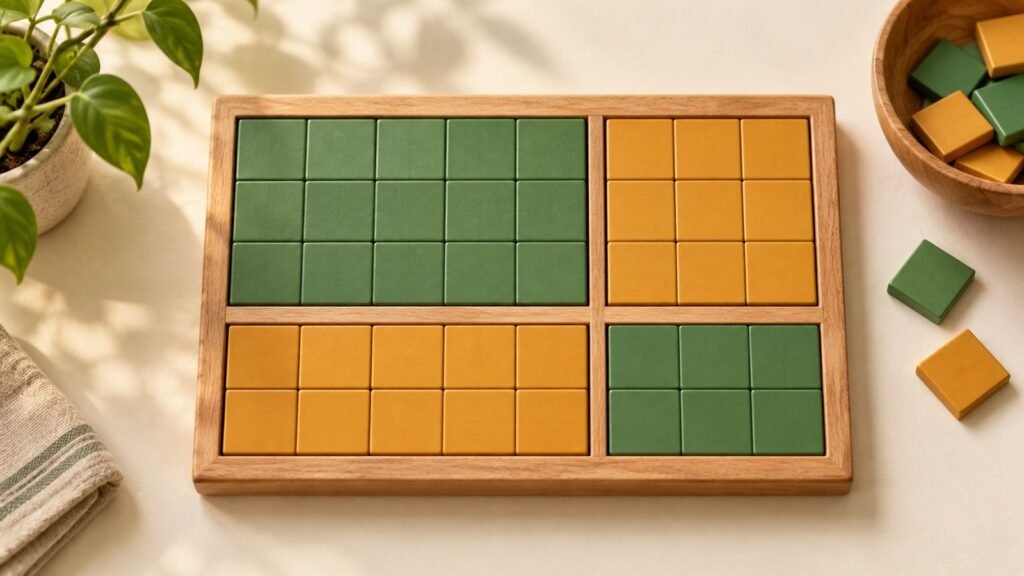
Draw a rectangle with height 1½ and width 2⅓. Split its height into 1 and ½, and its width into 2 and ⅓. The two dividing lines create four smaller rectangles. Since the original area is the sum of all four areas, none can be dropped.
Distribute once across the first sum and again across the second: (1 + ½)(2 + ⅓) = 1(2 + ⅓) + ½(2 + ⅓). This becomes 2 + ⅓ + 1 + ⅙. Combine the whole contributions to get 3, and the fractions to get ⅓ + ⅙ = ½. The result is 3½ square units.
Why Does Converting to Improper Fractions Work?
Conversion rewrites each sum as one fraction without changing its value. Since 1 = 2/2, 1½ = 3/2. Since 2 = 6/3, 2⅓ = 7/3. Now multiply: (3/2)(7/3) = 21/6 = 7/2 = 3½. Cancel the shared factor 3 before multiplying if you prefer.
OpenStax teaches conversion to improper fractions as a standard method for mixed-number multiplication. It is convenient, not the only valid method. Full distribution produces the same answer; partial distribution does not. Use the Mixed Number Calculator to check the equivalent fraction before doing arithmetic.
What Does the Incorrect Method Leave Out?
The separate-parts calculation gives 1 × 2 + ½ × ⅓ = 2 + ⅙ = 2⅙. It ignores 1 × ⅓ and ½ × 2. Those missing products total ⅓ + 1 = 1⅓. Adding them back gives 2⅙ + 1⅓ = 3½.
For positive proper fractional parts, the omitted terms are positive, so this mistake underestimates the answer. Do not extend that conclusion blindly to signed expressions: negative cross terms can change which direction the error goes.
How Should You Handle a Negative Mixed Number?
In conventional notation, −1½ means −(1 + ½) = −3/2. It does not mean −1 + ½, which equals −½. Keep the negative sign outside the entire magnitude when converting or expanding.
For example, −1½ × 2⅓ = (−3/2)(7/3) = −7/2 = −3½. Two negative factors give a positive product. With a text-entry calculator, follow the displayed input format so the sign is applied to the intended whole value.
How Can You Check Whether the Product Is Reasonable?
Estimate first: 1.5 × about 2.33 should be around 3.5. Because 2⅓ is greater than 2, multiplying it by positive 1½ must give more than 3. The incorrect 2⅙ fails that quick lower-bound check.
Then check the exact fraction: 7/2 is 3½. For another exercise, expand 2¼ × 1½ into four terms. You should get 2 + 1 + ¼ + ⅛ = 3⅜; the improper-fraction method gives (9/4)(3/2) = 27/8. Both methods must agree.
Check the Conversion, Then the Product
Rewrite mixed numbers as improper fractions, then use fraction arithmetic to verify your result.
Mixed Number CalculatorFraction CalculatorThe rectangle and worked examples are independently calculated illustrations.