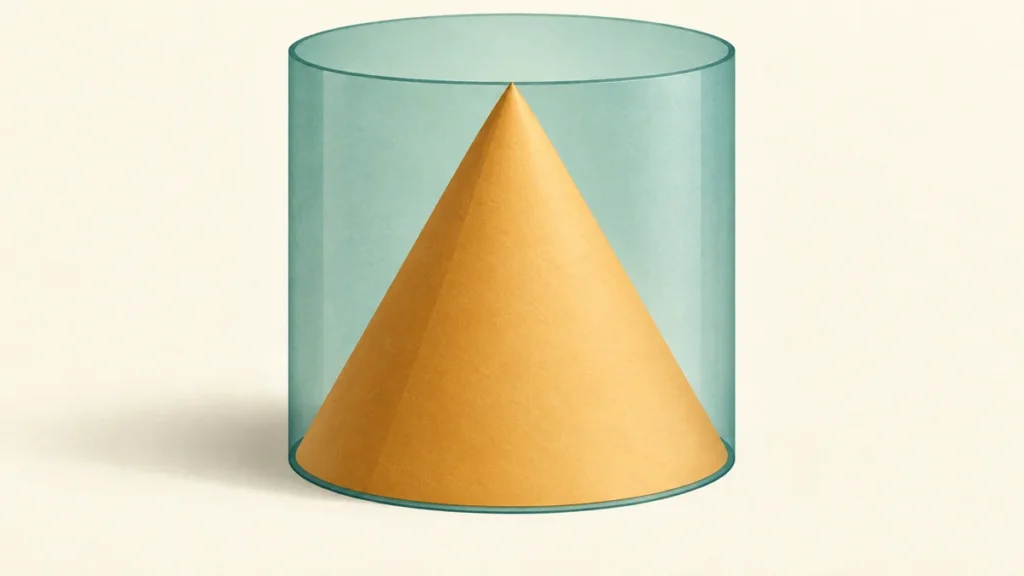
A cone has one-third the volume of a cylinder with the same base radius and perpendicular height because its circular slices get smaller toward the tip. The radius changes in a straight-line pattern, but each slice’s area depends on the radius squared. Across the full height, the average slice area is one-third the base area.
The matching dimensions matter. A tall cone can hold more than a short cylinder, and a wide cone can hold more than a narrow cylinder. The one-third rule compares a cone and cylinder whose base circles and perpendicular heights match. It describes the space inside these ideal shapes, not how much material covers them.
We’ll follow the cone from its tip to its base, check a numerical example, and explain why a halfway slice doesn’t give the average. You can find related shape tools in the geometry and trigonometry hub. You don’t need calculus to follow the main idea, though a short optional calculation shows where the exact fraction comes from.
Which Dimensions Must Match?
Compare the same base radius, r, and the same perpendicular height, h. The cylinder’s volume is πr²h, while the cone’s volume is πr²h/3. Dividing the second expression by the first leaves 1/3 because the shared base area and height cancel.
Perpendicular height is the shortest distance from the tip to the plane containing the base. For a right cone, whose tip sits directly above the base center, that distance runs down the central axis. The slant height follows the outer slope from the tip to the base edge and is longer.
Replacing perpendicular height with slant height would make the volume too large. A container’s sloped side doesn’t tell you how far its layers extend from top to bottom. If a diagram labels only the slanted edge, you still need to find the perpendicular height before using the volume formula.
How Do The Cone’s Slices Change?
Cut a right cone with imaginary planes parallel to its base. Each cross-section is a circle. At the tip its radius is zero; at the base its radius is r. Let z be the perpendicular distance from the tip to one slice, so z runs from 0 to h.
A side view shows similar triangles: the small triangle from the tip to the slice has the same shape as the full triangle. Their matching lengths share a ratio. The slice radius divided by r equals z divided by h, so the slice radius is r × z/h.
Halfway down from the tip, z/h equals 1/2. The slice radius is therefore r/2. But the area isn’t half the base area. Squaring that radius gives π(r/2)² = πr²/4. A circle with half the radius has one-quarter the area.
The same reasoning works at every level. At one-quarter of the height from the tip, the area is 1/16 of the base area. At three-quarters, it’s 9/16. Each slice’s fraction of the base area is (z/h)². The square is the key to the one-third result.
Why Is The Average Area One-Third?
The average slice area over the whole height is one-third the base area because the area follows a square pattern. Volume adds the areas of thin slices multiplied by their thickness. It doesn’t average just the tip and base, and it doesn’t use only the middle slice.
Why not average zero and the full base area to get one-half? That shortcut works when the quantity grows at a constant rate. The radius does grow that way, but the area doesn’t. Near the tip, many slices remain quite small. Larger areas appear closer to the base.
A triangle’s width provides a helpful comparison. Its width grows linearly from the tip, so its average width is half the base width. A cone adds another direction across each circular slice. Both dimensions shrink together, making its area decrease faster than a triangle’s width.
To estimate the cone’s volume, imagine dividing its height into many equal thin layers. Find a circular area near the middle of each layer, multiply by the layer thickness, and add. Thinner layers improve the estimate because each layer’s top and bottom areas become closer.
OpenStax’s lesson on determining volumes by slicing explains this method: add thin-slice volumes, then take the limit as the slices become thinner. It gives the cylinder formula and asks readers to derive the cone formula through slicing. The calculation below applies that method to our radius relationship.
Optional Exact Calculation
Calculus writes the thin-layer addition as V = ∫₀ʰ πr²(z/h)² dz. The fixed factor πr²/h² can move outside the integral. Since the integral of z² from 0 to h is h³/3, the result is (πr²/h²)(h³/3) = πr²h/3.
Dividing that volume by h gives an average slice area of πr²/3. You can leave the integral aside and still remember the reason: slice radii grow with distance from the tip, while slice areas grow with the square of that distance.
What Does A Filling Experiment Show?
A matching cone-shaped container should fill a cylinder-shaped container in three pours. Each container must have the same inside base radius and perpendicular height. Fill the cone level to its rim, empty it into the cylinder, and repeat until you have transferred three conefuls.
Water makes the amount easy to see, provided the containers don’t leak. Sand can also work, but packing and uneven surfaces affect the measurement. Use inside dimensions because thick walls change capacity even when the outside shapes look alike.
This experiment supplies physical evidence for the ratio. It isn’t an exact mathematical proof: a spill, a curved tip, or slightly different dimensions can change the measured result. The slicing argument explains the ideal result without depending on how carefully someone pours.
Also, three pours don’t mean the cylinder splits into three cone-shaped pieces. The water spreads across the cylinder after each pour. Equal amounts of space need not have equal shapes, just as two differently shaped containers can hold the same amount.
How Does The Rule Work With Numbers?
Take a cone and cylinder with radius 3 centimeters and perpendicular height 8 centimeters. Their shared base area is π × 3² = 9π square centimeters. The cylinder keeps that full area throughout its height, so its volume is 9π × 8 = 72π cubic centimeters.
The cone’s volume is one-third of that amount: 72π/3 = 24π cubic centimeters. Rounded to two decimal places, the volumes are about 226.19 cubic centimeters for the cylinder and 75.40 cubic centimeters for the cone. Keep π until the final step to avoid early rounding.
At 4 centimeters from the cone’s tip, its slice radius is 3 × 4/8 = 1.5 centimeters. The slice area is 2.25π square centimeters, one-quarter of the 9π base area. That check connects the measurements to the slice pattern rather than only to a memorized formula.
If the given width were a diameter of 6 centimeters, the radius would still be 3 centimeters. Using 6 as the radius would multiply the result by four. You can check a separate example with the cone calculator and compare the matching dimensions in the cylinder calculator.
What Happens When Radius Or Height Changes?
Doubling the radius while keeping height fixed multiplies either shape’s volume by four. Doubling the height while keeping radius fixed multiplies volume by two. Both formulas contain r² and h, so these changes act the same way for the cone and its matching cylinder.
For the example above, changing the radius from 3 to 6 centimeters makes the cone’s volume 96π cubic centimeters. Changing only the height from 8 to 16 centimeters makes it 48π. Doubling both dimensions gives 192π, eight times the original 24π.
The ratio stays one-third when you change both shapes together so they still match. Changing only the cone breaks that comparison. For instance, a cone with triple the matching cylinder’s height has the same volume as that cylinder, provided their base radii stay equal.
Does A Tilted Cone Follow The Same Rule?
An oblique circular cone also has volume πr²h/3. Its tip sits to one side rather than directly above the base center. Here h still means the perpendicular distance to the base plane. It is not the length of the leaning line from the tip to the center.
Slices parallel to the base remain circles with the same radius fractions as before. Their centers shift sideways, but their areas at matching perpendicular heights don’t change. Adding those areas through the height therefore gives the same volume as the right cone.
This statement assumes a mathematical cone with straight sides joining one tip to a circular base. A curved, dented, or bulging container may have a different slice pattern. A cone with its tip cut off is also a different solid, so don’t apply the full-cone formula to it unchanged.
How Can You Check Your Reasoning?
Start by identifying the radius and perpendicular height, then compare like dimensions. Ask whether the shape has one tip and a circular base joined by straight sides. Check that the measurements use the same length unit before multiplying, and report volume in cubic units.
Next, use the halfway slice as a quick test of your mental picture. Its radius is half the base radius and its area is one-quarter the base area. If you picture half the area there, you’re treating a squared relationship as a straight-line one.
The full-height average is a separate idea from that halfway measurement. Thin slices across the entire cone average one-third of the base area. Multiplying that average area by the perpendicular height explains the formula and shows why a matching cylinder holds exactly three times as much.