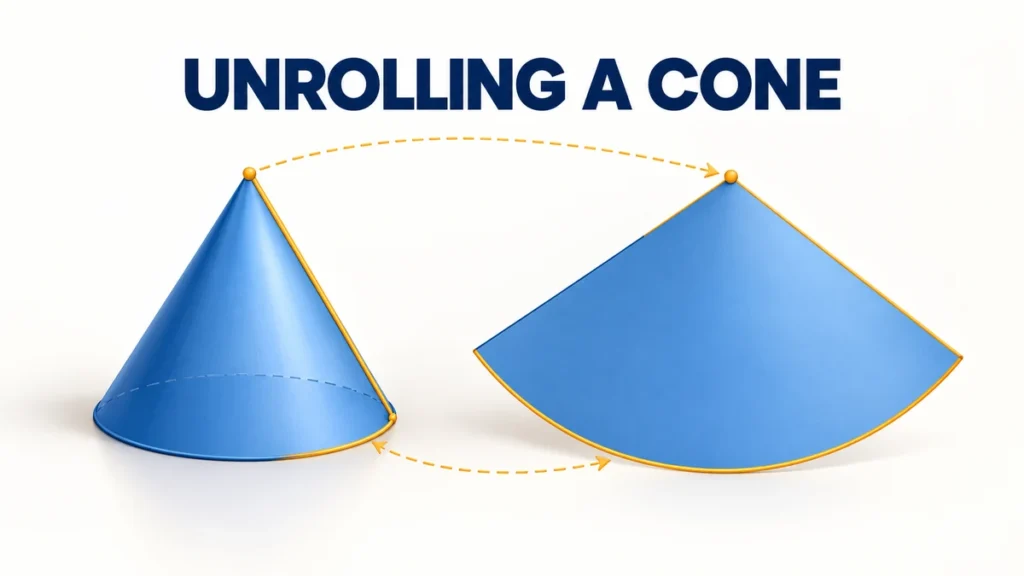
A right circular cone has lateral surface area πrl because its curved side becomes a circular sector when it is cut along a slant and laid flat. The sector has radius l and arc length 2πr. Those two measurements make its area exactly πrl.
Why Does A Cone Unroll Into A Sector?
A right cone’s curved side becomes one circular sector after one straight cut from the vertex to the base. The sector radius is the slant height l, and its arc is the base circumference 2πr. Harvard’s algebra appendix uses this same sector model for cone surface area.
Imagine wrapping a sheet of paper around an ice-cream cone. If you remove the paper and flatten it, you do not get a full circle or a triangle. You get a sector, which looks like a slice cut from a disk. Every straight path from the cone’s tip to its base edge keeps length l when flattened.
The outside curved edge also keeps its length. Before unrolling, it fits exactly around the circular base. Therefore, that arc has length 2πr. Flattening changes the shape’s position, but it does not stretch the material or change its area.
The sector model also explains why vertical height h does not appear directly in πrl. The curved sheet follows the slope, not the center line. That is why the relevant distance is the slant height.
How Does The Sector Prove πrl?
The sector occupies the fraction r/l of a full disk because its arc is 2πr, while a full disk of radius l has circumference 2πl. Multiplying that fraction by the disk area πl² gives (r/l)(πl²) = πrl, matching the sector treatment in Harvard’s appendix.
Here is the derivation in small steps:
- The flattened surface is part of a circle with radius l.
- Its arc length is the cone base circumference, 2πr.
- The matching full circle has circumference 2πl.
- The sector fraction is 2πr ÷ 2πl = r/l.
- The full circle area is πl².
- The sector area is (r/l)(πl²) = πrl.
There is a shorter route. Any sector has area (1/2) × radius × arc length. Substituting radius l and arc length 2πr gives (1/2)(l)(2πr) = πrl. Both routes describe the same flattened surface.
This proof is more useful than memorizing letters. If you forget the formula, picture the sector and rebuild it from the arc and slant height. For a numerical check, use the cone calculator after setting up the geometry yourself.
What Is The Difference Between Lateral And Total Area?
A closed cone has two surface parts: one curved lateral surface and one circular base. The lateral area is πrl, while the base area is πr². Therefore, total surface area is πrl + πr² = πr(l + r). The University of Chicago geometry text separates these surface components.
| Area Requested | Included Parts | Formula |
|---|---|---|
| Lateral surface area | Curved side only | πrl |
| Base area | Circular bottom only | πr² |
| Total surface area | Curved side and base | πrl + πr² |
The wording of a problem matters. A paper party hat has no base, so its material is modeled by lateral area. A completely closed cone-shaped object includes the base. If a cone is open at the bottom, adding πr² would overstate the material needed.
The circle calculator can check the base circumference and area separately. Keeping those quantities separate prevents the common mistake of treating 2πr, a length, as though it were already an area.
How Do You Find The Slant Height?
For a right cone, the radius, perpendicular height, and slant height form one right triangle. The Pythagorean theorem gives l = √(r² + h²). With r = 3 and h = 4, the result is l = 5, the familiar 3-4-5 triangle.
The perpendicular height h runs through the cone’s center from the base to the vertex. The slant height l runs along the surface from the base edge to the vertex. Since l is the hypotenuse, it must satisfy l ≥ r and l ≥ h for a nonnegative right cone.
If the problem gives r and l, do not calculate l again. Use those values directly in πrl. If it gives r and h, find l first. Mixing h into πrl produces an area that is too small.
How Does The Formula Work In An Example?
For a right cone with r = 3 units and h = 4 units, the slant height is 5 units. Its lateral area is 15π ≈ 47.124 square units, and its total area is 24π ≈ 75.398 square units. These values follow the sector method described by Harvard.
- Find the slant height: l = √(3² + 4²) = √25 = 5.
- Find lateral area: πrl = π(3)(5) = 15π ≈ 47.124.
- Find the base area: πr² = π(3²) = 9π ≈ 28.274.
- Add both parts for total area: 15π + 9π = 24π ≈ 75.398.
Now check the sector itself. Its radius is 5, so the matching full disk has circumference 10π. The cone needs an arc of 6π, which is three-fifths of that circumference. Three-fifths of the disk area 25π is 15π. The two approaches agree exactly.
Units provide another check. Radius times slant height has units squared, so πrl is an area. If both inputs are centimeters, the answer is in square centimeters, not centimeters.
When Does The Formula Need Care?
The formula πrl describes the lateral area of one right circular cone. OpenStax treats general surface area through parameterized surfaces, which matters when a shape is not this standard cone. A frustum, an oblique cone, or an irregular surface needs different geometry rather than a forced use of πrl.
- Zero radius: If r = 0, then πrl = 0. The circular base and curved surface collapse.
- Zero height: If h = 0, the solid is degenerate. The limiting surface does not behave like an ordinary upright cone.
- Frustum: A cone with its tip removed has two radii. Use a frustum calculator or derive its annular-sector area.
- Oblique cone: A tilted vertex makes slant distances vary around the base, so one value of l cannot describe the whole side.
Whitman College’s surface-area treatment shows why more general surfaces require calculus. For ordinary school problems, look for a circular base and a vertex directly above its center. Those conditions signal that πrl applies.
FAQs About Cone Lateral Surface Area
The key distinction involves three measurements: radius r, vertical height h, and slant height l. Harvard’s sector model uses r and l, while the right-triangle relation connects all three. The answers below resolve the remaining formula choices without repeating the full proof.
Why Is The Slant Height Used Instead Of Height?
The flattened sector’s radius follows the cone’s surface from vertex to rim. That distance is l, not the perpendicular center height h. Vertical height helps find l through l = √(r² + h²).
Is πrl The Total Surface Area?
No. πrl covers only the curved side. Add the circular base area πr² when the problem asks for the total area of a closed cone.
Can The Formula Be Written With Diameter?
Yes. Since r = d/2, substitute to get πdl/2. Keep the same length units before multiplying.
What Is The Sector’s Central Angle?
The sector is the fraction r/l of a full circle, so its angle is 360°(r/l), or 2πr/l radians. Because l ≥ r, the angle cannot exceed 360° for a regular right cone.
Sources
Four educational references support the geometry: Harvard University explains the cone-to-sector model, the University of Chicago covers cone measurements, OpenStax presents general surface-integral ideas, and Whitman College develops surface area through calculus. The numerical example and boundary checks were independently calculated from the stated formulas.
- Harvard University: Algebra Appendix
- University of Chicago: Mathematics For High School Teachers
- OpenStax: Surface Integrals
- Whitman College: Surface Area
For related formulas and interactive checks, browse the trigonometry and geometry tools.