Heron’s formula works because the usual triangle-area formula and the Law of Cosines describe the same triangle. Starting with K = (1/2)bc sin A, the Law of Cosines replaces the unknown angle with the three side lengths. Factoring the result produces K = √[s(s − a)(s − b)(s − c)].
The formula can look mysterious because it jumps from three side lengths to an area without showing a height. The proof below reveals that the height is still present through the sine of an angle. It also explains why the semiperimeter appears and checks every step with a 13-14-15 triangle.
Why Does Heron’s Formula Work?
OpenStax gives both Heron’s formula, K = √[s(s − a)(s − b)(s − c)], and the side-angle formula K = (1/2)bc sin A. Heron’s formula works because the Law of Cosines converts sin A into an expression containing only a, b, and c, after which ordinary factoring creates the four semiperimeter factors.
Here, a, b, and c are the three side lengths, K is the area, and s = (a + b + c)/2. Any side may be called a, as long as angle A is opposite that side and the two sides around angle A are b and c.
The Reader-Friendly Intuition
A triangle’s area depends on two sides and how widely they open. If b and c close toward each other, sin A approaches zero and so does the area. If they open to a right angle, sin A becomes 1 and the area reaches (1/2)bc.
Knowing all three sides fixes that opening angle. The Law of Cosines calculator makes the same connection numerically: the opposite side a determines cos A once b and c are known. Heron’s formula packages that angle information into side-length factors, so no angle appears in the final answer.
This is the core idea, but it is not yet a proof. The high-school algebra proof must show that the side-only expression is exactly equal to the familiar area formula, not merely close to it for a few examples.
How Does The Algebraic Proof Work?
University of Kentucky geometry notes derive Heron’s formula from K = (1/2)bc sin A and cos A = (b² + c² − a²)/(2bc). Squaring the area formula, using sin²A = 1 − cos²A, and factoring a difference of squares changes the angle expression into four linear side-length factors.
Step 1: Start With The Side-Angle Area Formula
Choose angle A between sides b and c. Dropping an altitude from the opposite vertex gives height h = c sin A when b is used as the base. Therefore, K = (1/2)bh becomes:
K = (1/2)bc sin A
Squaring avoids carrying a square root through each algebra step:
4K² = b²c² sin²A
Step 2: Replace The Angle
The Law of Cosines says a² = b² + c² − 2bc cos A. Solving for the cosine gives cos A = (b² + c² − a²)/(2bc). Since sin²A = 1 − cos²A, substitute this cosine into the squared area equation:
16K² = 4b²c² − (b² + c² − a²)²
The multiplication by 4 clears the denominator created by the cosine fraction. No approximation has entered the proof. Every expression is still exact.
Step 3: Factor Twice
The right side is a difference of squares. Treat 2bc as one quantity and b² + c² − a² as the other:
16K² = [2bc − (b² + c² − a²)][2bc + (b² + c² − a²)]
Rearranging each bracket creates two more differences of squares:
- 2bc − b² − c² + a² = a² − (b − c)²
- 2bc + b² + c² − a² = (b + c)² − a²
Factor those expressions to obtain:
16K² = (a − b + c)(a + b − c)(b + c − a)(a + b + c)
MathWorld presents the same accessible cosine-law path. The proof is useful because it works for acute, right, and obtuse triangles. The sine stays nonnegative for an interior triangle angle between 0° and 180°, so taking the positive square root gives the nonnegative geometric area.
Why Does The Semiperimeter Appear?
MathWorld’s factorization produces a + b + c and the three triangle-inequality gaps: −a + b + c, a − b + c, and a + b − c. Dividing all four factors by 2 turns them into s, s − a, s − b, and s − c, which explains the semiperimeter naturally.
Since 2s = a + b + c, each linear factor is twice a semiperimeter expression:
- a + b + c = 2s
- −a + b + c = 2(s − a)
- a − b + c = 2(s − b)
- a + b − c = 2(s − c)
Multiplying these four equations contributes 2⁴ = 16. That 16 cancels the 16 beside K², leaving K² = s(s − a)(s − b)(s − c). Taking the nonnegative square root gives Heron’s formula.
The three differences also carry geometric meaning. For a real, nondegenerate triangle, each pair of sides must add to more than the remaining side. Therefore, s − a, s − b, and s − c are positive. They measure half of each triangle-inequality gap.
How Does A 13-14-15 Triangle Check The Formula?
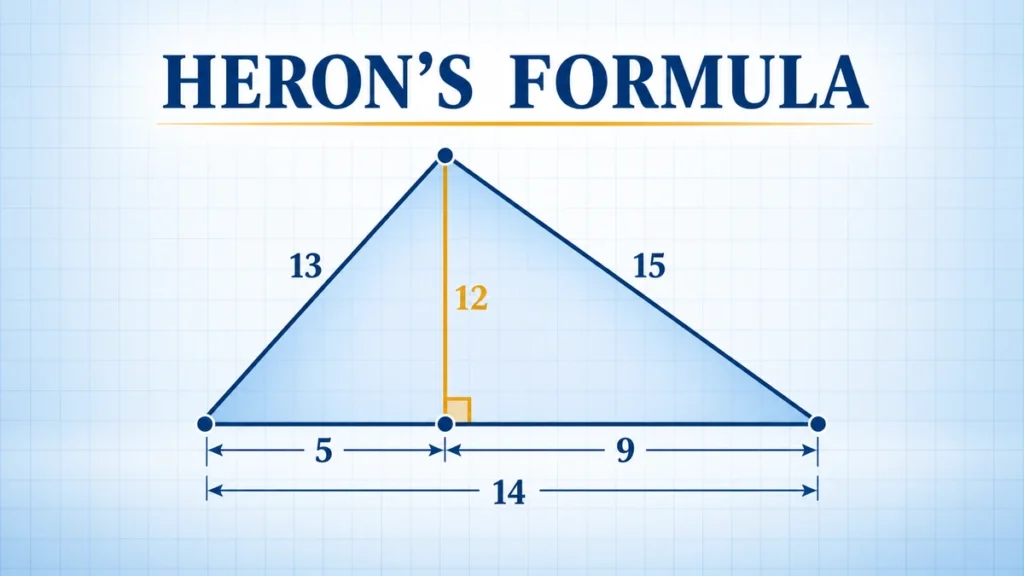
OpenStax defines s as half the perimeter before applying Heron’s formula. For side lengths 13, 14, and 15, the perimeter is 42, so s = 21. The four factors are 21, 8, 7, and 6; their product is 7,056, whose positive square root is exactly 84.
- Find the semiperimeter: s = (13 + 14 + 15)/2 = 21.
- Find the differences: s − 13 = 8, s − 14 = 7, and s − 15 = 6.
- Multiply: 21 × 8 × 7 × 6 = 7,056.
- Take the square root: K = √7,056 = 84 square units.
Independent Height Check
Use the side of length 14 as the base. The altitude divides it into lengths 5 and 9. One right triangle then has hypotenuse 13 and horizontal leg 5, so the Pythagorean theorem gives h = √(13² − 5²) = √144 = 12.
The ordinary area formula gives K = (1/2)(14)(12) = 84 square units. This agreement checks Heron’s result through a separate route. The Triangle Area Calculator can evaluate the side-only method, but the exact arithmetic above shows why the result is trustworthy.
What Checks And Mistakes Matter?
OpenStax states that Heron’s formula applies when three triangle sides are known, but those lengths must satisfy all three triangle inequalities. The radicand also provides useful scaling and unit checks: multiplying every side by k multiplies all four factors by k, so the final area grows by k².
Boundary And Scaling Checks
- Degenerate boundary: If a + b = c, then s − c = 0, so K = 0. The “triangle” has flattened into a segment.
- Invalid sides: If one side exceeds the sum of the other two, one factor is negative. Those lengths do not form a triangle.
- Scale: Doubling all three sides multiplies the area by 4, not 2 or 8.
- Units: Four length factors create fourth-power units inside the square root. The answer therefore has square units.
- Symmetry: Swapping the names a, b, and c does not change the product or the area.
Common Mistakes
- Using the perimeter instead of half: The formula uses s = (a + b + c)/2, not a + b + c.
- Taking separate square roots too early: Multiply the four exact factors first when possible, then simplify or approximate the final square root.
- Forgetting the triangle test: Positive inputs alone are not enough. Sides 2, 3, and 6 cannot close into a triangle.
- Rounding s too soon: Decimal side lengths can make early rounding noticeably change the final area.
- Reporting linear units: An area found from centimeter side lengths is measured in cm².
Heron’s formula is one option among several. If a base and perpendicular height are known, (1/2)bh is usually shorter. If two sides and their included angle are known, (1/2)bc sin A is direct. The Geometry And Trigonometry hub connects these methods to the appropriate tools.
FAQs About Why Heron’s Formula Works
OpenStax describes Heron’s formula as a method for an SSS triangle, meaning all three side lengths are known. That scope answers many practical questions: the sides may be decimals, the triangle may be obtuse, and the resulting area can also be used to recover an altitude.
Does Heron’s Formula Work For An Obtuse Triangle?
Yes. The proof uses sin²A = 1 − cos²A, which works for acute, right, and obtuse angles. An obtuse angle has a negative cosine but a positive sine, and geometric area remains nonnegative.
Can The Side Lengths Be Decimals?
Yes. The side lengths do not need to be integers. Keep enough precision in s and the four factors, verify the triangle inequalities, and round only the final area to the required place.
Can Heron’s Formula Find A Triangle’s Height?
Yes, after finding area K. Choose a side as base b, then rearrange K = (1/2)bh to get h = 2K/b. Each choice of base produces its matching altitude.
Why Does Heron’s Formula Use A Square Root?
The cosine-law proof naturally produces K² as a product of four length factors. Area K is the nonnegative square root of that product because a geometric area cannot be negative.
What Should You Remember?
University of Kentucky’s derivation reaches Heron’s formula through three standard facts: K = (1/2)bc sin A, the Law of Cosines, and the difference-of-squares identity. The semiperimeter appears only after the resulting four side-sum factors are halved, and the 13-14-15 example confirms an exact area of 84.
The formula is therefore not an unrelated shortcut. It is the usual base-height idea with the hidden angle removed. Check the triangle inequalities, keep the calculation exact until the end, and report square units.
Sources
Four references support the formula, its scope, and the proof used here. OpenStax supplies the Law of Cosines, Heron’s formula, and worked SSS examples; MathWorld and two university mathematics resources show the cosine-law factorization that turns the side-angle area formula into the semiperimeter form.