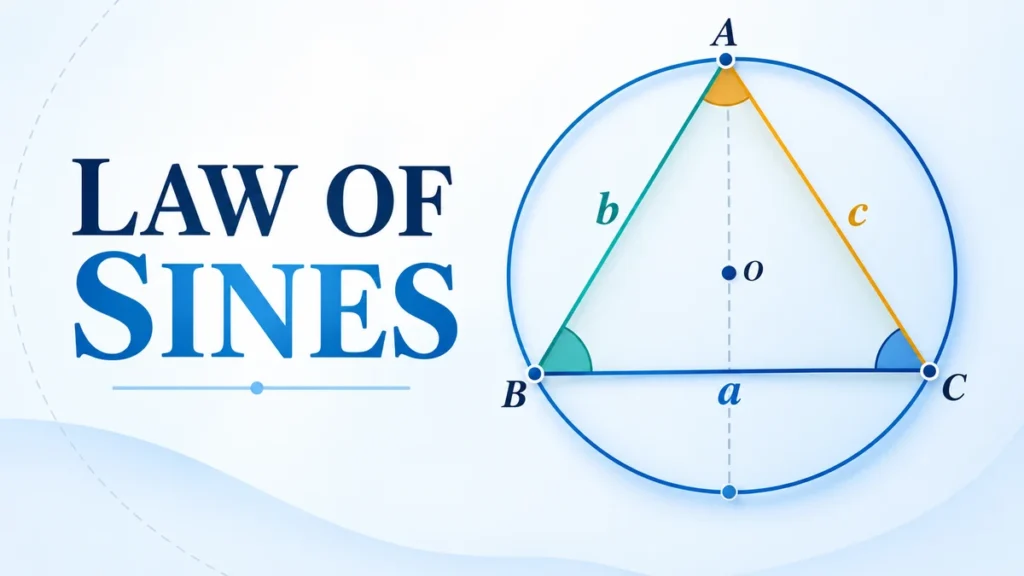
The Law of Sines works because every side of a triangle and the sine of its opposite angle describe the same altitude. It also has a circle meaning: each ratio a/sin A, b/sin B, and c/sin C equals the diameter of the triangle’s circumcircle. Those two views explain both the formula and when to use it.
What Does The Law Of Sines Say?
For one nondegenerate triangle, OpenStax gives three equal ratios: a/sin A = b/sin B = c/sin C. Each lowercase side must sit opposite the matching uppercase angle. The formula compares opposite pairs, not sides and nearby angles. That labeling rule is the foundation of every correct setup.
The reciprocal form is equally valid:
sin A/a = sin B/b = sin C/c
Use whichever direction puts the unknown where it is easiest to isolate. To find a side, the side-over-sine form is usually clearer. To find an angle, the sine-over-side form often needs fewer rearrangement steps.
The formula does not say that side length equals angle size. It says the three sides share one scale factor with the sines of their opposite angles. A larger angle has a larger sine only from 0° through 90°. Past 90°, sine decreases, which is why an inverse-sine result can hide an obtuse second possibility.
You can test triangle values or solve missing measurements with the Law of Sines Calculator. The calculator handles AAS, ASA, and the ambiguous SSA case, while this article explains why its proportions are valid.
Why Does The Area Proof Work?
OpenStax writes the same triangle’s area in three exact ways: K = (1/2)bc sin A, K = (1/2)ac sin B, and K = (1/2)ab sin C. Because all three expressions equal one area K, comparing them forces the Law of Sines ratios to be equal.
Choose AB as the base and drop an altitude h from C. In the right triangle beside angle A, sin A = h/b, so h = b sin A. In the other right triangle, sin B = h/a, so h = a sin B. Therefore:
b sin A = a sin B
Divide both sides by ab. The result is sin A/a = sin B/b. Drop another altitude, or repeat the same comparison with a different base, and you obtain sin B/b = sin C/c. Joining the equalities proves the full law.
The proof also covers an obtuse triangle. Its altitude can land on an extension outside the triangle. The right triangle then uses the supplementary angle 180° − B, but sin(180° − B) = sin B. The height relationship remains unchanged.
If you want to calculate K directly from two sides and their included angle, use the Triangle Area Calculator. That area identity is the shortest algebraic bridge to the Law of Sines.
What Does The Circumcircle Explain?
LibreTexts states the extended Law of Sines as a/sin A = b/sin B = c/sin C = 2R, where R is the circumradius. Thus, the common ratio is not an unexplained number. It is the diameter of the unique circle passing through the triangle’s three vertices.
An inscribed angle A intercepts the chord with length a. The central angle over the same chord is 2A. Splitting the resulting isosceles triangle in half gives a right triangle with hypotenuse R and opposite leg a/2. Therefore sin A = (a/2)/R = a/(2R), which rearranges to a/sin A = 2R.
This circle view reveals the formula’s scale. Two triangles with the same angles are similar, so their side lengths can differ. Their Law of Sines ratios differ by the same scale factor because their circumcircle diameters also scale. The angle pattern controls shape, while 2R controls size.
The Circle Calculator can help you check radius and diameter relationships. However, you do not need to construct the circumcircle to solve an ordinary triangle.
How Does It Solve An ASA Triangle?
For A = 40°, B = 60°, and a = 8, the triangle angle sum gives C = 80°. Applying OpenStax’s side-over-sine proportion produces b ≈ 10.778 and c ≈ 12.257. This ASA data determines one triangle because two known angles fix its shape.
- Find the third angle: C = 180° − 40° − 60° = 80°.
- Find side b: b = 8 sin 60° / sin 40° ≈ 10.778.
- Find side c: c = 8 sin 80° / sin 40° ≈ 12.257.
- Check the order: 80° is the largest angle, and c is the longest side. The side-angle ordering agrees.
Keep full calculator values until the final line. If you round b before using it in another step, the later result may drift. Also confirm degree mode when the angles include the degree symbol. Radian mode would calculate different sine values.
Could the Law of Cosines solve this problem? Yes, but only after more information is known. The Law of Sines is the direct choice because the given side a already has its opposite angle A. Compare methods with the Law of Cosines Calculator.
Why Can SSA Give Two Triangles?
OpenStax explains that SSA data may produce zero, one, or two triangles. For a = 8, A = 40°, and b = 10, sin B = 10 sin 40°/8 ≈ 0.8035. Both B ≈ 53.464° and its supplement 126.536° have that sine, and both leave room for a positive third angle.
The ambiguity comes from sin θ = sin(180° − θ). An inverse-sine button normally returns the acute angle, so you must test its supplement. Keep the second option only if A + (180° − B) is less than 180°. Otherwise, no positive third angle remains.
There may also be no triangle. If the computed sine of an angle exceeds 1, no real angle has that sine. There is exactly one triangle when only one candidate angle produces a positive third angle, or when the two candidates coincide at 90°.
When Should You Use The Law Of Sines?
The Law of Sines needs at least one known opposite side-angle pair. In the common ASA or AAS cases, that pair becomes available after finding the third angle from the 180° sum. In SSA, the known pair is given, but the result needs the ambiguity check described above.
- Use it for ASA or AAS: two angles and one side determine one triangle.
- Use it carefully for SSA: two sides and a non-included angle can produce zero, one, or two triangles.
- Prefer the Law of Cosines for SAS: two sides and the included angle do not start with an opposite pair.
- Prefer the Law of Cosines for SSS: three sides are known, but no angle is known.
- Use right-triangle ratios for a right triangle: the Law of Sines still works, but basic sine, cosine, or tangent may be faster.
The triangle must be nondegenerate: its angles are positive and total 180°, and its sides satisfy the triangle inequality. The formula applies to acute, right, and obtuse triangles. Browse the Geometry and Trigonometry hub when you need to choose between triangle methods.
What Mistakes Should You Avoid?
In the ASA example, a = 8 must pair with A = 40°, not B = 60°. That one pairing error changes every later value. OpenStax’s standard labeling keeps side a opposite A, side b opposite B, and side c opposite C, regardless of how a diagram is rotated.
Pairing A Side With The Wrong Angle
Write each known pair before building a proportion: (a, A), (b, B), and (c, C). Put complete pairs in matching positions. A rotated or mirrored drawing never changes which angle is opposite a side.
Forgetting The Second SSA Angle
If inverse sine returns B, also test 180° − B. Reject the supplement only after checking the remaining angle. Automatically keeping just the calculator’s first angle can erase a valid triangle.
Using Degrees In Radian Mode
An input such as sin 40° requires degree mode. If your problem uses radians, keep every angle in radians. Do not mix units inside one proportion.
Rounding Too Early
Carry several extra digits through each step, then round the final side or angle as requested. Early rounding matters most when the last angle is small or the triangle is close to a boundary.
Frequently Asked Questions
The extended formula has four equal quantities: a/sin A = b/sin B = c/sin C = 2R. LibreTexts identifies R as the circumradius. The following answers address details that are useful after the proof but do not require another full derivation.
Does The Law Of Sines Work For Right Triangles?
Yes. If C = 90°, then sin C = 1, so c/sin C = c. The side c is the hypotenuse and also the circumcircle’s diameter. The other ratios equal the same value.
Why Does An Obtuse Angle Not Break The Altitude Proof?
The altitude may fall outside the triangle, creating a supplementary right-triangle angle. Since sin(180° − B) = sin B, the height remains a sin B. The same algebra follows.
Is The Common Ratio The Circumradius?
No. It is the diameter 2R, not the radius R. Equivalently, a = 2R sin A. Missing the factor 2 makes every computed circumradius twice as large or every side half as large.
Can The Law Of Sines Solve Three Known Sides?
Not directly, because no angle-side pair is available. Start with the Law of Cosines to find one angle. Then the Law of Sines can find another angle if desired.
Why Must The Largest Side Face The Largest Angle?
The circle view places each side as a chord. Within a triangle, a larger opposite angle intercepts a longer chord. This is also a useful reasonableness check after calculating missing values.