Geometry · Pyramid Volume Proof
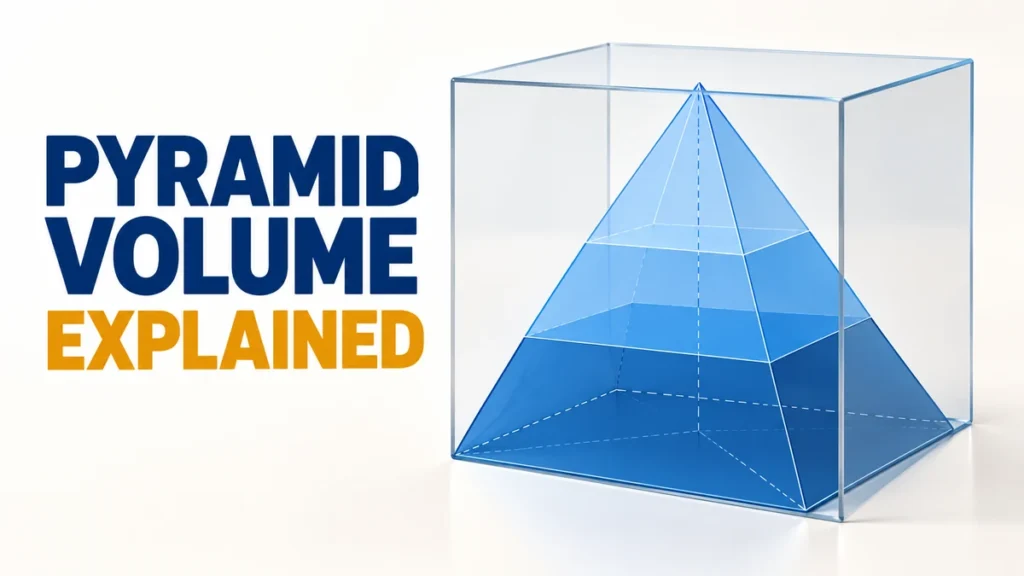
A pyramid has volume V = Bh/3 because its parallel cross-sections shrink by a length scale and an area scale. At a fraction x/h of the height from the apex, a slice has area B(x/h)². Adding all those slices gives exactly one-third of the matching prism.
The factor 1/3 is not an estimate based on appearance. Similar cross-sections show that a pyramid’s area grows quadratically from 0 at the apex to B at the base. The average slice area over the full perpendicular height is B/3, so volume is (B/3)h = Bh/3.
What Does V = Bh/3 Mean?
OpenStax gives the volume of a pyramid as one-third of base area times perpendicular height. In symbols, V = (1/3)Bh, where B is measured in square units and h is measured in the matching length unit (OpenStax, accessed October 14, 2026).
The letter B represents the entire area of the polygonal base, not one side length. For a square base with side a, B = a². For a rectangular base, B = length × width. For a triangular base, find the triangle’s area first.
The product Bh is the volume of a prism with the same base and height. Dividing by 3 says that three copies of the pyramid’s volume equal that prism’s volume. This comparison is exact when both solids share base area B and perpendicular height h.
Volume uses cubic units. If B is 36 square centimeters and h is 4 centimeters, then Bh = 144 cubic centimeters. The pyramid occupies 144 ÷ 3 = 48 cubic centimeters.
Why Do A Pyramid’s Cross-Sections Shrink?
At half the distance from the apex to the base, every length in a parallel cross-section is one-half of its matching base length. Its area is therefore (1/2)² = 1/4 of B, a similarity result used in the OpenStax slicing derivation (OpenStax, accessed October 14, 2026).
Imagine cutting the pyramid with a plane parallel to its base. The cut shape is similar to the base: it has the same angles and proportional side lengths. It is smaller near the apex and grows steadily as the cutting plane moves toward the base.
Let x be the perpendicular distance from the apex to a slice. The full height is h, so the slice’s length scale is x/h. Area changes with the square of a length scale, giving the slice area
A(x) = B(x/h)².
This square is the key. Halfway down, the area is B/4, not B/2. One-quarter of the way down, it is B/16. Three-quarters of the way down, it is 9B/16. Most upper slices are much smaller than a linear guess suggests.
The pyramid is not losing the same amount of area at each step. Its area follows a square pattern. That quadratic growth is why its average slice is only one-third of the base, even though the slice halfway down has one-quarter of the base area.
Where Does The One-Third Factor Come From?
OpenStax adds the areas B(x/h)² from x = 0 to x = h and obtains Bh/3. In calculus notation, the exact sum is ∫₀ʰ B(x/h)² dx = Bh/3, because the average value of (x/h)² over that interval is 1/3 (OpenStax, accessed October 14, 2026).
You can understand the argument without performing an integral. Divide the height into many thin layers. Each layer is almost a short prism, so its volume is approximately its cross-sectional area times its tiny thickness. Adding more, thinner layers makes the approximation approach the exact volume.
The bottom layers contribute most because their areas are largest. The upper layers contribute less and less as they approach the apex. The total behaves as though a prism of height h had a constant cross-sectional area B/3.
This also explains why a visual guess can be misleading. A pyramid reaches the full base area only at its bottom boundary. It does not keep a large cross-section through most of its height the way a prism does.
How Does Cavalieri’s Principle Explain Oblique Pyramids?
Cavalieri’s principle says two solids of equal height have equal volumes when their cross-sections have equal areas at every matching level. A right and an oblique pyramid with the same B and h meet that test, so both have volume Bh/3 (University of Kentucky mathematics notes, accessed October 14, 2026).
Moving the apex sideways changes where each parallel slice sits, but not its area. At distance x from either apex, the scale is still x/h and the area is still B(x/h)². The slices may be shifted, yet their sizes match level by level.
Picture two stacks of thin cards. One stack stands straight, while the other leans because each card is shifted slightly. If corresponding cards have the same area and both stacks have the same height, their total volumes match.
This is why the apex does not need to sit over the center of the base. Leaning can change edge lengths, slant heights, and surface areas, but it does not change volume while B and perpendicular h remain fixed.
How Do You Calculate Pyramid Volume?
A square pyramid with side 6 and perpendicular height 4 has B = 6² = 36 and V = 36 × 4 ÷ 3 = 48 cubic units. Its matching prism has volume 36 × 4 = 144, exactly three times as much (SolverCalc Pyramid Calculator).
Square Base Example
- Find the base area: B = 6 × 6 = 36 square units.
- Multiply by perpendicular height: Bh = 36 × 4 = 144 cubic units.
- Divide by 3: V = 144 ÷ 3 = 48 cubic units.
Use the rectangular prism calculator to compare the matching prism. With the same 6 by 6 base and height 4, it returns 144 cubic units.
Rectangular Base Example
Suppose a pyramid has an 8-meter by 5-meter base and a perpendicular height of 9 meters. The base area is 8 × 5 = 40 square meters. Therefore, V = 40 × 9 ÷ 3 = 120 cubic meters.
Triangular Base Example
A triangular base has base length 10 centimeters and its own perpendicular height 6 centimeters, so B = 10 × 6 ÷ 2 = 30 square centimeters. If the pyramid’s perpendicular height is 12 centimeters, V = 30 × 12 ÷ 3 = 120 cubic centimeters.
Notice the two different heights in that problem. The 6-centimeter measurement finds the area of the triangular base. The 12-centimeter measurement runs from the pyramid’s apex perpendicular to the base plane.
Which Height Belongs In The Formula?
The height h is the shortest perpendicular distance from the apex to the plane containing the base. Math Open Reference emphasizes that this vertical distance, not a slanted edge or face height, belongs in V = Bh/3 (Math Open Reference, accessed October 14, 2026).
In a right pyramid, the perpendicular may land at the base’s center. In an oblique pyramid, it can land away from the center and may even meet the extended base plane outside the polygon. The formula still uses that perpendicular distance.
A lateral edge connects the apex to a base vertex. A face slant height runs down a triangular face, often to the midpoint of a base side. Both measurements can be longer than h, so substituting either one makes the calculated volume too large.
If a diagram marks a right-angle box where a segment meets the base plane, that segment is usually the intended height. If no perpendicular height is given, another geometry step may be needed before applying the volume formula.
When Does The Formula Need Extra Care?
At h = 0, the formula gives V = B × 0 ÷ 3 = 0, which matches a pyramid flattened into its base plane. The formula assumes a finite polygonal base area and a nonnegative perpendicular height (Wolfram MathWorld, accessed October 14, 2026).
- Oblique pyramid: Bh/3 still works when h is perpendicular to the base plane.
- Irregular polygonal base: Find its total area B, then use the same formula.
- Triangular base: A tetrahedron is a pyramid, so its volume is also Bh/3.
- Circular base: The solid is a cone, not a pyramid, although the related formula is still one-third of base area times height.
- Truncated pyramid: A frustum has two parallel bases and needs a different formula.
The formula also assumes ordinary Euclidean geometry. It is designed for straight edges, flat faces, and a flat base plane. A warped base or curved-space model needs different definitions and cannot be handled by inserting numbers into Bh/3.
What Common Mistakes Change The Answer?
Dropping the factor 1/3 returns the volume of the matching prism, which is three times the pyramid’s volume. In the 6-by-6-by-4 example, that error gives 144 instead of the correct 48 cubic units (OpenStax, accessed October 14, 2026).
- Using a side instead of base area: If a square side is 6, B is 36, not 6.
- Using slant height: Volume needs the perpendicular height to the base plane.
- Mixing units: Convert all lengths to one unit before finding B and h.
- Forgetting cubic units: Area times height produces cubic centimeters, cubic feet, or another cubic unit.
- Treating a frustum as a full pyramid: A cut-off top changes the solid and its formula.
A useful size check is to calculate Bh first. A valid pyramid with positive B and h must have a positive volume smaller than Bh. If your result equals Bh, the one-third factor is missing. If it exceeds Bh, the height or base area may be wrong.
Frequently Asked Questions About Pyramid Volume
The same 1/3 factor works for every polygonal base because corresponding slices scale by (x/h)². The University of Kentucky notes extend the result from a special pyramid to any pyramid with the same base area and height through similarity and Cavalieri’s principle (University of Kentucky, accessed October 14, 2026).
Can Two Different Pyramids Have The Same Volume?
Yes. Two pyramids can have different base shapes or different apex positions and still share the same volume. If their base areas B and perpendicular heights h are equal, Cavalieri’s principle gives equal cross-sectional areas at every matching level, so both volumes equal Bh/3.
How Do You Find Height From Pyramid Volume?
Rearrange V = Bh/3 to get h = 3V/B. For V = 80 cubic units and B = 24 square units, h = 240/24 = 10 units. The base area must be positive because division by zero is undefined.
Why Does A Cone Also Use One-Third?
A cone’s parallel circular slices follow the same square scaling pattern as a pyramid’s polygonal slices. The base area is πr², so V = Bh/3 becomes V = πr²h/3. Use the cone calculator when the base is circular.
Use the proof to understand the one-third factor, then calculate a specific solid with the tool that matches its base and measurements.
Calculate pyramid volumeBrowse geometry and trigonometry tools