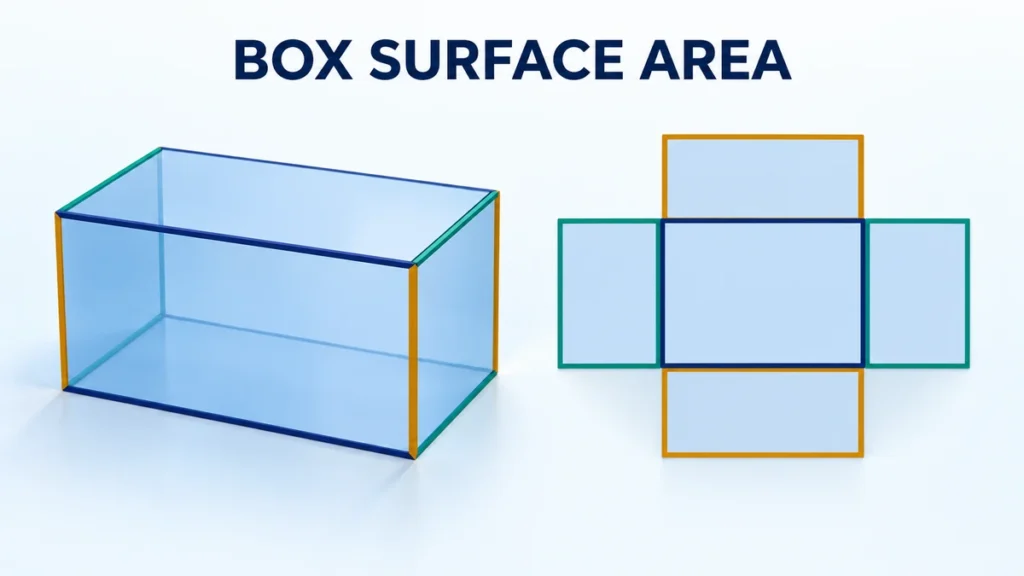
A rectangular prism’s surface area is 2(lw + lh + wh) because its six rectangular faces come in three matching opposite pairs. Two faces each have area lw, two have area lh, and two have area wh. Adding all six faces gives 2lw + 2lh + 2wh, which factors to 2(lw + lh + wh).
Why Is A Rectangular Prism’s Surface Area 2(lw + lh + wh)?
A rectangular prism has 6 rectangular faces, and opposite faces are equal, according to OpenStax Contemporary Mathematics. The 6 faces make 3 equal pairs, so their areas are 2lw, 2lh, and 2wh. Their sum is exactly 2(lw + lh + wh).
Surface area measures every outer face needed to cover the closed solid. Imagine wrapping the prism with paper, painting every side, or cutting cardboard for a sealed box. Each task needs the combined area of the top, bottom, front, back, left side, and right side.
The outer factor 2 is not an extra rule to memorize. It records the second face in each opposite pair. The expression inside the parentheses lists one area from each kind of face: lw, lh, and wh.
A rectangular prism calculator evaluates the formula quickly. The face-pair explanation shows why its result covers the whole outside without missing or counting any face twice.
How Do The Six Faces Form Three Pairs?
The 3 opposite pairs are top and bottom, front and back, and left and right. Connected Mathematics at Michigan State University teaches surface area by unfolding and covering solids. Each opposite pair has the same two side lengths, so each pair has twice one rectangle’s area.
- Top and bottom: Each uses length l and width w, so the pair contributes 2lw.
- Front and back: Each uses length l and height h, so the pair contributes 2lh.
- Left and right: Each uses width w and height h, so the pair contributes 2wh.
Add the pairs: SA = 2lw + 2lh + 2wh. Because every term contains 2, factor it out: SA = 2(lw + lh + wh). Both forms are equal. The expanded form helps you audit the six faces, while the factored form is shorter to calculate.
How Does A Net Derive The Formula?
A rectangular prism net contains the same 6 faces laid flat without overlap. OpenStax defines a net as a two-dimensional pattern that folds into a three-dimensional figure. Since unfolding changes positions but not dimensions, adding the 6 rectangles in the net must equal the closed prism’s surface area.
One common net places four side faces in a strip and attaches the top and bottom. Its exact arrangement may change, but the face list never does. Every valid closed-prism net contains two lw rectangles, two lh rectangles, and two wh rectangles.
Write the area inside each rectangle before adding. The six labels read lw, lw, lh, lh, wh, and wh. Grouping equal labels gives 2lw + 2lh + 2wh. Factoring the 2 gives the familiar formula.
A net also prevents a common error: using only lw + lh + wh. That expression counts just one face from each pair, so it gives exactly half the area of a closed rectangular prism.
What Do l, w, And h Mean?
The formula uses 3 perpendicular edge lengths: length l, width w, and height h. OpenStax notes that the dimensions of a rectangular prism meet at right angles. Their names may swap when the solid is rotated, but the products lw, lh, and wh still describe the same three face pairs.
Each product multiplies two lengths because a rectangle’s area equals one side times the adjacent side. No face uses all three dimensions. Multiplying lwh would measure volume in cubic units, not surface area in square units.
Use one measurement unit before calculating. If l and w are in centimeters but h is in meters, convert h first. A consistent input in centimeters produces an answer in square centimeters.
Rotation does not affect the answer. If l and w trade names, lw remains the same and the other two terms simply switch order. Addition and multiplication are commutative, so the total is unchanged.
How Does The Formula Work For An 8 By 5 By 3 Prism?
For l = 8, w = 5, and h = 3, the three distinct face areas are 40, 24, and 15 square units. Substitution gives 2(40 + 24 + 15) = 2(79) = 158 square units. This follows the same add-the-faces method shown in OpenStax examples.
- Find the length-width area: lw = 8 × 5 = 40.
- Find the length-height area: lh = 8 × 3 = 24.
- Find the width-height area: wh = 5 × 3 = 15.
- Add one of each kind: 40 + 24 + 15 = 79.
- Count both faces in every pair: 2 × 79 = 158.
The expanded form confirms the same result: 2(8 × 5) + 2(8 × 3) + 2(5 × 3) = 80 + 48 + 30 = 158. Agreement between both forms is a useful arithmetic check.
For comparison, the volume is lwh = 8 × 5 × 3 = 120 cubic units. The numerical values differ because surface area covers six faces, while volume measures the space inside. Use the volume calculator when the question asks about capacity instead of covering.
What Checks Confirm The Formula?
The formula passes 3 strong checks: a cube becomes 6a², doubling all dimensions multiplies area by 4, and units become squared. These checks follow from the standard prism formula in OpenStax Prealgebra 2e and expose many setup errors.
Cube Check
If l = w = h = a, then SA = 2(a² + a² + a²) = 6a². A cube has six congruent square faces, each with area a², so this reduction is exactly what geometry requires.
Scaling Check
Double every dimension: 2l, 2w, and 2h. Then SA = 2[(2l)(2w) + (2l)(2h) + (2w)(2h)] = 4 · 2(lw + lh + wh). Therefore, doubling all edge lengths multiplies surface area by 4, not 2 or 8.
Unit Check
Every term multiplies one length unit by another, so each term has square units. Terms such as l + w + h cannot represent area because they still have linear units. The formula is dimensionally consistent.
Degenerate Boundary Check
If one dimension approaches zero, the solid flattens and stops being an ordinary three-dimensional prism. For h = 0, the algebra gives 2lw because the top and bottom coincide in the limit. Treat this as a limiting flat shape, not as a usable closed box with six separate faces.
How Does The Formula Change For An Open-Top Box?
A closed rectangular prism has 6 faces, but an open-top box has only 5. If its missing top would have area lw, subtract one lw from the closed formula. The result is lw + 2lh + 2wh, assuming the bottom is lw and the vertical height is h.
For the 8 by 5 by 3 example, the closed area is 158 square units. Removing the 8 × 5 top subtracts 40, leaving 118 square units. If the box has no bottom instead, the same subtraction applies because top and bottom have equal areas.
Do not automatically use the closed-prism formula for packaging, rooms, tanks, or trays. Identify which surfaces actually exist. A room-painting question may exclude the floor, ceiling, doors, or windows. The geometry stays simple once the included faces are listed.
The general surface area calculator helps compare closed solids, while a custom open shape should be handled by adding only its present faces.
What Common Mistakes Should You Avoid?
The most common setup error counts only 3 faces instead of 6. The Michigan State net approach makes the missing opposite faces visible. Writing all six face areas before simplifying is the safest method when the diagram is rotated, partially open, or labeled in an unfamiliar way.
- Forgetting the factor 2: lw + lh + wh counts only half of a closed prism’s surface.
- Using volume: lwh gives cubic units and does not measure outside covering.
- Mixing units: Convert every edge to one unit before multiplying.
- Counting a missing face: An open box needs a face-by-face formula.
- Rounding too early: Keep exact measurements until the final step.
- Ignoring square units: Report cm², m², ft², or another squared unit.
A quick sketch can settle uncertain labels. Mark one corner with l, w, and h along its three perpendicular edges. Then trace the opposite face for each pair. This prevents a diagonal or repeated edge from entering the formula.
The related rectangle calculator can verify each individual face area before you combine the six rectangles.
FAQs About Rectangular Prism Surface Area
These answers separate the 6-face closed formula from common variations. OpenStax distinguishes surface area, which adds exterior faces, from volume, which multiplies three dimensions. Check what the problem asks you to cover before choosing a formula.
Why Is There A 2 Outside The Parentheses?
There are two faces of each type. The top matches the bottom, the front matches the back, and the left matches the right. The 2 counts the second rectangle in all three pairs.
Can Length, Width, And Height Be Switched?
Yes. Rotating the prism may change which edge you call length, width, or height, but it does not change the total. The three pairwise products are the same, only rearranged.
Is Surface Area The Same As Lateral Area?
No. Total surface area includes all six faces. If lh and wh are the vertical side faces, lateral area is 2lh + 2wh = 2h(l + w). It excludes the top and bottom pair 2lw.
Why Does Doubling Every Edge Quadruple Surface Area?
Each rectangular face uses two edge lengths. Doubling both lengths multiplies that face by 2 × 2 = 4. Since every face becomes four times larger, the total also becomes four times larger.
Does The Formula Work For A Slanted Prism?
Not in this form. The formula assumes a right rectangular prism with rectangular side faces and perpendicular dimensions. An oblique prism may have parallelogram side faces that require their own base and perpendicular height measurements.
Sources
The formula and teaching model use 3 educational sources: two OpenStax textbooks and Michigan State University’s Connected Mathematics materials. Together they support the right-prism formula, nets, face areas, dimensional units, and the difference between wrapping a surface and filling a volume.