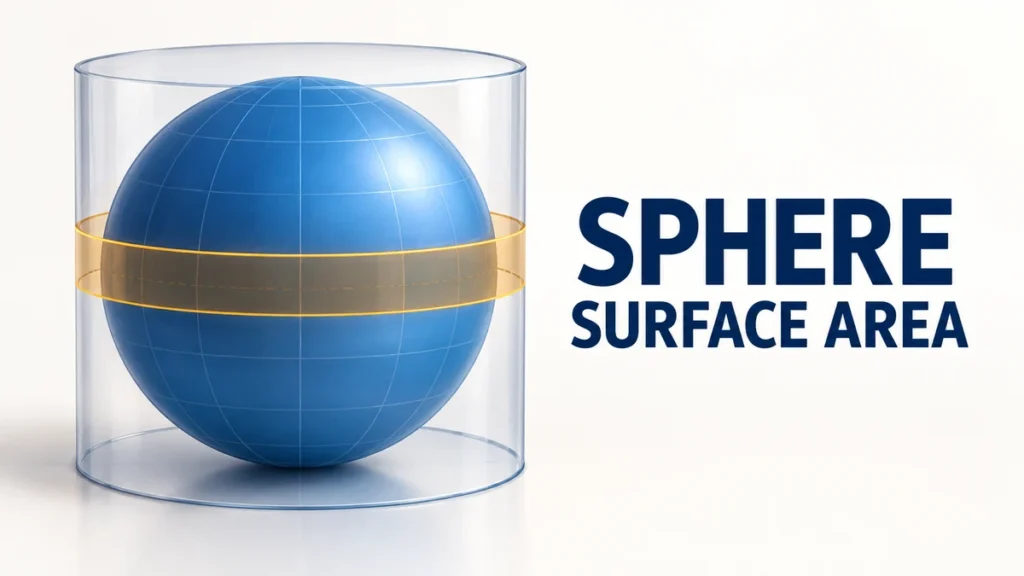
A sphere’s surface area is 4πr² because every thin horizontal band on the sphere has the same area as a band of equal height on the curved side of its snug cylinder. The cylinder has radius r and height 2r, so its lateral area is 2πr(2r) = 4πr².
Why Is A Sphere’s Surface Area 4πr²?
The factor 4 has a geometric meaning. A great circle through the sphere’s center has area πr², and the entire curved surface has exactly four times that area. The formula therefore gives a surface measurement in square units, not the space enclosed by the sphere.
One reliable explanation compares the sphere with a cylinder that fits tightly around it. Both shapes have radius r, while the cylinder’s height equals the sphere’s diameter, 2r. Archimedes’ sphere-to-cylinder relationship says that the sphere’s surface matches the cylinder’s curved side, excluding the two flat circular ends.
The curved side of a cylinder unwraps into a rectangle. Its width is the base circumference, 2πr, and its height is 2r. Multiplying gives (2πr)(2r) = 4πr². A sphere calculator applies this result, while this lesson explains why the comparison is exact.
The equality is not based on the shapes looking similar. A sphere curves in two directions, while a cylinder curves in only one. The proof works because matching thin horizontal bands have equal areas, even though those bands have different shapes.
How Does A Cylinder Explain The Formula?
Place a sphere of radius r inside a cylinder of radius r and height 2r. The sphere touches the cylinder along its equator and at the centers of the top and bottom. The cylinder is called circumscribed because it surrounds the sphere as tightly as possible.
Now divide both curved surfaces into horizontal bands with the same small vertical height. A band near the sphere’s equator has a large circumference and only a gentle slope. A band near a pole has a small circumference but a much steeper slope.
Those two changes balance. Near a pole, the sphere band must travel farther along the sloping surface than its vertical height suggests. Its extra slant exactly makes up for its smaller circumference. The result is the same area as the cylinder band beside it.
Adding all matching bands covers the sphere and the cylinder side. Therefore, their total areas are equal. This result is sometimes called the sphere’s cylindrical projection or Archimedes’ hat-box relationship. The University of California, Irvine’s sphere notes develop the sphere’s surface through a surface-of-revolution calculation.
Do not include the cylinder’s bases. Each base has area πr², so adding both would produce 6πr². The sphere matches only the lateral area, which is circumference times height.
Why Does Each Sphere Band Match A Cylinder Band?
Look at a narrow band on the sphere. Let ρ be the distance from the vertical axis to the band, let ds be its small slanted width along the sphere, and let dz be its vertical height. The band’s area is approximately its circumference, 2πρ, times ds.
A meridian slice through the sphere produces a circle. In that circle, the radius to the band and a tiny tangent segment form related right triangles. Their geometry gives the key proportion ρ ds = r dz. This relationship captures the exact balance between shrinking circumference and increasing slant.
Substitute that proportion into the band area: 2πρ ds = 2πr dz. A cylinder band with radius r and vertical height dz also has area 2πr dz. Thus, corresponding bands have equal areas from the lower pole to the upper pole.
The narrow-band language becomes exact in the limit as each band’s height approaches zero. This is the same limiting idea used in calculus. The proof does not flatten a wide curved strip and pretend it is a rectangle; it compares increasingly thin strips whose approximation error disappears.
The result has a useful consequence beyond the total area. Any spherical zone cut between two parallel horizontal planes has area 2πrh, where h is the zone’s vertical height. Its location does not matter. A zone near a pole and one near the equator have equal areas when their vertical heights match.
This zone rule also explains why the complete sphere gives 4πr². The full vertical height is h = 2r, so 2πr(2r) = 4πr². The band argument proves the formula by adding local pieces rather than assuming the total in advance.
How Does A Surface Integral Confirm The Formula?
Calculus reaches the same area by describing the sphere as a surface of revolution. For the upper hemisphere, write z = √(r² − ρ²), where ρ runs from 0 at the top axis to r at the equator. Rotating this curve around the vertical axis creates the curved hemisphere.
A thin ring has circumference 2πρ. Because the surface slopes, its true width is not dρ alone. The surface-of-revolution factor is √(1 + (dz/dρ)²)dρ. Since dz/dρ = −ρ/√(r² − ρ²), the factor simplifies to r/√(r² − ρ²).
The upper hemisphere’s area is therefore the integral of 2πρr/√(r² − ρ²) from ρ = 0 to ρ = r. An antiderivative is −2πr√(r² − ρ²). Evaluating the endpoints gives 2πr² for one hemisphere.
Doubling produces 4πr² for the full sphere. This agrees with the general definition of a surface integral presented in OpenStax Calculus Volume 3. The integral and cylinder-band arguments are two descriptions of the same local geometry.
Does Differentiating Volume Prove Surface Area?
Differentiating V = (4/3)πr³ gives dV/dr = 4πr². This is a valid calculus relationship: increasing the radius by a tiny amount adds a thin shell whose volume is approximately surface area times thickness. However, it is not a stand-alone geometric proof if the volume formula was established using the surface-area formula.
The derivative is best used as a consistency check. It confirms that sphere volume changes at the rate predicted by the surface formula, but the cylinder-band or surface-integral argument explains the area without circular reasoning.
Why Does Surface Area Scale With r²?
Surface area measures two-dimensional coverage, so scaling every length by a factor k multiplies area by k². If the radius doubles, the new area is 4π(2r)² = 16πr², which is four times the original 4πr².
Tripling the radius multiplies area by 3² = 9. Halving the radius multiplies it by (1/2)² = 1/4. These ratios follow before π is approximated, so they remain exact.
The exponent also checks units. A radius measured in centimeters produces square centimeters. A formula involving r³ would describe a volume-type measurement instead. The related cylinder calculator separates lateral area, total area, and volume for this reason.
A great circle provides another scale check. Its flat area is πr², while the sphere’s curved area is 4πr². The surface is therefore four times the area of its largest circular cross-section. It is not four times the circle’s circumference, which uses linear units.
How Do Worked Examples Check The Formula?
Example With Radius 5
For r = 5 units, substitute directly: S = 4π(5²) = 4π(25) = 100π square units. Using π ≈ 3.14159265359 gives approximately 314.159 square units. Keep 100π when an exact answer is requested.
The circumscribed cylinder gives the same result. Its circumference is 2π(5) = 10π, and its height is 10. Multiplying 10π by 10 gives 100π.
Example With A Doubled Radius
A sphere with radius 5 has area 100π. A sphere with radius 10 has area 4π(10²) = 400π. Dividing 400π by 100π gives 4, confirming that doubling radius quadruples surface area.
Example From Diameter
Suppose a sphere has diameter 18 centimeters. First find the radius: r = 18/2 = 9 centimeters. Then S = 4π(9²) = 324π cm², or about 1,017.876 cm². Using 18 as the radius would make the answer four times too large.
A hemisphere needs special care. Its curved area is half the sphere’s area, or 2πr². If the flat circular base is included, the total becomes 3πr². The hemisphere calculator distinguishes those two requests.
What Boundaries And Mistakes Matter?
The sphere formula assumes a nonnegative geometric radius and a complete spherical surface in ordinary Euclidean space. A radius of zero gives 4π(0)² = 0, which matches a sphere collapsed to a point. A negative radius is not a physical length and should not be entered.
- Surface Versus Volume: Surface area is 4πr² in square units. Volume is (4/3)πr³ in cubic units.
- Radius Versus Diameter: Divide a given diameter by 2 before using the formula.
- Curved Cylinder Only: The matching cylinder area excludes both circular bases.
- Complete Sphere: A hemisphere, spherical cap, and spherical zone use related but different formulas.
- Rounding: Keep π throughout the work and round only the final result.
- Units: Convert the radius to one unit before squaring it.
The formula also assumes an ideal sphere. Real objects may only approximate that shape, so measurements can introduce error. For other solid shapes and related formulas, use the geometry and trigonometry hub rather than forcing the sphere formula onto a different surface.
What Should You Remember?
A sphere has surface area 4πr² because its thin horizontal bands match equal-height bands on the curved side of a cylinder with radius r. The matching cylinder has height 2r, so its lateral area is 2πr × 2r = 4πr².
The formula passes three strong checks. It equals four great-circle areas, it scales with the square of the radius, and it matches a surface-integral calculation. These checks explain both the coefficient 4 and the exponent 2, making the formula easier to understand and apply correctly.