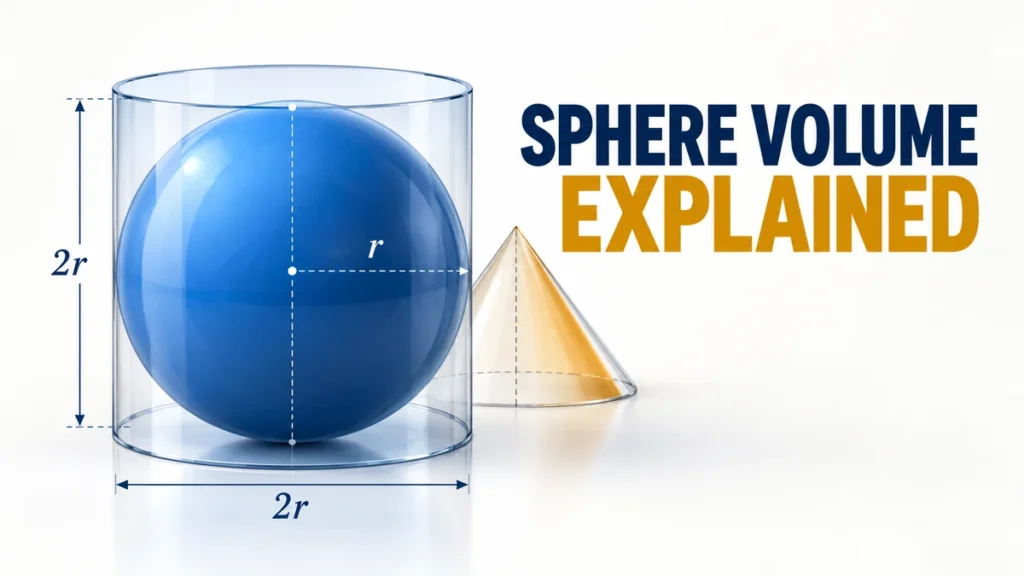
A sphere’s volume is V = (4/3)πr³ because its circular cross-sections match the cross-sections left when a cone is removed from a cylinder. That comparison gives a hemisphere a volume of (2/3)πr³. Doubling the hemisphere gives the whole sphere and produces the factor 4/3.
Why Is A Sphere’s Volume (4/3)πr³?
The formula has three meaningful parts. The factor π comes from circular cross-sections, r³ appears because volume changes in three dimensions, and 4/3 records the sphere’s exact relationship to a cylinder and cone. None of these parts is an optional adjustment or a rounding choice.
Imagine a sphere of radius r fitted tightly inside a cylinder. The cylinder has radius r and height 2r, so its volume is πr²(2r), or 2πr³. The sphere occupies exactly two-thirds of that cylinder, giving (2/3)(2πr³) = (4/3)πr³.
That two-thirds statement still needs a reason. It follows from comparing cross-sections at every height, not from judging the shapes by sight. A sphere calculator applies the finished formula, while this article explains why the formula works.
How Do Circular Slices Build A Sphere?
Cut a sphere with flat planes perpendicular to a vertical axis. Every interior cut is a circle. The middle cut is the largest, and the circles shrink toward the top and bottom until each becomes a single point.
Place the sphere’s center at height x = 0. At a height x, the slice radius, call it y, forms a right triangle with legs x and y and hypotenuse r. The Pythagorean theorem gives x² + y² = r², so y² = r² − x².
The area of that circular slice is therefore A(x) = πy² = π(r² − x²). This one expression tracks every slice from the bottom of the sphere to the top.
A sphere’s volume can be understood as the total of these extremely thin circular layers. In calculus, that total is written as the integral of π(r² − x²) from −r to r, following the volume-by-slicing method explained by Emory University. The next geometric comparison reaches the same result without requiring the full integration process.
For readers using calculus, an antiderivative is π(r²x − x³/3). Evaluating it at r gives (2/3)πr³, while evaluating it at −r gives −(2/3)πr³. Subtracting the lower value from the upper value produces (4/3)πr³.
The signs in that subtraction matter. The lower half does not have negative physical volume; its coordinate x is negative, and the definite integral correctly adds its positive slice areas to those of the upper half.
How Does The Cylinder-Minus-Cone Proof Work?
Cavalieri’s principle says that two solids have equal volumes when they have the same height and equal cross-sectional areas at every matching height. We can compare one hemisphere with the space that remains after removing a cone from a cylinder.
Use a cylinder with radius r and height r. Inside it, place a cone whose tip is at the cylinder’s base center and whose top circular edge matches the cylinder’s top edge. At height x above the base, the cone’s radius is x because its radius grows in the same proportion as its height.
The cylinder’s slice area is πr². The cone’s slice area is πx². The area left outside the cone but inside the cylinder is therefore πr² − πx² = π(r² − x²).
Now compare a hemisphere of radius r, measured upward from its flat center face. Its slice at height x also has area π(r² − x²). Since the two solids have equal heights and equal areas at every height, Cavalieri’s principle says their volumes are equal.
This argument uses the solid left outside the cone, not the cone alone. It also compares a hemisphere with a cylinder of height r. Keeping those details straight prevents the most common mistake in this proof.
Where Does The 4/3 Come From?
The 4/3 appears when we subtract the cone from the cylinder and then double the result. The cylinder in the comparison has radius r and height r, so its volume is πr³. The cone has the same base and height, so its volume is (1/3)πr³.
- Cylinder: πr² × r = πr³
- Cone: (1/3)πr² × r = (1/3)πr³
- Hemisphere: πr³ − (1/3)πr³ = (2/3)πr³
- Sphere: 2 × (2/3)πr³ = (4/3)πr³
The coefficient is therefore a geometric ratio. It does not come from estimating π, and it should not be converted to 1.33 before the final calculation. Keeping 4/3 exact preserves accuracy.
The full enclosing cylinder has height 2r and volume 2πr³. Dividing the sphere’s volume by that cylinder’s volume gives [(4/3)πr³] ÷ [2πr³] = 2/3. This is the same relationship viewed from the complete sphere instead of one hemisphere.
Two similar-looking cylinders appear in the reasoning. The Cavalieri comparison uses a cylinder of height r for one hemisphere, while the tight enclosing cylinder has height 2r for the full sphere. In either matching comparison, the curved solid takes two-thirds of its cylinder’s volume.
This cylinder relationship has a long history. MathWorld’s sphere reference notes that Archimedes derived the sphere formula and recognized its connection to the circumscribed cylinder. The historical fact is not part of the proof, but it shows why the cylinder is a natural comparison rather than a convenient modern trick.
Why Does The Radius Have An Exponent Of 3?
Volume measures three-dimensional space, so changing every length by a scale factor k changes volume by k³. A sphere enlarged to twice its radius is twice as wide, twice as tall, and twice as deep. Its new volume is 2 × 2 × 2 = 8 times the original volume.
The formula shows this directly: (4/3)π(2r)³ = (4/3)π(8r³) = 8V. Tripling the radius multiplies the volume by 3³, or 27. Halving the radius multiplies it by (1/2)³, or 1/8.
This scaling rule is also a quick error check. A formula with r² describes an area-type quantity, not a volume. The cylinder calculator likewise multiplies a circular area, πr², by a height, producing three length factors in total.
How Do You Check The Formula With Examples?
Example With Radius 3
For r = 3 units, r³ = 27. Substitute that value: V = (4/3)π(27) = 36π cubic units, or about 113.10 cubic units. The circumscribed cylinder has radius 3 and height 6, so its volume is π(3²)(6) = 54π.
Two-thirds of 54π is 36π, which confirms the cylinder ratio. The check works with exact values before any decimal rounding occurs.
Example With Radius 5
For r = 5 centimeters, V = (4/3)π(125) = 500π/3 cubic centimeters. Using π ≈ 3.14159 gives about 523.60 cm³. The unit is cubic centimeters because the radius was measured in centimeters.
Example With A Doubled Radius
A sphere with radius 2 has volume (32/3)π. A sphere with radius 4 has volume (256/3)π. Dividing the second value by the first gives 8, exactly as cubic scaling predicts.
What Are The Formula’s Important Boundaries?
The formula describes the volume enclosed by a sphere, often called a solid ball. It does not describe only the curved surface. Sphere surface area is 4πr², measured in square units, while sphere volume is (4/3)πr³, measured in cubic units.
- Zero radius: r = 0 gives V = 0. The sphere has collapsed to a point and encloses no space.
- Negative radius: A geometric radius is a nonnegative length. Do not insert a negative measurement and accept a negative volume.
- Diameter: If a problem gives diameter d, use r = d/2 before applying the formula.
- Units: Feet produce cubic feet, meters produce cubic meters, and centimeters produce cubic centimeters. Convert lengths before cubing when the given units differ.
- Rounding: Keep π and 4/3 exact during the calculation, then round the final decimal to the requested place.
The sphere formula applies to a complete sphere. A hemisphere uses half the volume, (2/3)πr³, while a cap or zone needs a different formula. The geometry and trigonometry hub separates these solid-shape tools by the measurements and portion of the shape you know.
What Should You Remember?
The formula V = (4/3)πr³ is not a pattern to memorize without meaning. Circular slices explain π(r² − x²), Cavalieri’s principle matches those slices to a cylinder-minus-cone solid, and subtraction gives (2/3)πr³ for a hemisphere. Doubling produces (4/3)πr³.
The proof also gives three useful checks. A sphere is two-thirds of its tight enclosing cylinder, its volume scales with r³, and its answer uses cubic units. Together, these checks make the formula easier to understand and harder to misuse.