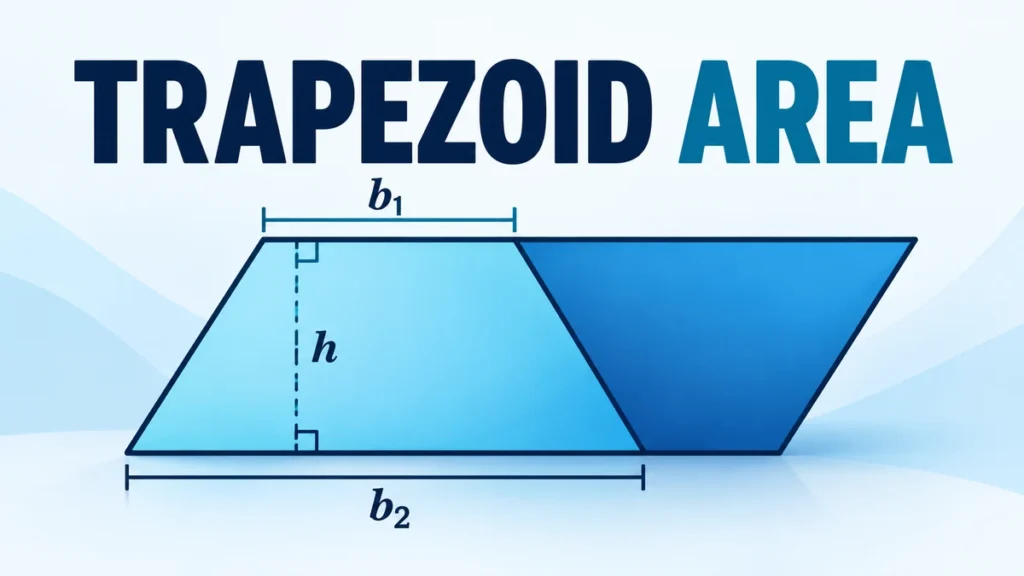
A trapezoid’s area equals its average base length times its perpendicular height: A = ((b₁ + b₂) ÷ 2)h. The average appears because a trapezoid changes evenly from one parallel base to the other. Two geometric proofs show exactly why the formula works instead of asking you to memorize it.
Why Does The Trapezoid Area Formula Use An Average?
A trapezoid has two parallel bases, and OpenStax gives its area as one-half the height times their sum. Rewriting ½h(b₁ + b₂) as ((b₁ + b₂) ÷ 2)h shows the idea directly: average the two base lengths, then multiply by the perpendicular height. (OpenStax Prealgebra 2e)
The formula is A = ½(b₁ + b₂)h. The symbols b₁ and b₂ represent the lengths of the parallel sides. The symbol h represents the shortest distance between their supporting lines, measured at a right angle. Either base may be called b₁; their order does not affect the sum.
Why is the average reasonable? Imagine measuring many horizontal slices across the trapezoid. Their lengths change steadily from b₁ at one edge to b₂ at the other. The middle slice has length (b₁ + b₂) ÷ 2, and the shorter slices balance the longer ones. A rectangle with that average width and the same height therefore has the same area.
This is not an estimate. Straight sides make the slice length change at a constant rate, so the arithmetic mean is exact. A curved shape may widen unevenly and need a different method. For a trapezoid, however, the straight-line change is precisely what turns “average width times height” into an exact formula.
How Does A Diagonal Prove The Formula?
One diagonal divides a trapezoid into two triangles. OpenStax notes that both triangles use the same perpendicular height h because their bases lie on the trapezoid’s parallel sides. Their areas are ½b₁h and ½b₂h, so adding them gives ½(b₁ + b₂)h. (OpenStax Prealgebra 2e)
Draw a diagonal from one corner on b₁ to the opposite corner on b₂. The diagonal covers no area by itself; it only separates the original region. The upper triangle has base b₁, while the lower triangle has base b₂. Together, the two nonoverlapping triangles fill the trapezoid exactly.
The triangles appear to point in different directions, but height means perpendicular distance from a base line to the opposite vertex. Since b₁ and b₂ are parallel, every point on one line is the same perpendicular distance h from the other line. That is why both triangle-area calculations use the same h.
Now add their areas: ½b₁h + ½b₂h. Factor out the common ½h to get ½h(b₁ + b₂). The distributive property then lets us write the same result as ((b₁ + b₂) ÷ 2)h. The average appears because we combined two half-base contributions.
How Do Two Copies Make A Parallelogram?
Two congruent trapezoids can be rotated and joined to make a parallelogram whose base is b₁ + b₂ and whose height is h. Because a parallelogram’s area is base times height, the pair has area (b₁ + b₂)h. One copy has half that area. (Math Open Reference)
Start with one trapezoid and make an exact copy. Rotate the copy 180 degrees, then place its slanted side against the matching slanted side of the first. The two pieces fit without a gap or overlap. Their upper and lower edges combine into a parallelogram’s opposite parallel sides.
Along the long edge, one copy contributes b₁ and the other contributes b₂. That makes the parallelogram base b₁ + b₂. Rotation does not change the perpendicular distance between the bases, so the height remains h. The combined area is therefore (b₁ + b₂)h.
The combined figure contains two equal original areas. Divide by 2: A = (b₁ + b₂)h ÷ 2. Moving the division inside the first factor gives A = ((b₁ + b₂) ÷ 2)h. In this proof, the average appears because one trapezoid is half of a figure whose base is the sum of both bases.
How Do You Use The Formula With 8, 14, And 5?
For bases 8 units and 14 units and height 5 units, the average base is 11 units. Multiplying 11 by 5 gives an area of 55 square units. This result matches the OpenStax rule A = ½h(b + B). (OpenStax Prealgebra 2e)
- Identify the parallel sides: b₁ = 8 and b₂ = 14.
- Use the perpendicular height: h = 5.
- Average the bases: (8 + 14) ÷ 2 = 22 ÷ 2 = 11.
- Multiply by height: A = 11 × 5 = 55.
- Write square units: A = 55 units².
The equivalent substitution form reaches the same result: A = ½(8 + 14)(5) = ½(22)(5) = 55. Keeping the parentheses around the base sum prevents an order-of-operations error. The trapezoid calculator can check other measurements after you identify the two parallel sides and the perpendicular height.
You can also verify the result by the diagonal proof. The two triangle areas are ½(8)(5) = 20 and ½(14)(5) = 35. Their sum is 20 + 35 = 55 square units. This independent calculation is useful because it exposes a wrong base or height before you submit an answer.
How Can You Check A Trapezoid Area?
A correct area must lie between the areas of rectangles built with the shorter and longer bases. OpenStax uses this exact reasonableness idea: b₁h < A < b₂h when 0 < b₁ < b₂. For 8, 14, and 5, that means 40 < 55 < 70. (OpenStax Prealgebra 2e)
Rectangle Boundary Check
If b₁ = b₂, the trapezoid becomes a parallelogram or rectangle-like case. The formula becomes ½(b + b)h = ½(2b)h = bh. That is exactly the familiar base-times-height formula. A valid general formula should agree with this simpler boundary case.
Triangle Boundary Check
If one base shrinks toward 0, the shape approaches a triangle. The formula approaches ½(0 + b)h = ½bh, which is the triangle-area formula. This does not change the usual trapezoid definition; it checks what the algebra predicts at the geometric limit.
Scaling Check
If every length doubles, the new area is ½(2b₁ + 2b₂)(2h) = 4[½(b₁ + b₂)h]. Area must grow by the square of the length scale. Doubling all dimensions should therefore multiply area by 4, not by 2 or 8.
Unit Check
The average base has units of length, and height also has units of length. Their product has square units. If the bases and height are measured in centimeters, the result is square centimeters. Convert mixed units before substituting so every length uses the same unit.
Which Trapezoid Area Mistakes Are Common?
The most common errors involve the two parallel bases, perpendicular height, and factor of ½. OpenStax defines height as the distance between the bases, not the length of a slanted leg. A careful sketch and labeled right angle prevent most mistakes. (OpenStax Prealgebra 2e)
- Using the slanted side as height: Height must meet the base lines at 90 degrees.
- Averaging the wrong sides: Only the parallel sides are bases.
- Forgetting to divide by 2: The sum b₁ + b₂ is twice the average base.
- Dividing only one base by 2: Use (b₁ + b₂) ÷ 2, not b₁ + b₂ ÷ 2.
- Adding all four sides: That finds perimeter, not area.
- Writing linear units: Area must use square units.
Another mistake is assuming the trapezoid must be isosceles. The area formula works for right, isosceles, and scalene trapezoids. Sliding one base sideways changes the legs and angles, but it does not change either base length or the perpendicular distance between them. The area therefore stays the same.
Where Does The Formula Apply?
The formula applies to any planar trapezoid with two known parallel side lengths and their perpendicular separation. Math Open Reference describes it as average width times altitude. It can model cross-sections, sloped lots, channel profiles, and other straight-sided regions that widen evenly. (Math Open Reference)
For a composite figure, divide the region into trapezoids, rectangles, and triangles, then add nonoverlapping areas. If coordinates are given, first confirm which sides are parallel and calculate their lengths. Then find the perpendicular distance between their lines. The distance formula calculator can help with coordinate lengths, while the geometry and trigonometry calculators cover related shapes.
Do not apply this formula to a general quadrilateral whose opposite sides are not parallel. A random four-sided shape may need a diagonal, coordinates, or another area method. The defining structure here is the pair of parallel bases. That structure guarantees a single constant height and makes both proofs work.
Trapezoid Area FAQs
Is The Trapezoid Area Formula The Same As Average Width Times Height?
Yes. The arithmetic mean of the parallel bases is (b₁ + b₂) ÷ 2. Multiplying it by h gives ((b₁ + b₂) ÷ 2)h, which is algebraically identical to ½(b₁ + b₂)h.
Why Must The Height Be Perpendicular?
Area measures coverage across the shortest separation between parallel base lines. A slanted leg combines vertical and sideways movement, so multiplying by it would overstate the area. The perpendicular height isolates the true separation.
Does The Formula Work For A Right Trapezoid?
Yes. In a right trapezoid, one leg is perpendicular to both bases, so that leg is also the height. The same formula applies because the two bases remain parallel.
Does It Matter Which Base Is b₁?
No. Addition is commutative, so b₁ + b₂ equals b₂ + b₁. You may label either parallel side first, provided both are included exactly once.
Can A Trapezoid Have The Same Area With A Different Slant?
Yes. If both base lengths and the perpendicular height stay fixed, sliding one base sideways changes the angles but not the area. The formula contains no leg length because the slant does not control coverage.