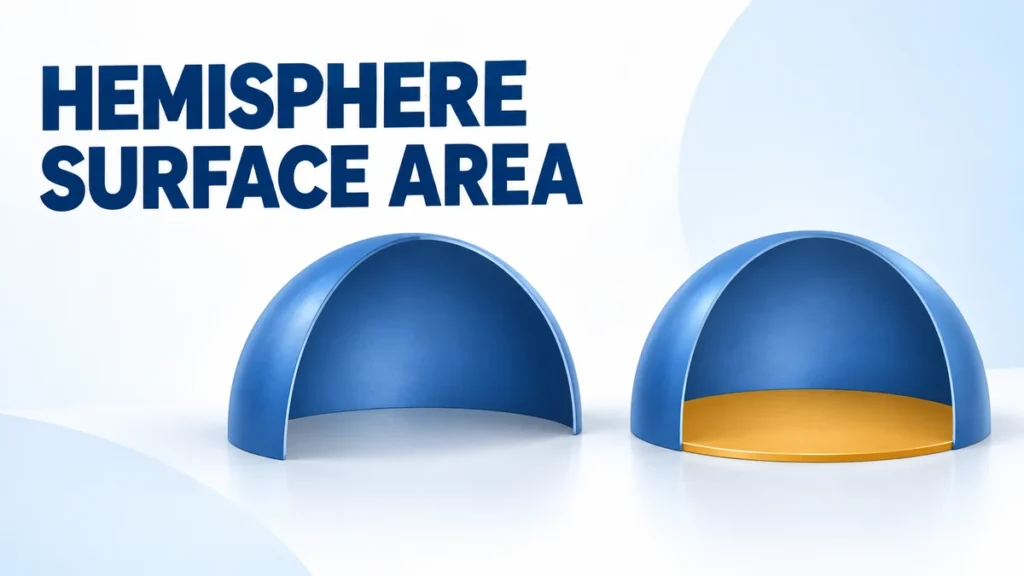
A hemisphere has curved surface area 2πr² because its dome is exactly half of a sphere’s 4πr² surface. Its total surface area is 3πr² because the total also includes the flat circular base, whose area is πr². The wording of the question decides which formula belongs.
Why Does A Hemisphere Have Two Surface Area Formulas?
A hemisphere has two formulas because it can mean either an open dome or a closed solid. The open dome contains only the curved half-sphere, so its area is 2πr². A closed hemisphere also has one flat circular face, which raises the total to 3πr².
Think about a bowl and a paperweight. The bowl’s outside dome is curved, but its open top is not a material surface. A solid half-ball has a circular cut face as well as a dome. The two objects share the same radius, yet the surfaces being counted differ.
Words such as curved area, lateral area, dome area, or open hemisphere normally point to 2πr². Words such as total area, closed hemisphere, or including the base point to 3πr². The hemisphere calculator keeps these results separate.
| Surface Being Counted | Pieces | Area |
|---|---|---|
| Curved surface only | Half of a sphere | 2πr² |
| Total closed surface | Curved dome plus circular base | 3πr² |
Why Is The Curved Surface Area 2πr²?
A hemisphere’s curved area is 2πr² because two congruent hemispheres join to make one complete sphere. A sphere has surface area 4πr², and the equatorial cut divides that surface into two equal curved parts. Therefore, each part has area (4πr²) ÷ 2 = 2πr².
The word congruent matters. The upper and lower hemispheres have the same shape and size, so neither receives more of the sphere’s surface. Their shared equator is only the boundary between them. A circle line has no surface area of its own, so it is not added to either dome.
This argument depends on the established sphere formula. A separate explanation of why a sphere’s surface area is 4πr² uses matching horizontal bands on a sphere and cylinder. Once 4πr² is known, symmetry gives the hemisphere result immediately.
Why Is The Total Surface Area 3πr²?
Total surface area counts every exposed two-dimensional face. A closed hemisphere has the curved dome, worth 2πr², and a flat circular base, worth πr². Adding the nonoverlapping pieces gives 2πr² + πr² = 3πr².
The flat base has radius r because it is the great circle created by cutting the sphere through its center. Its area follows the usual circle formula, A = πr². The base is not another hemisphere and should be counted once, not twice.
This addition is similar to finding the total area of a cone or cylinder. Curved area describes only the wrapping surface, while total area includes the flat ends that close the shape. You can compare that structure with the cylinder calculator, where two circular bases are added instead of one.
Whether the base is exposed depends on the object. A dome attached to the ground may require only curved roofing material. A solid hemisphere being painted on every side requires the base too. Geometry supplies both formulas; the real situation tells you which surfaces are included.
How Does Calculus Verify The Curved Area?
Optional calculus check: rotate the quarter-circle y = √(r² − x²), from x = 0 to x = r, around the x-axis. The standard surface-of-revolution formula adds thin circular bands: S = 2π∫y√(1 + (dy/dx)²) dx.
Differentiate y to get dy/dx = −x/√(r² − x²). Then √(1 + (dy/dx)²) simplifies to r/√(r² − x²). Multiplying by y cancels the square roots, leaving the constant r inside the integral.
The area becomes 2π∫ from 0 to r of r dx. That equals 2πr[x] from 0 to r, or 2πr². This calculation verifies the curved dome only. The circular base is not generated by rotating the arc, so it must be added separately for total area.
This setup follows the surface-of-revolution method described by OpenStax Calculus Volume 1. The calculus proof and the congruent-half proof reach the same result by different routes, which is a useful consistency check.
How Do The Formulas Work When r = 4?
For radius 4, square the radius first: r² = 4² = 16. The curved area is 2π(16) = 32π, or about 100.53 square units. The circular base is π(16) = 16π, or about 50.27 square units.
Add the dome and base for the total: 32π + 16π = 48π, or about 150.80 square units. Using the direct formula gives the same answer: 3π(4²) = 48π. Keeping π exact until the final step avoids extra rounding error.
- Identify whether the problem asks for curved or total area.
- Square the radius: 4² = 16.
- Multiply by 2π for the dome or 3π for the closed solid.
- State the result in square units.
What Checks Confirm The Formulas?
Several checks expose a wrong hemisphere formula. First, joining two curved hemispheres must recover a sphere: 2(2πr²) = 4πr². This matches the result from the sphere calculator.
Second, the difference between total and curved area must equal one circle: 3πr² − 2πr² = πr². If the difference is 2πr², two bases were added by mistake. A hemisphere has only one flat circular face.
Third, area must scale with the square of length. If the radius doubles, r² becomes (2r)² = 4r². Both the curved and total areas become four times larger. If an answer only doubles, the radius was probably not squared.
Finally, the formulas behave properly at the boundary r = 0. Both areas become zero because the shape collapses to a point. For every positive radius, total area is exactly one and a half times curved area because 3πr² ÷ 2πr² = 3/2.
What Assumptions And Mistakes Matter?
These formulas describe an ideal geometric hemisphere with a perfectly circular equator and zero material thickness. They measure surface, not volume. If a physical shell has inner and outer radii, its two curved faces have different areas and must be calculated separately.
Thickness also creates a narrow rim around an open shell. The simple 2πr² dome formula excludes that rim. Real manufacturing estimates may need the rim, seams, overlap, waste, or openings. Those practical additions are not part of the textbook hemisphere.
Common Formula Errors
- Adding a base when the dome is open: use 2πr² when only the curved surface is requested.
- Forgetting the base on a closed solid: use 3πr² when all exposed surfaces count.
- Using diameter as radius: divide the diameter by 2 before substituting.
- Using cubic units: surface area is measured in square units.
- Rounding π too early: keep π until the last numerical step.
Do not confuse hemisphere surface area with hemisphere volume. Surface area measures covering, while volume measures enclosed space. For broader comparisons among curved solids, visit the trigonometry and geometry tools hub.
Hemisphere Surface Area FAQs
Does A Hemisphere Always Include Its Circular Base?
No. A hemisphere as a mathematical solid has a flat base, but a question may ask only for its curved surface. Read the wording carefully. Curved area is 2πr², while total area including the base is 3πr².
Why Is The Base Area πr²?
The equatorial cut passes through the sphere’s center, producing a circle with the same radius r as the sphere. The standard circle area formula therefore gives πr². That single circle is added once for total surface area.
Can Diameter Be Used In The Hemisphere Formulas?
Yes, after writing r = d/2. Curved area becomes 2π(d/2)² = πd²/2. Total area becomes 3π(d/2)² = 3πd²/4. Converting to radius first usually prevents substitution mistakes.
Is A Hemisphere’s Curved Area Equal To A Circle’s Area?
No. The curved dome has area 2πr², which is twice the πr² area of its circular base. The total closed surface is three times the base area. These ratios stay the same for every positive radius.
Sources
- OpenStax Calculus Volume 1: Arc Length Of A Curve And Surface Area, for the surface-of-revolution formula used in the calculus verification.
- University Of California, Irvine: Surface Area Of A Sphere, for an academic derivation of the sphere’s 4πr² surface area.
- OpenStax Prealgebra 2e: Solve Geometry Applications, for the distinction between curved faces, bases, and total surface area in solid geometry.