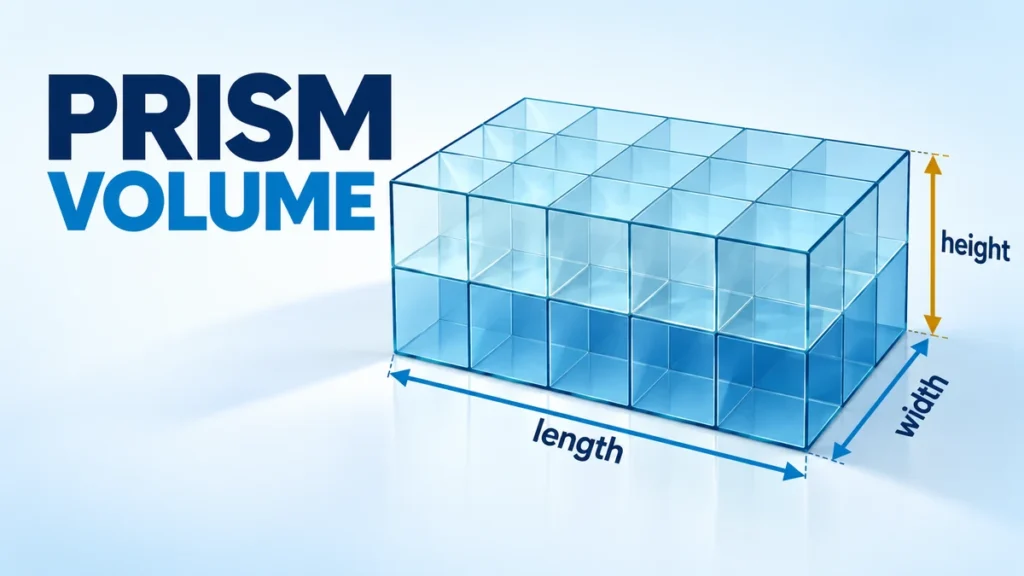
A rectangular prism’s volume is V = lwh because one horizontal layer contains l × w unit cubes, and a height of h fills the prism with h equal layers. In the general prism rule V = Bh, the rectangular base has area B = lw. Substitution gives V = (lw)h = lwh.
Why Is A Rectangular Prism’s Volume lwh?
A rectangular prism uses 3 perpendicular dimensions: length, width, and height. OpenStax Contemporary Mathematics explains that volume counts the unit cubes needed to fill a solid. Multiplying l × w counts one base layer, and multiplying by h counts every equal layer above it.
The formula is not a shortcut added after the geometry. It is a compact record of the filling process. First count how many one-unit squares fit across the rectangular floor. Then extend each square upward through the full height. Every unit of space is counted once.
This reasoning gives two equivalent forms:
V = l × w × h = lwh
V = B × h = Bh, where B is the area of the base.
The order of the three dimensions does not matter. Multiplication is commutative, so lwh, whl, and hlw have the same value. Rotating the prism may change which edge you call length or width, but it cannot change the space inside.
If you already know the dimensions, the rectangular prism calculator gives the numerical result. This article explains why that calculation measures the entire interior.
Building The Formula With Unit Cubes
A unit cube measures 1 unit by 1 unit by 1 unit and therefore occupies 1 cubic unit, according to Michigan State University’s Connected Mathematics. A rectangular floor l units long and w units wide holds lw cubes in one layer. Repeating that layer h times gives lwh cubes.
Suppose the floor is 4 units long and 3 units wide. One layer contains 4 × 3 = 12 unit cubes. If the prism is 2 units high, it holds 2 equal layers, so its volume is 12 × 2 = 24 cubic units.
The model works cleanly when all dimensions are whole numbers because you can see complete unit cubes. It also reveals why volume uses cubic units. The count describes three-dimensional cubes, not flat squares or one-dimensional segments.
Why Is Volume Also Written As Bh?
The general right-prism formula is V = Bh, where B is the base area and h is the perpendicular height. Lane Community College’s ORCCA text lists volume as base area times height. For a rectangular base, B = lw, so Bh becomes (lw)h = lwh.
Think of B as the amount of floor covered by one layer. The height tells how far that fixed cross-section extends. Every slice parallel to the base has the same area B, so filling the prism repeats the same cross-sectional amount from bottom to top.
This form matters because it connects rectangular prisms to all right prisms. A triangular prism uses the same V = Bh structure, but its B is a triangle’s area. A cylinder also uses V = Bh, with B = πr². Only the base-area formula changes.
Does The Formula Work With Decimal Dimensions?
Yes. A prism measuring 2.5 by 1.2 by 4 units has volume 2.5 × 1.2 × 4 = 12 cubic units. OpenStax defines volume through a chosen unit of measure, and subdivision lets fractional parts of a unit be counted consistently even when full unit cubes do not fit each edge.
For tenths, divide each unit edge into 10 equal parts. The smaller building blocks have side length 0.1 unit and volume 0.001 cubic unit. Counting those smaller cubes produces the same multiplication rule.
The deeper reason is continuity. Rectangular prisms with rational dimensions can be measured using a fine common subdivision. Decimal measurements can be approximated as closely as needed, and their volumes approach lwh without a jump or gap.
Keep every dimension in the same unit before multiplying. If the length is in meters and the width is in centimeters, convert one of them first. Otherwise, the product combines unlike units and does not represent a valid cubic measurement.
Worked Example: An 8 By 5 By 3 Prism
An 8 by 5 base contains 40 square units, and a height of 3 creates 3 equal unit-high layers. The ORCCA prism formula V = Bh therefore gives 40 × 3 = 120 cubic units. Direct multiplication confirms the same answer: 8 × 5 × 3 = 120.
- Identify the dimensions: l = 8, w = 5, and h = 3.
- Find the base area: B = lw = 8 × 5 = 40 square units.
- Multiply by the height: V = Bh = 40 × 3.
- Report the result: V = 120 cubic units.
You can also choose the 5 by 3 face as the base. That base has area 15, and its perpendicular extension is 8. The product 15 × 8 is still 120. Any face can serve as the base when the matching perpendicular dimension is used as the height.
A reasonable estimate supports the result. The prism holds three layers of 40 cubes, so the answer must be greater than 40 and equal to three times 40. An answer such as 48 or 400 would not fit the layer model.
How Can You Check A Rectangular Prism Volume?
The formula passes 4 useful checks: a cube becomes s³, changing dimension order changes nothing, a zero dimension gives zero, and scaling every edge by k scales volume by k³. The University of Florida geometry review uses cubic units and the standard prism-volume relationship that these checks confirm.
Check The Units
Multiplying three lengths produces cubic units: cm × cm × cm = cm³. Square units signal that you found an area, not a volume. Plain units signal that you measured only a length.
Check The Cube Case
If l = w = h = s, then V = s × s × s = s³. This agrees with the definition of a cube. For s = 4, the volume is 4³ = 64 cubic units.
Check Scaling
If every edge is multiplied by k, the new volume is (kl)(kw)(kh) = k³lwh. Doubling all three dimensions multiplies volume by 2³ = 8. This differs from surface area, which grows by the square of the scale factor.
Check Boundary Values
If l, w, or h is zero, then lwh is zero. The shape has collapsed and encloses no three-dimensional space. Negative physical dimensions are not valid, although algebra can still produce a signed product.
Check Dimension Order
Rearranging 8 × 5 × 3 as 3 × 8 × 5 still gives 120. If changing the prism’s orientation changes your answer, you probably paired a base with the wrong height or omitted a dimension.
How Is Volume Different From Surface Area?
For an 8 by 5 by 3 prism, volume is 120 cubic units, while total surface area is 2(40 + 24 + 15) = 158 square units. Michigan State University distinguishes filling from wrapping: volume fills the interior with cubes, while surface area covers the outside with squares.
Use volume for capacity, storage space, soil in a planter, water in a tank, or air inside a room. Use surface area for paint, wrapping paper, cardboard, insulation, or material covering the faces.
The formulas reflect those different jobs. Volume multiplies all three dimensions: V = lwh. Surface area adds six face areas: SA = 2(lw + lh + wh). The rectangular prism surface-area explanation shows why its three pairwise products and outer factor 2 are required.
Do not compare the bare numbers without their units. A volume of 120 units³ and an area of 158 units² measure different kinds of quantities. One is not “larger” in a meaningful geometric sense.
Common Rectangular Prism Volume Mistakes
A rectangular prism requires all 3 perpendicular dimensions, not a diagonal or the sum of its edges. OpenStax’s unit-cube model makes the correct operation visible: count cubes across the base, then count layers. If your method does not describe filling three-dimensional space, it is probably measuring something else.
- Adding the dimensions: l + w + h is a length sum, not an interior volume.
- Using only lw: This finds one face’s area and ignores the height.
- Using the surface-area formula: 2(lw + lh + wh) measures the outside covering.
- Using a diagonal: A face or space diagonal is not one of the three perpendicular dimensions in lwh.
- Mixing units: Convert feet, inches, meters, or centimeters to one common unit first.
- Writing square units: Volume must be reported in cubic units.
- Rounding too early: Keep full decimal values until the final result.
Also check whether the shape is truly a rectangular prism. A slanted or irregular solid may need a different base-height interpretation. For a right prism, h is the perpendicular distance between the parallel bases, not a slanted edge.
FAQs About Rectangular Prism Volume
The key relationship is V = Bh, and a rectangular base makes B = lw. Lane Community College’s ORCCA text uses this general prism structure. The short answers below apply it to orientation, units, missing measurements, and scaling without changing the underlying idea.
Can Any Face Be The Base?
Yes. Any face of a rectangular prism can be chosen as the base. Use the area of that face for B and the perpendicular distance to the opposite congruent face for h. The final product remains lwh.
Why Are The Units Cubed?
Volume counts three-dimensional unit cubes. Multiplying length × width × height multiplies three linear units, such as cm × cm × cm, which produces cm³.
How Do You Find A Missing Dimension?
Divide the volume by the other two dimensions. From V = lwh, the height is h = V ÷ (lw). A prism with volume 120 and an 8 by 5 base has h = 120 ÷ 40 = 3.
Does lwh Work For A Cube?
Yes. A cube is a rectangular prism with l = w = h = s. Substituting gives V = s × s × s = s³.
What Happens If Every Dimension Doubles?
The volume becomes 8 times as large because each of the three factors doubles: (2l)(2w)(2h) = 8lwh. The scale factor for volume is cubed.
How Was This Explanation Reviewed?
This page checks the derivation against 4 educational references: OpenStax, Lane Community College, Michigan State University, and the University of Florida. The article separates volume from surface area, tests units and scaling, and includes a worked example so the formula can be verified from more than one direction.
This educational math content follows SolverCalc’s reviewer rule and is intended to explain the reasoning, not replace classroom instructions or a required course method.
Sources
The explanation uses 4 authoritative educational sources: OpenStax, Lane Community College, Michigan State University, and the University of Florida. Together, they cover unit cubes, base-area reasoning, volume formulas, filling models, and cubic units. These references support the mathematical claims and classroom language used above.