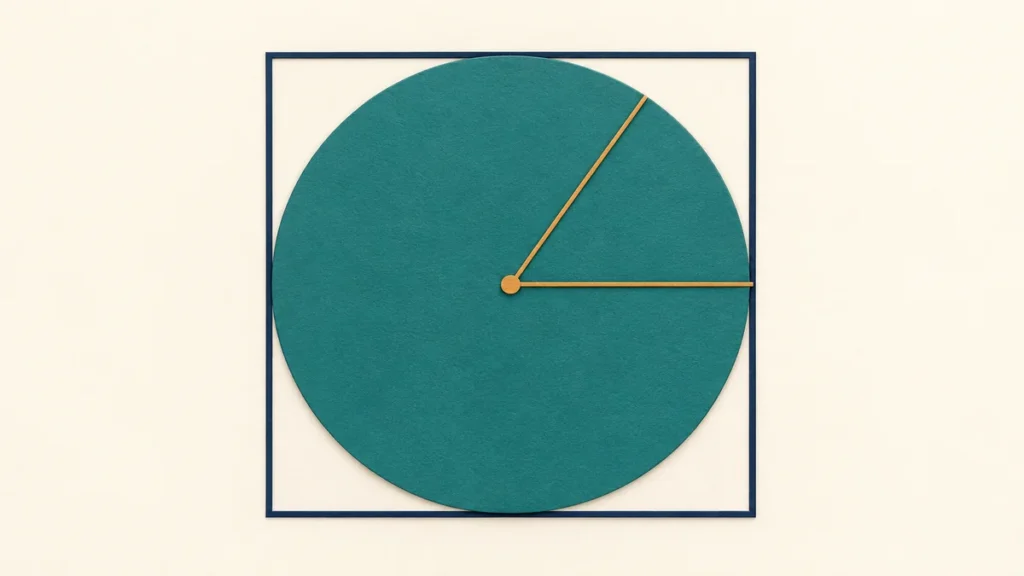
A circle’s area is πr² because its curved boundary contributes a circumference of 2πr, while its interior extends from that boundary to the center. Splitting a closely fitting polygon into triangles gives half its perimeter times its height. As those triangles fit the circle more closely, the result approaches πr².
The squared radius also reflects how area scales. Doubling a circle’s radius stretches the shape in two dimensions, so its area becomes four times larger. Its circumference only doubles because that measurement follows a one-dimensional boundary.
The geometry and trigonometry hub includes related tools. This lesson explains the formula’s structure, its geometric reasoning, and the input checks that prevent common calculation errors.
What Do Radius, Circumference, And Area Measure?
The radius is a center-to-edge length, circumference measures the boundary, and area measures the enclosed surface. OpenStax lists d = 2r, C = 2πr, and A = πr² for circles. These formulas describe different quantities, so their units and inputs should not be treated as interchangeable. (OpenStax, Prealgebra 2e, section 9.5)
For a radius measured in centimeters, circumference is also in centimeters. Area is in square centimeters because it measures how much two-dimensional surface fits inside the boundary. A result labeled only “centimeters” is not a correctly stated area.
The diameter passes through the center from one side of the circle to the other. It contains two radii. Always identify which length the problem provides before squaring a number; the label changes the area calculation substantially.
How Do Triangles Explain The Circle Area Formula?
A regular polygon inside a circle can be split into equal triangles by connecting its vertices to the center. Each triangle has one polygon side as its base and the same perpendicular height. Adding their areas gives polygon area = ½ × perimeter × apothem.
The apothem is the perpendicular distance from the center to a polygon side. It is shorter than the circle’s radius for any finite inscribed polygon. The polygon perimeter is also shorter than the circular boundary, because its straight sides cut across the curved arcs.
Now imagine adding more and more sides. The polygon’s boundary follows the circle more closely, and its apothem moves closer to the radius. Its area also approaches the circle’s area because the small missing regions shrink.
The limiting expression is ½ × 2πr × r = πr². “Limiting” means the value approached as the approximation improves without stopping at a fixed number of sides. It does not claim that a six-sided or twelve-sided polygon already equals the circle.
The triangle area explanation supplies the smaller formula behind this argument. The circle result comes from adding triangle pieces and following their changing dimensions, rather than guessing from a drawing.
Why Do Rearranged Circle Wedges Look Like A Rectangle?
Alternating thin circle wedges creates a shape that approaches a rectangle with height r and width πr. Half the total curved boundary contributes to each long edge. The rectangle-style area is therefore r × πr = πr², matching the polygon argument.
A drawing with a few wedges has wavy edges, slanted ends, and a height that only approximates the radius. Do not label that finite arrangement an exact rectangle. Thinner wedges make those differences smaller, which is why the picture becomes useful as an approximation improves.
Rearranging pieces preserves their total area if they neither overlap nor leave pieces out. It does not automatically turn a curved shape into a rectangle. The reasoning needs both facts: the pieces preserve area, and the rearranged dimensions approach the stated rectangle dimensions.
How Do You Calculate Area From A Radius Or Diameter?
Square the radius, then multiply by π. For a radius of 3 centimeters, A = π × 3² = 9π square centimeters. Keeping the exact form gives 9π; a decimal display rounded to four places is approximately 28.2743 square centimeters.
When the diameter is 10 centimeters, first find r = 10/2 = 5 centimeters. Then A = π × 5² = 25π square centimeters, or approximately 78.5398 square centimeters. Squaring the diameter directly would produce 100π, four times the correct answer.
The circle calculator can check these related measurements. Select the quantity actually supplied, rather than entering a diameter into a radius field. A correctly executed formula can still give a wrong answer when the input has the wrong meaning.
Read πr² as π × r × r. It is not (πr)², which equals π²r² and introduces an extra factor of π. Parentheses tell you which part is squared, so preserve them when rewriting an expression.
How Can A Surrounding Square Check The Answer?
A square fitted around a circle has side length 2r and area 4r². The circle fills πr²/(4r²) = π/4 of that square for positive r. This ratio is approximately 0.7854, so the circle occupies about 78.54% of the surrounding square’s area.
For r = 3, the square’s area is 36 square units, while the circle’s area is about 28.2743. An answer of 90 square units would not fit this boundary check. This is a useful error detector, not a substitute for the geometric proof.
Why Does Doubling The Radius Quadruple The Area?
Replacing r with 2r gives A = π(2r)² = 4πr². The squared length creates the factor of four. Circumference instead becomes 2π(2r), which is twice its original value. Area and boundary length respond differently to the same enlargement.
More generally, multiplying every length by a positive factor k multiplies area by k². A circle enlarged threefold has nine times the area. This rule also explains why square-unit conversions need a squared conversion factor.
You can reverse the formula to find a radius: r = √(A/π). If A = 36π square centimeters, then r = √36 = 6 centimeters. Choose the nonnegative root because a geometric radius is a length, not a signed coordinate.
How Does The Formula Work For A Circular Ring?
A ring between two concentric circles has area πR² − πr², where R is the outer radius and r is the inner radius. For R = 5 and r = 3, subtract the missing inner disk: 25π − 9π = 16π square units.
Do not square the difference in radii. The expression π(5 − 3)² gives 4π, which describes a different circle. Ring area is a difference of two disk areas, not the area of a disk whose radius equals the ring’s thickness.
Both radii must use the same length unit and describe circles with the same center. If the inner disk is offset, other geometry may be needed to identify the region. The subtraction applies directly when the entire inner disk lies inside the outer one.
How Should You Handle Units, Pi, And Rounding?
Keep π in the exact expression until the final decimal step unless the task supplies an approximation. Both 3.14 and 22/7 approximate π; neither equals it exactly. Different choices can give slightly different decimal answers without changing the underlying formula.
Use a consistent length unit before calculating. Converting 3 centimeters to 30 millimeters changes the area from 9π square centimeters to 900π square millimeters. The area numbers differ by 100 because the length conversion factor of 10 is squared.
The area converter can help with the final square-unit conversion. Do not apply a plain length conversion factor to an area or report more decimal precision than your measured radius supports.
Separate Measurement Error From Rounding Error
A more precise value of π cannot repair an uncertain radius measurement. If the radius might be between 2.9 and 3.1 centimeters, the corresponding area lies between 8.41π and 9.61π square centimeters. That uncertainty comes from the measured length, not from the final decimal display.
For an exact textbook radius of 3, the expression 9π is exact. For a measured radius rounded to 3, it describes an area estimate. State which situation applies rather than assuming that additional calculator digits make every answer more accurate.
FAQs About The Circle Area Formula
Does A Zero Radius Give Zero Area?
Yes. The formula gives π × 0² = 0. A radius of zero describes a degenerate point rather than an ordinary circle with positive size. The surrounding-square ratio requires positive r because it divides by r².
Can You Use A Negative Radius?
Not as a geometric length. A negative coordinate may describe a location, but a circle’s radius measures distance from its center. Use a nonnegative length and interpret the original measurement correctly.
Is Area The Space On The Boundary?
No. Area measures the enclosed surface. Circumference measures the boundary’s length. Their formulas share π and r because they describe the same circle, but they answer different questions and use different units.