Geometry · Why the area formula works
The factor one half comes from comparing a triangle with a matching shape made from two copies. The height must be perpendicular to the chosen base, not simply another side.
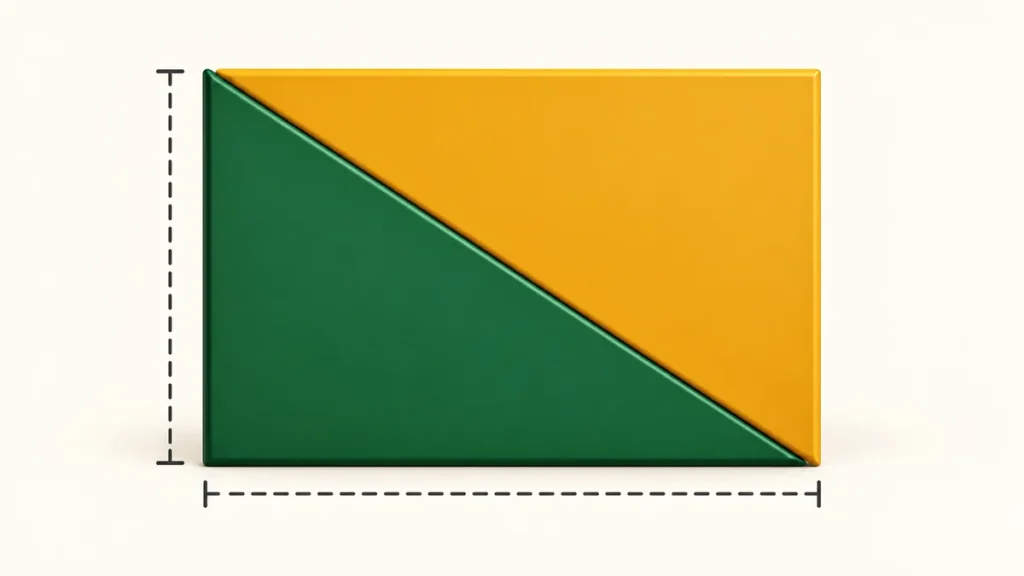
A triangle with base b and perpendicular height h has area bh/2. A rectangle split along a diagonal contains two congruent right triangles, each with half its area. Splitting an acute triangle, or subtracting a right triangle for an obtuse one, extends the same formula.
What Does A Triangle’s Area Measure?
Area measures the two-dimensional region inside the triangle. It is counted in square units, such as square centimeters. Perimeter instead measures the one-dimensional boundary and uses ordinary length units.
A base is any side you choose as the reference side. Its matching height is the perpendicular distance from the opposite vertex to the line containing that side. Every chosen base has a corresponding height.
The formula uses both of those measurements because together they describe the triangle’s spread across and away from its base. Knowing only the base does not determine area. Triangles sharing a base can have different heights.
Why Does A Right Triangle Have Half A Rectangle’s Area?
Place a right triangle inside a rectangle whose width and height match its perpendicular legs. The rectangle’s diagonal divides it into two congruent triangles. Congruent means the pieces have the same shape and size.
The rectangle has area bh. Its two matching triangles cover it without gaps or overlaps, so each triangle has half that area. Therefore the right-triangle area is bh/2.
For a rectangle measuring 8 by 5 units, the total area is 40 square units. Either diagonal half has area 20 square units. This is a relationship between regions, not a rule that halves the side lengths.
Why Does The Formula Also Work For An Acute Triangle?
Drop a perpendicular from the top vertex to the chosen base. In an acute triangle, that segment meets the base inside the triangle. It divides the shape into two right triangles with the same height h.
Let their base lengths be p and q. Their areas are ph/2 and qh/2 by the right-triangle result. Adding gives h(p + q)/2.
The lengths p and q together make the original base b. Thus the sum is bh/2. The perpendicular need not split the base into equal parts because the two base lengths still add to b.
OpenStax gives the triangle area formula using base and perpendicular height. The split above explains why the formula applies beyond a triangle with a visible right-angle corner.
Why Is A Sloping Side Usually Not The Height?
A sloping side generally does not meet the base at 90°. Its length includes horizontal movement as well as vertical separation. The formula needs only the perpendicular separation from the base line.
Suppose a triangle has base 10 centimeters, a sloping side of 7 centimeters, and perpendicular height 4 centimeters. The area is 10 × 4/2 = 20 square centimeters. Using 7 as the height would give 35, which measures the wrong quantity.
A side can serve as height in a right triangle when it is perpendicular to the chosen base. For an oblique triangle, look for an altitude line or a stated perpendicular measurement. Do not choose whichever side happens to be drawn upright.
How Can The Height Lie Outside An Obtuse Triangle?
The height is measured to the line containing the base, so that line may need to be extended. For an obtuse triangle, the perpendicular from the opposite vertex can meet the extension outside the triangle. The area formula still uses that distance.
Imagine a larger right triangle formed by the extended base and the altitude. The original triangle is the larger region minus the smaller right triangle beside it. Both right triangles have height h.
If the added base segment is t, their areas are (b + t)h/2 and th/2. Subtracting leaves bh/2. The extra segment cancels, which explains why an outside height does not require a different formula.
Can You Choose A Different Side As The Base?
Yes. Any side can be chosen as the base when you use its matching perpendicular height. The triangle’s area stays the same regardless of how the drawing is rotated or labeled.
For example, a triangle with area 12 square units might use base 6 and height 4. Choosing another side of length 5 would require its corresponding height to be 24/5, or 4.8. Both products give 24 before halving.
You cannot pair one side with a height measured to another side. Mark the right-angle relationship first. A correct multiplication using mismatched measurements still gives an incorrect geometric answer.
Can Different-Shaped Triangles Have The Same Area?
Yes. Triangles with the same base length and perpendicular height have equal areas, even when their side lengths and angles differ. Moving the opposite vertex along a line parallel to the base preserves that height.
A base of 8 and height of 5 always give area 20 square units. One such triangle may be acute, another right, and another obtuse. Shape and perimeter can change while that area remains fixed.
This does not mean every triangle with the same perimeter has the same area. Perimeter is a separate measurement. The fixed-area statement depends specifically on the base and its perpendicular height.
How Do Units And Scaling Affect The Calculation?
Convert base and height to matching length units before multiplying. A base of 50 centimeters and height of 0.4 meters can be written as 0.5 and 0.4 meters. The area is 0.1 square meters, equal to 1,000 square centimeters.
Doubling both base and height multiplies area by four. The factor one half stays unchanged: (2b)(2h)/2 = 4(bh/2). Doubling only the base, with height fixed, doubles the area.
Square-unit conversion also uses a squared scale factor. One square meter equals 10,000 square centimeters because each length dimension contributes a factor of 100. Do not convert areas using only the length multiplier.
How Can You Find A Missing Base Or Height?
Rearrange the area equation instead of guessing. From A = bh/2, multiply by 2 to get 2A = bh. For a nonzero base, h = 2A/b.
If the area is 24 square centimeters and the base is 8 centimeters, the height is 48/8 = 6 centimeters. To find a missing base, use b = 2A/h with a nonzero height. Each calculation must use the measurements paired in the original formula.
A zero base or height gives a collapsed figure rather than a genuine triangle. The area formula may return zero for that limit, but the usual geometric triangle requires positive dimensions. Never divide by a zero dimension when reversing the formula.
Practice Identifying The Perpendicular Height
Find the area for base 12 and height 7, then for base 3.5 and height 4. State square units with each answer. The areas are 42 and 7 square units.
Next, a triangle has area 30 square units and base 10 units. Its height is 60/10 = 6 units. Explain why a sloping side of length 8 would not replace that perpendicular height.
Should You Halve Both The Base And The Height?
No. Halve the product once. You may calculate (b/2)h or b(h/2), since each equals bh/2. Halving both dimensions gives (b/2)(h/2) = bh/4, which is too small for the original triangle.
For base 8 and height 5, the correct area is 20 square units. Using half of each gives 4 × 2.5 = 10. The one-half factor describes an area relationship, not an instruction to shrink both measurements.
FAQs About Triangle Area
Is The Factor One Half Used Only For Right Triangles?
No. The split-and-subtract proofs extend the result to acute and obtuse triangles. The perpendicular height must match the chosen base in every case.
Can You Find Area From Three Side Lengths?
Yes, other methods such as Heron’s formula use three side lengths. That is a different input method. Base times height still works, but you would first need to determine a matching height.
Check A Triangle Area
Identify the base and perpendicular height before entering measurements. Use another input method only when your known measurements require it.
Triangle area calculatorBrowse geometry tools