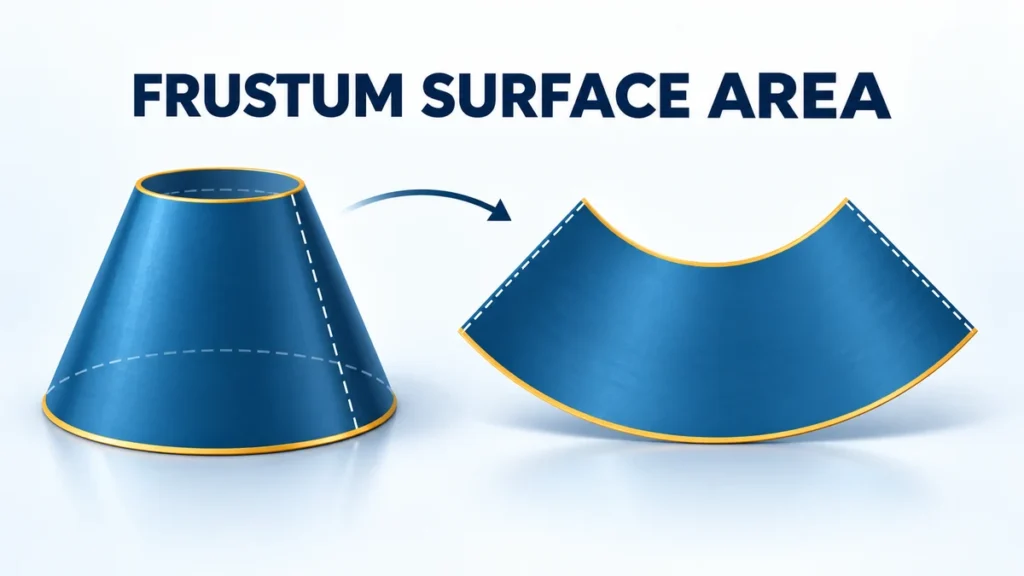
A right circular frustum has lateral surface area π(R + r)s because its curved side is what remains after a smaller, similar cone is removed from a larger cone. Subtracting the two cone areas leaves the sum of the two radii, R + r, multiplied by the shared frustum slant height s.
What Does The Frustum Formula Measure?
The formula π(R + r)s measures only the sloped, curved side of a right circular frustum. It does not include either circular end. OpenStax derives this expression by removing the lateral area of a smaller cone from that of a larger cone, which matches the geometry of a frustum exactly.
A frustum forms when a plane cuts a cone parallel to its base and removes the pointed top. The remaining solid has two parallel circular faces. The lower face usually has radius R, and the upper face has radius r, with R ≥ r.
The slant height s is measured along the side from one circular rim to the other. It is not the perpendicular height h. For a right circular frustum, those measurements satisfy s = √(h² + (R – r)²).
Knowing which surface is requested prevents an early error. A lampshade with open ends needs lateral area. A closed container shaped like a frustum needs lateral area plus the areas of both circles. The frustum calculator can check either result after the correct surfaces are selected.
Why Do Similar Cones Prove The Formula?
Similar cones prove the formula because the original cone and removed cone have the same shape and share one vertex. OpenStax writes the frustum area as the difference of two cone areas. Similarity then converts the unknown full slant heights into the known gap s.
Call the larger complete cone’s slant height L. Call the removed smaller cone’s slant height l. Since the frustum lies between their circular rims, its slant height is
s = L – l.
The lateral area of the large cone is πRL, while the lateral area of the small cone is πrl. Subtract the missing top cone:
AL = πRL – πrl.
Because the cones are similar, corresponding radius-to-slant ratios are equal:
R/L = r/l.
This relation gives L = Rs/(R – r) and l = rs/(R – r) when R ≠ r. Substitute those expressions into the area difference:
AL = πR[Rs/(R – r)] – πr[rs/(R – r)].
Combine the terms to get πs(R² – r²)/(R – r). The difference of squares factors as (R – r)(R + r). Cancel the common factor R – r, and the result is
AL = π(R + r)s.
The derivation explains why the radii are added rather than subtracted. Their difference appears temporarily in the similar-cone heights, but it cancels against the difference-of-squares factor. The surviving factor is R + r.
What Does Each Part Of π(R + r)s Mean?
Each factor has a geometric job. The term π(R + r) is the average circumference of the two circular rims, while s is the distance across the sloped surface. Multiplying average circumference by slant height gives the curved area.
The two rim circumferences are 2πR and 2πr. Their average is
(2πR + 2πr)/2 = π(R + r).
This offers a second way to remember the formula: curved area equals average circumference times slant height. It does not replace the similar-cone proof, but it makes the result easier to understand and estimate.
The dimensions also make sense. Both R + r and s are lengths. Their product has square units, and π has no units. Therefore, the result is an area.
How Does The Formula Work In An Example?
For R = 6, r = 3, and h = 4, the slant height is 5. The lateral area is 45π ≈ 141.37 square units. Adding both circular ends gives a total surface area of 90π ≈ 282.74 square units.
- Find the radius change: R – r = 6 – 3 = 3.
- Find the slant height: s = √(h² + (R – r)²) = √(4² + 3²) = 5.
- Find the lateral area: π(R + r)s = π(6 + 3)(5) = 45π ≈ 141.37.
- Find both base areas: πR² + πr² = 36π + 9π = 45π.
- Find total area: 45π + 45π = 90π ≈ 282.74.
The 3-4-5 right triangle is a useful check for s. The horizontal leg is not either radius by itself. It is their difference, 3. The vertical leg is the perpendicular height, 4. The sloped side is therefore 5.
You can compare the result with the surface area calculator. Keep the exact answer in terms of π until the last step, then round only once.
How Is Total Surface Area Different?
Total surface area includes three pieces: the curved side, the large circular base, and the small circular top. Add πR² and πr² to the lateral area. The complete formula is π(R + r)s + πR² + πr².
| Requested Area | Included Surfaces | Formula |
|---|---|---|
| Lateral area | Curved side only | π(R + r)s |
| Total area | Curved side and both circles | π(R + r)s + πR² + πr² |
| Open-top area | Curved side and large base | π(R + r)s + πR² |
A bucket without a lid does not include the smaller top circle. A lampshade may include neither circle. Read the object description before adding bases. This choice often matters more than the arithmetic.
How Do The Cone And Cylinder Checks Work?
The formula passes two strong boundary checks. Setting r = 0 turns the frustum into a cone and gives πRs. Setting R = r turns the sloped side into a cylinder and gives 2πRs. These are the expected lateral-area formulas.
For the cone check, the small rim shrinks to a point. Then π(R + 0)s = πRs, the ordinary cone result. The related cone lateral-area explanation shows why that formula comes from a circular sector.
For the cylinder check, equal radii mean there is no sideways change. The slant height equals the vertical height, so π(R + R)s = 2πRs. That is circumference 2πR times height s, exactly as a cylinder’s curved rectangle requires. Use the cylinder calculator to test a numerical case.
The formula is also symmetric in R and r. Swapping the names of the two rims does not change R + r. That makes sense because turning the frustum upside down does not change its area.
Which Mistakes Should You Avoid?
The most common errors come from using the wrong height or adding the wrong surfaces. The lateral formula needs the slant height s, not the perpendicular height h. It includes neither circular end unless the problem asks for total area.
- Using R – r in the final formula: The subtraction helps find s, but lateral area uses R + r.
- Substituting h for s: First calculate s = √(h² + (R – r)²).
- Adding only one base: A closed frustum has two circular faces with different radii.
- Using mixed units: Convert all lengths to one unit before calculating.
- Rounding too early: Keep radicals and π exact until the final answer.
- Applying the formula to an oblique frustum: The simple expression assumes a right circular frustum with parallel circular ends.
FAQs About Frustum Lateral Surface Area
Why Are The Two Radii Added?
Similar-cone subtraction creates R² – r². Factoring gives (R – r)(R + r), and the R – r factor cancels. The remaining sum also represents half the sum of the two rim circumferences.
Can The Smaller Radius Be Zero?
Yes, as a limiting case. When r = 0, the top circle collapses to a point, and the frustum becomes a cone. The formula becomes πRs.
What If The Two Radii Are Equal?
The shape becomes a cylinder. Then R = r, s = h, and the formula becomes 2πRh, the cylinder’s lateral area.
Does The Formula Include The Circular Ends?
No. It gives only curved lateral area. For a closed frustum, add πR² + πr². For an open object, add only the circular faces that are actually present.
When Is The Slant Height Equal To The Vertical Height?
They are equal when R = r, which is the cylinder case. Otherwise, the side moves inward or outward, so s = √(h² + (R – r)²) is longer than h.
Sources
OpenStax provides the similar-cone derivation of the lateral surface area of a conical frustum. The worked example, limiting cases, and error checks above were independently calculated from that established formula.
For more related formulas, browse the trigonometry and geometry tools.