Fractions · Why the division rule works
Dividing by a fraction asks how many fraction-sized groups fit into an amount. The reciprocal changes the size of that group into one, which makes the number of groups easier to calculate.
For a nonzero divisor, dividing by a fraction equals multiplying by its reciprocal. A reciprocal is the number that multiplies the divisor to give 1. For example, 3/4 ÷ 1/4 = 3 because three quarter-sized groups fit into three quarters.
What Does Division By A Fraction Ask?
Division can ask how many groups of a given size fit into an amount. In 6 ÷ 2, the amount is 6 and each group has size 2. Three groups fit, so the quotient is 3.
Fraction division uses the same question with smaller or larger groups. In 3/4 ÷ 1/4, the amount is three quarters and each group is one quarter. The answer counts groups, not the number of pieces in a whole.
Keep the amount and group size in the same unit. Three quarters of a meter divided into quarter-meter lengths gives three lengths. Comparing fractions of different-sized wholes would not describe the same measurement problem.
How Can Fraction Pieces Show The Quotient?
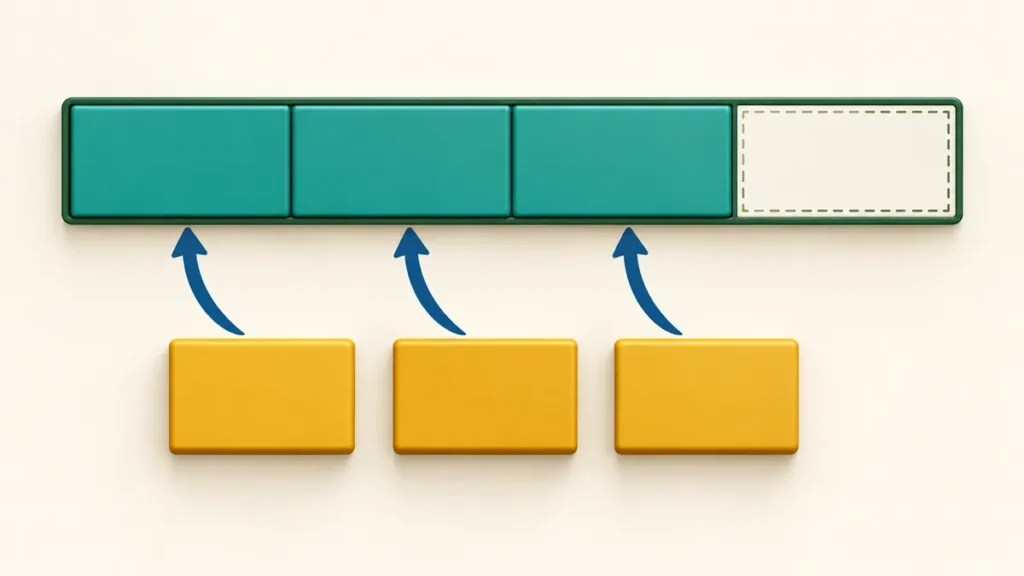
A strip divided into four equal parts shows the example directly. Shade three parts for 3/4, then count how many one-part groups cover the shaded section. There are three complete groups.
The answer is a whole number because the group size divides the amount exactly. Not every fraction division has that outcome. A remaining partial group contributes a fractional part to the quotient.
What Is A Reciprocal?
A reciprocal multiplies a nonzero number to give 1. The reciprocal of 2/3 is 3/2 because (2/3)(3/2) = 1. The numerator and denominator exchange positions, but the sign stays the same.
The reciprocal of a whole number follows the same rule. Write 5 as 5/1, then exchange the numerator and denominator to get 1/5. The reciprocal of −5 is −1/5.
Zero has no reciprocal. Every finite number multiplied by zero gives zero, never 1. That is why the division rule needs a nonzero divisor, not merely a fraction written with two numbers.
OpenStax defines reciprocals by their product being 1. That definition explains the rule more clearly than memorizing a direction to flip something.
Why Does Multiplying By The Reciprocal Undo Division?
Let q be the answer to A ÷ B, where B is nonzero. The definition of division says Bq = A. Multiply both sides by 1/B, which makes the coefficient of q equal to 1.
The left side becomes (1/B)Bq = q, and the right side becomes A(1/B). Therefore q = A × 1/B. This proof uses multiplication and equality, not a special exception for fraction notation.
For A = a/b and B = c/d, the reciprocal of B is d/c. Thus (a/b) ÷ (c/d) = (a/b)(d/c). The denominators b and d must be nonzero, and c must also be nonzero because the divisor cannot equal zero.
What If Only Part Of Another Group Fits?
For 3/4 ÷ 1/2, one half-sized group fits completely, with one quarter left. That leftover quarter is half of another half-sized group. The answer is therefore 1 1/2 groups.
The reciprocal calculation gives the same result: (3/4) × 2 = 3/2. This connects the procedure to the group-count interpretation. A quotient need not be an integer even when the inputs describe physical pieces.
For 1/4 ÷ 1/2, only half a group fits, so the quotient is 1/2. The answer does not describe half the original amount. It describes the original amount measured in units of one half.
Why Can Division Make A Number Larger?
Dividing a positive amount by a positive number less than 1 makes its numerical quotient larger. Smaller groups fit more often. For example, 2 ÷ 1/4 = 8 quarter-sized groups.
Dividing the same amount by a number greater than 1 makes the quotient smaller. In 2 ÷ 4, the amount fills only half of a four-unit group. The answer is 1/2.
These statements concern positive quantities. With negative inputs, sign rules also affect the result. Do not use the idea that division always makes smaller numbers as a universal check.
How Do You Divide Two Fractions Step By Step?
Keep the first fraction unchanged and replace division with multiplication by the second fraction’s reciprocal. For 5/6 ÷ 10/9, write (5/6) × (9/10). Cancel common factors in the product before multiplying.
The factor 5 cancels against 10, leaving 1 and 2. The factor 9 reduces against 6, leaving 3 and 2. The product is 3/4.
Check by multiplying the answer by the original divisor. Here (3/4)(10/9) = 30/36 = 5/6. That returns the original dividend, which is the defining requirement for the quotient.
What Changes With Mixed Numbers Or Negative Fractions?
Convert a mixed number into an improper fraction before finding its reciprocal. For 1 1/2 ÷ 3/4, the first number is 3/2. The product (3/2)(4/3) equals 2.
The reciprocal of 1 1/2 is 2/3, not 1 2/1. A mixed number represents one quantity, so it must be converted as a whole. Flipping only its fractional part changes the value.
Signs follow ordinary multiplication rules after the reciprocal step. For −3/4 ÷ 1/2, the result is −3/2. For −3/4 ÷ −1/2, the result is positive 3/2.
Which Fraction-Division Shortcuts Cause Errors?
Flip only the divisor, not both fractions. For 2/3 ÷ 4/5, the correct product is (2/3)(5/4) = 5/6. Flipping both would instead give (3/2)(5/4) = 15/8.
Do not reverse the input order. Fraction division is not commutative: 2/3 ÷ 4/5 = 5/6, while 4/5 ÷ 2/3 = 6/5. The answer depends on which amount is being measured by which group size.
A common denominator is not required for this multiplication method. It can provide another way to understand division, but addition rules do not automatically transfer. Identify the operation before choosing a fraction procedure.
Practice Checking The Quotient
Try 4/5 ÷ 2/3, 3 ÷ 3/4, and 2/7 ÷ 4/7. Predict whether each positive quotient is larger or smaller than its dividend. Then use a reciprocal and multiply back to check.
The answers are 6/5, 4, and 1/2. For the last example, both amounts already use sevenths, so two seventh-sized pieces form half of a four-piece group. That explains the quotient without a decimal approximation.
Can A Common Denominator Explain Fraction Division Too?
Yes. Rewrite 2/3 and 4/5 in fifteenths: they are 10/15 and 12/15. The question becomes how many twelve-piece groups fit into ten pieces, where every piece has the same size.
The answer is 10/12 = 5/6 of a group. This method works because the shared unit cancels in the ratio of the amounts. It gives the same result as (2/3)(5/4).
The common-denominator route explains the quotient, while the reciprocal route usually gives a faster calculation. Neither method adds denominators or changes the amounts. Choose the representation that makes the problem clear.
Does A Fractional Quotient Mean Another Complete Group Fits?
Not necessarily. Suppose 7/8 of a liter is poured into containers holding 1/4 liter each. The quotient is (7/8) × 4 = 7/2, or 3 1/2 container capacities.
That amount fills three containers completely and half of another. You need four physical containers to hold everything, but you do not have four full containers of liquid. The mathematical quotient and the count of containers needed answer different questions.
State which count the problem requests before rounding. Rounding 3 1/2 down would lose available capacity, while rounding it up and calling all four containers full would invent liquid. Interpret the exact result before choosing a whole-number answer.
FAQs About Dividing Fractions
Can You Divide Zero By A Nonzero Fraction?
Yes. Zero divided by a nonzero fraction equals zero because multiplying that divisor by zero returns zero. This is different from dividing a nonzero number by zero, which is undefined.
Is The Reciprocal The Same As A Negative?
No. The reciprocal changes multiplicative size, while negation changes sign. The reciprocal of 2/3 is 3/2; its negative is −2/3. Each operation answers a different question.
Check Fraction Division With Exact Values
Use the calculator to compare your product and its reduced result. Keep the group-size explanation beside your work.
Fraction calculatorBrowse fraction tools