Algebra · Understanding an undefined operation
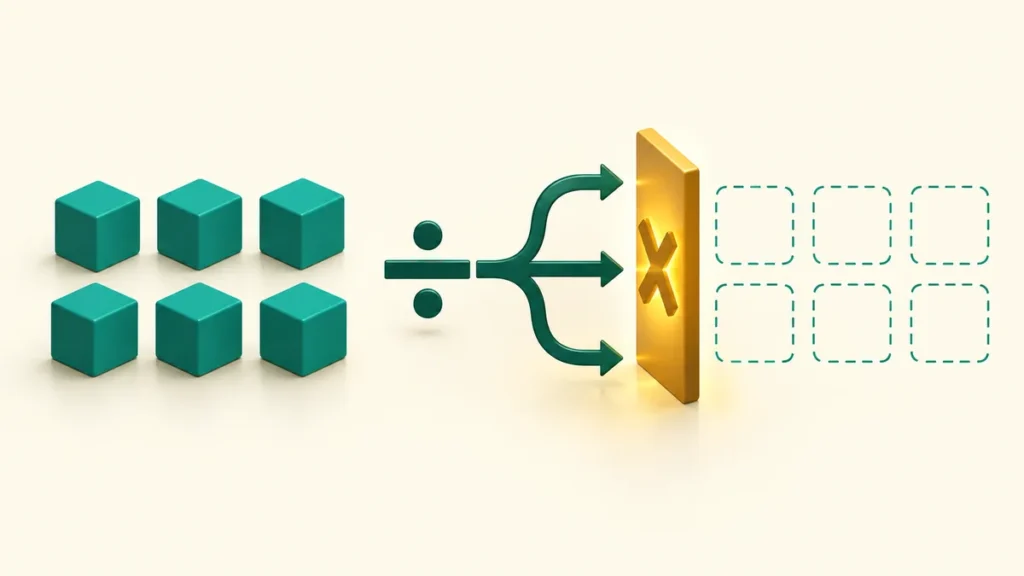
Division must produce a value that passes a multiplication check. A zero divisor breaks that requirement: it either produces no possible answer or fails to select one unique answer.
If 6 ÷ 0 equaled q, then 0 × q would have to equal 6. But zero times every real number is zero, so no such q exists. For 0 ÷ 0, every q passes the multiplication check, so there is no unique quotient. Both are undefined in ordinary arithmetic.
What Must A Division Answer Satisfy?
The quotient a ÷ b is the number q for which bq = a, provided b is nonzero. For 12 ÷ 3, the answer is 4 because 3 × 4 = 12. Multiplication checks the meaning of the quotient.
This definition works for negative values and fractions as well as whole numbers. The answer to −6 ÷ 2 is −3 because 2 × (−3) = −6. It is not a new rule based only on how many objects a picture contains.
The nonzero requirement ensures that one input to multiplication can be recovered from its product. Zero multiplication erases that information. Once a product is zero, it does not reveal which real number was multiplied by zero.
Why Does A Nonzero Numerator Give No Answer?
Assume 6 ÷ 0 has a real answer q. The multiplication check would require 0q = 6. Since 0q is always zero, the requirement contradicts 6 being nonzero.
Changing the proposed answer does not repair the contradiction. A quotient of 0, 6, −6, or a million still gives zero when multiplied by zero. No finite real value can pass the check.
The same reasoning works for any nonzero numerator. It does not matter whether the numerator is positive, negative, a fraction, or a decimal. The obstacle is the zero divisor, not the numerator’s size.
Why Is Zero Divided By Zero Undefined Too?
For 0 ÷ 0, the multiplication check becomes 0q = 0. Every real q satisfies that equation. It does not select one answer.
Choosing 1 would be arbitrary, since 0, 2, and −5 work just as well in the same check. Division is supposed to name a unique quotient, not an unrestricted collection of candidates. That is why the expression remains undefined.
This is a different failure from 6 ÷ 0. One case has no candidate and the other has too many. Both fall outside ordinary real-number division.
OpenStax distinguishes zero divided by a nonzero number from division by zero. Keep the location of zero visible before applying a memorized shortcut.
When Is A Zero Numerator Allowed?
A zero numerator is allowed with a nonzero denominator. For 0 ÷ 5, the unique answer is zero because 5q = 0 implies q = 0. The nonzero divisor makes that implication possible.
The same holds for a negative or fractional nonzero denominator. Thus 0 ÷ (−3) = 0 and 0 ÷ (1/2) = 0. These are valid operations, unlike dividing by zero.
Read the order carefully. The expressions 0/5 and 5/0 do not exchange roles. Division is not commutative, so swapping the numerator and denominator changes the task.
Why Doesn’t Zero Have A Reciprocal?
A reciprocal is a multiplicative partner that gives 1. The reciprocal of 4 is 1/4 because their product is 1. For zero, no real partner can give that product.
Every product 0r equals zero, not 1. Therefore 1/0 cannot be a real reciprocal. The usual instruction to divide by multiplying by the reciprocal stops when the divisor is zero.
A fraction can equal zero even when its written denominator is nonzero. For example, 0/7 is zero, so dividing by that whole fraction is still dividing by zero. Inspect the divisor’s value, not only its appearance.
Why Isn’t The Answer Simply Infinity?
Infinity is not a real number that you can substitute for an ordinary quotient. Saying a quantity grows without bound describes a pattern, not a finite value solving 0q = 6. The multiplication contradiction still matters.
Small nonzero divisors do create large quotients in some examples. The values 1/0.1, 1/0.01, and 1/0.001 are 10, 100, and 1,000. Every division there is valid because its divisor is not zero.
Does Approaching Zero Always Give The Same Behavior?
No. For 1/x, small positive x gives large positive values, while small negative x gives large negative values. The two directions do not approach one common real value.
Other expressions behave differently near zero. For nonzero x, x/x equals 1, x²/x equals x, and x/x² equals 1/x. All become undefined when you substitute x = 0 into their original quotients, despite different nearby patterns.
This is why 0/0 is called an indeterminate form in discussions of limits. The written form alone does not determine nearby behavior. It does not mean that ordinary arithmetic assigns 0/0 whichever value seems convenient.
Can Canceling A Factor Make A Zero Input Valid?
Cancellation is division by a common nonzero factor. The expression x²/x simplifies to x only for x ≠ 0. The simpler formula does not restore the original expression’s missing input.
At x = 3, both forms give 3. At x = 0, the standalone expression x gives 0, but x²/x is still 0/0 and undefined. State the restriction when comparing the expressions.
Likewise, (x² − 1)/(x − 1) simplifies to x + 1 for x ≠ 1. The original fraction excludes 1 because its denominator becomes zero. A valid simplification must keep that domain condition.
How Does Division By Zero Create False Algebra?
An equation can appear to prove a false result when a step divides by an expression equal to zero. Suppose x = y. Then x − y is zero, so dividing any equation by x − y is invalid.
A common trap is canceling x − y after factoring, as though a shared factor can always be removed. The shared factor’s value matters. Canceling a zero factor throws away the condition that made the argument possible.
Before dividing by a variable expression, identify where it becomes zero. Separate those cases rather than silently excluding them. This protects valid solutions and prevents fabricated contradictions.
Where Does This Restriction Appear In Everyday Formulas?
A slope calculation divides rise by run. When two distinct points have the same horizontal coordinate, the run is zero and the slope is undefined. The line is vertical; it does not have a real numerical slope produced by that formula.
An arithmetic mean divides a sum by the observation count. An empty list has count zero, so its ordinary mean is undefined. A software default of zero would be a separate design choice, not the result of the mean formula.
A unit-rate calculation also needs a nonzero unit quantity. Check the denominator before interpreting the result. A calculator error can reveal a missing or invalid input rather than a faulty arithmetic rule.
Is An Undefined Expression The Same As An Equation With Many Solutions?
No. The expression 0/0 asks for one division value, which ordinary arithmetic does not define. The equation 0q = 0 instead asks which q values make a statement true. Every real q does.
These are related questions with different expected outputs. Reporting all real values as the solution set of 0q = 0 is valid. Reporting all real numbers as the value of the expression 0/0 is not how division is defined.
The distinction also explains a linear equation whose variable terms cancel. A true statement such as 0 = 0 does not require you to divide by zero. It indicates that every value allowed by the original equation satisfies it.
Read whether a problem asks you to evaluate an expression or solve an equation before choosing an answer format. That prevents an undefined quotient from being confused with a perfectly meaningful solution classification.
Practice Locating The Zero
Classify 0/8, 8/0, 0/0, and (x + 2)/(x − 4) at x = 4. The first equals zero, while the others are undefined. Explain whether the multiplication check has one answer, no answer, or no unique answer.
Then simplify (x − 4)/(x − 4). It equals 1 for x ≠ 4, but the original quotient is undefined at 4. Include that restriction beside the simplified expression.
Check Inputs Before Calculating
Inspect denominators and variable restrictions before testing an expression. A numerical tool cannot make an undefined operation valid.
Browse algebra toolsSlope calculator