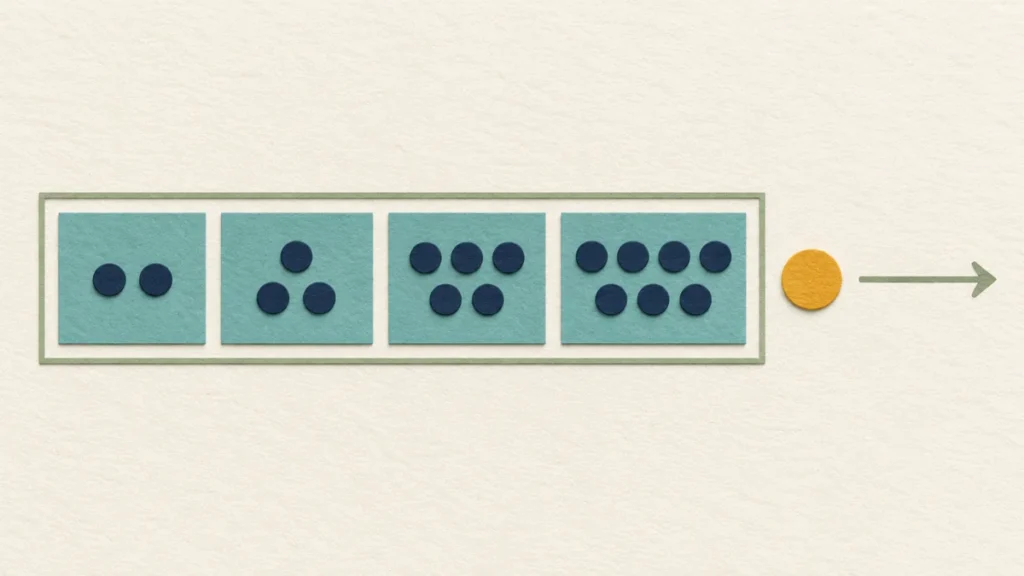
There are infinitely many prime numbers because no finite collection can include every prime. Multiply the primes in a proposed complete list and add 1. None of the listed primes divides the resulting number. That number either is prime itself or has a prime factor missing from the list.
The important point is not that a computer keeps finding more primes. A search checks only the numbers it reaches. A proof explains why every possible finite list must fail, regardless of its size. This lesson unpacks that reasoning with examples, checks, and common mistakes.
What Would A Finite List Of All Primes Mean?
A finite list of all primes would contain every prime exactly somewhere in a list that ends. It could be extremely long, but it would have a last entry and a fixed number of entries. To disprove that possibility, we need a method that works for any such list, not just a small example.
Assume, for the moment, that someone provides a complete finite list. Call its entries p₁, p₂, and so on through pₙ. This notation does not claim to know the number n. It lets us discuss a list of any finite length using one argument.
We then build a number from those entries and show that a prime outside the list must exist. That contradicts the claim that the list contains every prime. A contradiction rejects the completeness assumption, not the individual primes that were correctly included.
Euclid’s Book IX, Proposition 20 gives the classical argument that primes exceed any assigned finite collection. The modern product-plus-one presentation follows the same key idea: a common multiple and the number one greater cannot share a listed prime divisor.
Why Do You Multiply The List And Add One?
Multiplying the listed primes creates a number divisible by every one of them. Adding one breaks all those divisibilities at once. If P is the product and p is a listed prime, then P = pk for some integer k. Therefore, P + 1 = pk + 1 leaves remainder 1 when divided by p.
This is why the construction uses the entire proposed list. You do not need to guess a number and hope its factors are new. The multiplication makes every listed prime a known divisor of P, while the added one makes every listed prime a known nondivisor of P + 1.
You can also explain the step through subtraction. If a prime divided both P and P + 1, it would divide their difference, which is 1. No prime divides 1. The two explanations describe the same obstruction, using either a remainder or a difference.
How Does A Small Worked Example Illustrate The Proof?
Start with the list 2, 3, and 5. Its product is 30, so the constructed number is 31. Dividing 31 by 2, 3, or 5 leaves remainder 1. In this example, 31 is prime, providing a prime that the starting list did not contain.
To check that 31 is prime directly, test primes no greater than √31, which is between 5 and 6. Those possible trial divisors are 2, 3, and 5. None divides 31, so 31 is prime. This is a check of the example, not the reason the general construction works.
The prime checker can help check individual inputs. Use it to confirm arithmetic examples while keeping the proof’s logic separate. Even thousands of successful checks would not replace an argument covering every finite proposed list.
A small list makes the calculations manageable. It does not imply that the theorem only concerns three primes. Replacing 2, 3, and 5 with any finite collection preserves the remainder reasoning, even when the constructed number becomes too large for convenient hand calculation.
Must The Product Plus One Be Prime?
No. The product plus one can be composite, and the proof still works. Multiply 2, 3, 5, 7, 11, and 13 to obtain 30,030. Adding one gives 30,031. This number factors as 59 × 509, so it is not prime.
Check the multiplication: 509 × 60 − 509 = 30,540 − 509 = 30,031. Neither 59 nor 509 appears in the starting list. Both are prime, but the argument only needs a prime factor outside the list; it does not require every displayed factorization to be the easiest possible one.
For a hand check, √59 is below 8, so test 2, 3, 5, and 7; none divides 59. Also, √509 is below 23, so its trial primes are 2, 3, 5, 7, 11, 13, 17, and 19. None divides 509. These finite checks verify the two factors used in this example.
The prime factorization calculator supports this different task: finding prime factors of a particular integer. A composite constructed number shifts the question from “Is this new number prime?” to “Which prime factors does it have?”
Why Does Every Integer Greater Than One Have A Prime Factor?
An integer greater than one either is prime or has a smaller divisor greater than one. If that divisor is not prime, choose a smaller divisor of it. Repeating this process must stop because the positive integers decrease. The final divisor is prime and divides the original integer.
For example, a composite factor of 84 is 21. A smaller divisor of 21 is 3, which is prime. Thus 3 is a prime factor of 84. You do not need to finish the full factorization to establish that at least one prime factor exists.
That existence fact closes the composite case of the infinite-primes argument. The constructed integer P + 1 is greater than one, so it has a prime factor. Since no listed prime divides it, that prime factor cannot belong to the supposed complete list.
Does The New Prime Always Exceed Every Listed Prime?
Not for an arbitrary incomplete list. The construction guarantees a prime outside the list, not necessarily one larger than its largest entry. Starting with 2 and 101 gives 2 × 101 + 1 = 203 = 7 × 29. The new prime factors are smaller than 101.
The example is not a contradiction. The starting list omitted 7 and 29, so finding those primes satisfies the outside-the-list conclusion. Do not confuse a list’s largest member with a claim that it contains every smaller prime.
To prove a prime exists above a chosen bound B, take the finite list of all primes at most B. Construct its product plus one. Any prime factor outside this complete below-the-bound list must exceed B. This gives a prime beyond every chosen finite bound.
Consequently, there is no largest prime. If there were one, using it as the bound would produce a larger prime and contradict the claim. This formulation makes the connection between an infinite supply and the absence of a final largest prime explicit.
Is This A Practical Method For Generating Every Prime?
The argument proves existence, but it is not a promise of an efficient prime generator. Multiplying many primes creates a large integer quickly. The resulting number may be composite, and finding its prime factors may take considerable work. It also does not guarantee the next prime in numerical order.
Appending a newly found prime and repeating the construction can extend a list, but that process differs from systematically checking every integer. Some smaller primes may remain absent. The theorem needs only a new prime outside each finite list, not a complete ordered output sequence.
The prime numbers lesson explains the basic classification separately. Here the question is why that class never ends, not how to test every possible input or how a particular computer search operates.
Which Mistakes Can Break The Explanation?
The most important mistake is claiming that the constructed number must be prime. The composite example disproves that shortcut. Keep both cases: if the number is prime, it is new; if it is composite, at least one of its prime factors is new.
Also distinguish “none of these primes divides the number” from “no prime divides the number.” Only the listed primes have been ruled out. The remaining prime factor is precisely what supplies the missing entry. Overstating the divisibility conclusion would remove the step the proof relies on.
Finally, do not count 1 as prime. Its only positive divisor is itself, and including it would not supply the prime-divisor logic used here. A prime is greater than one. The product P is not the new candidate either; the added one is essential.
Return to the main idea: every proposed finite complete list leads to a prime outside it. That conclusion covers lists of any finite length, without needing a record-sized calculation. Visit the number theory hub for the related tools, while using the proof to understand why the search can never reach a final prime.