Coordinate geometry · From changes to distance
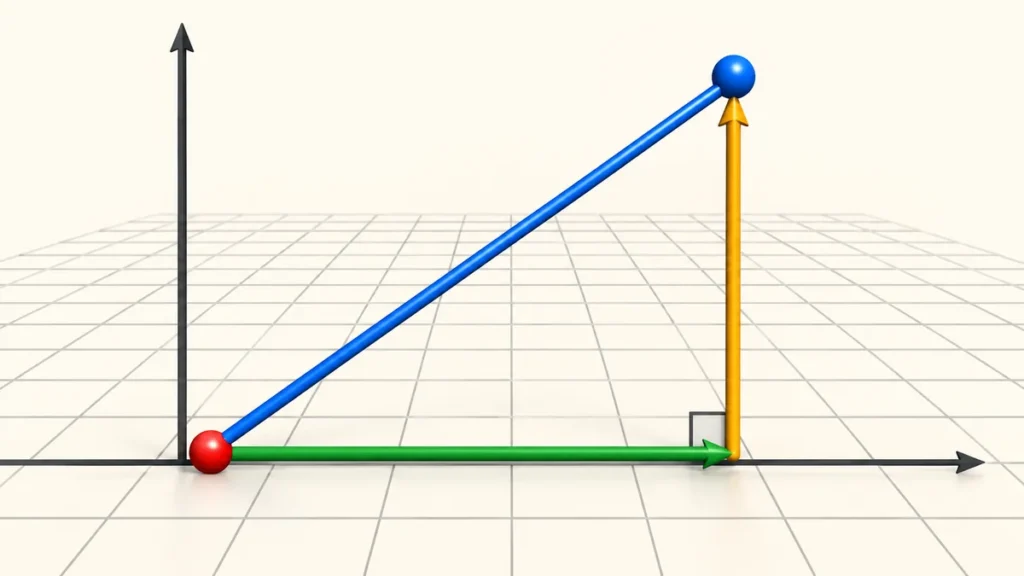
The distance formula is the Pythagorean theorem applied to horizontal and vertical coordinate changes. Squaring combines perpendicular lengths; the square root returns the straight-line length.
For two points in a flat Cartesian plane, d = √((x₂ − x₁)² + (y₂ − y₁)²). The coordinate differences form perpendicular triangle legs. Their squared lengths add to d², and taking the nonnegative square root gives distance rather than squared distance.
What Do The Coordinates Of Two Points Describe?
A coordinate pair records a horizontal position and a vertical position relative to the chosen axes. In (−2, 1), the first number is x and the second is y. Keep each coordinate in its own role.
To measure change, compare like coordinates: subtract x from x and y from y. Do not subtract a point’s y-coordinate from the other point’s x-coordinate. That would mix different directions.
For points A = (−2, 1) and B = (4, 9), the horizontal change is 4 − (−2) = 6. The vertical change is 9 − 1 = 8. These changes describe how far apart the points are in each perpendicular direction.
Why Do Coordinate Changes Form A Right Triangle?
Horizontal and vertical lines meet at a right angle in a Cartesian plane. Connect the points with a horizontal segment and then a vertical one. The direct segment between the endpoints becomes the hypotenuse of that triangle.
Its leg lengths are the absolute values of the coordinate differences. A negative change tells you direction, while length is nonnegative. The Pythagorean theorem then relates those two leg lengths to the diagonal.
Why Are The Differences Squared Instead Of Added?
The Pythagorean relationship is a² + b² = c². Replacing the two legs with horizontal and vertical changes gives d² = (Δx)² + (Δy)². The squares come from the right-angle geometry, not only from wanting a positive answer.
Taking absolute values and adding would also give a nonnegative number, but it would measure a different route. For changes 6 and 8, that sum is 14. The direct diagonal is 10.
Square each difference after subtraction. The expression (4 − (−2))² means 6² = 36. It is not 4² − (−2)², which would give 12 and fail to represent the squared horizontal length.
Why Is A Square Root Needed At The End?
The sum of the squares gives squared distance. In the example, 36 + 64 = 100, so d² = 100. Taking the square root returns d = 10.
Stopping at 100 would report the wrong quantity. If coordinate lengths are in meters, squared distance has units of square meters. The square root returns a length measured in meters.
Use the nonnegative root because distance cannot be negative. The equation d² = 100 has algebraic solutions ±10, but the definition of distance selects 10. This is a geometric restriction on the quantity being measured.
OpenStax states the distance formula for two coordinate endpoints. The triangle reasoning explains each operation in that expression.
How Do You Calculate A Distance Without Mixing The Steps?
- Write both ordered pairs and identify x and y in each.
- Subtract matching coordinates to find the two changes.
- Square each complete change.
- Add the squares.
- Take the nonnegative square root and label the units.
For (−2, 1) and (4, 9), the calculation is √(6² + 8²) = √100 = 10. A check should compare the answer with the leg lengths. The diagonal is longer than either positive leg.
A diagonal of 5 would be impossible here because it is shorter than the vertical separation of 8. An estimate can catch a misplaced sign or a missing square. It does not replace the exact calculation.
Why Does Reversing The Points Give The Same Distance?
Reversing endpoints changes both difference signs. The horizontal change becomes −6 and the vertical change becomes −8. Their squares stay 36 and 64.
Therefore the distance formula is symmetric: the distance from A to B equals the distance from B to A. Direction changes, but the length of the same segment does not. Squaring preserves that geometric fact.
Use one consistent subtraction order to reduce sign errors. You may use second minus first for both coordinates or first minus second for both. Parentheses matter most when subtracting a negative coordinate.
What Happens With Horizontal, Vertical, Or Identical Points?
If the points share a y-coordinate, the vertical change is zero. The formula reduces to √((Δx)²) = |Δx|. Their distance is the horizontal separation.
If they share an x-coordinate, use the vertical separation instead. For (3, −2) and (3, 5), the distance is |5 − (−2)| = 7. No division by the horizontal change is required.
If both coordinates match, both changes are zero and the distance is zero. Identical points do not form a nondegenerate right triangle, but the distance formula still has a well-defined result. That boundary is different from an undefined operation.
Does The Distance Have To Be A Whole Number?
No. Points (0, 0) and (1, 1) have distance √2. This is an exact irrational length, not an arithmetic failure.
Keep √2 when an exact answer is requested. Its decimal approximation is about 1.4142. Squaring a rounded decimal can give a value slightly different from 2 because rounding changes the input.
For changes 2 and 3, the exact distance is √13, about 3.6056. You cannot replace √(4 + 9) with √4 + √9. The latter gives 5 and measures neither the same diagonal nor the same expression.
How Does Straight-Line Distance Differ From A Grid Route?
A grid route follows horizontal and vertical segments rather than the diagonal. With changes 6 and 8, its length is 6 + 8 = 14. The straight segment has length 10.
Both values can be useful, but they answer different questions. A walking route constrained by blocks may need a route calculation. A ruler segment between two points in a flat drawing uses Euclidean distance.
Which Unit And Axis Assumptions Matter?
The formula assumes perpendicular axes with compatible length units. If a graph uses different visual scales on the two axes, count coordinate units rather than relying on the picture’s pixel lengths. A diagram may not be drawn to physical scale.
Convert different physical units before applying the formula. A horizontal change of 300 centimeters and vertical change of 4 meters become 3 and 4 meters. The distance is then 5 meters.
A graph with time on one axis and temperature on the other does not automatically describe geometric length. Adding their squared numerical changes cannot be labeled meters. The formula’s interpretation depends on what the coordinates measure.
When Is This Formula Not The Right Distance Model?
The two-dimensional formula describes a straight segment in a flat Cartesian plane. It is not automatically a surface distance across Earth, a road route, or a three-dimensional separation. Those tasks need their own models and inputs.
For three-dimensional Cartesian coordinates with the same Euclidean assumptions, an additional squared z-change is included. The result is √((Δx)² + (Δy)² + (Δz)²). Do not discard a known third coordinate and claim the two-dimensional result is the full spatial distance.
Why Doesn’t Shifting The Coordinate Origin Change Distance?
A translation adds the same horizontal and vertical offsets to both endpoints. Their differences stay unchanged because the added offsets cancel during subtraction. The distance therefore stays unchanged too.
For example, add (2, −1) to both (−2, 1) and (4, 9). The new points are (0, 0) and (6, 8), whose changes are still 6 and 8. Their distance remains 10.
This shows why absolute coordinate values are not the quantities squared in the formula. You can change those values by choosing another origin without moving the points relative to one another.
Practice Reading The Changes Before Calculating
Find the distance between (1, −2) and (4, 2). The changes are 3 and 4, so the result is 5. Reversing the point order must give the same answer.
Next compare (−3, 6) with (2, 6). Their shared y-coordinate makes the distance 5 directly. Explain why the coordinate −3 does not make the distance negative.
Check The Coordinate Calculation
Enter matching coordinate pairs and compare the distance with your perpendicular changes. Keep exact radicals until rounding is requested.
Distance formula calculatorBrowse algebra tools