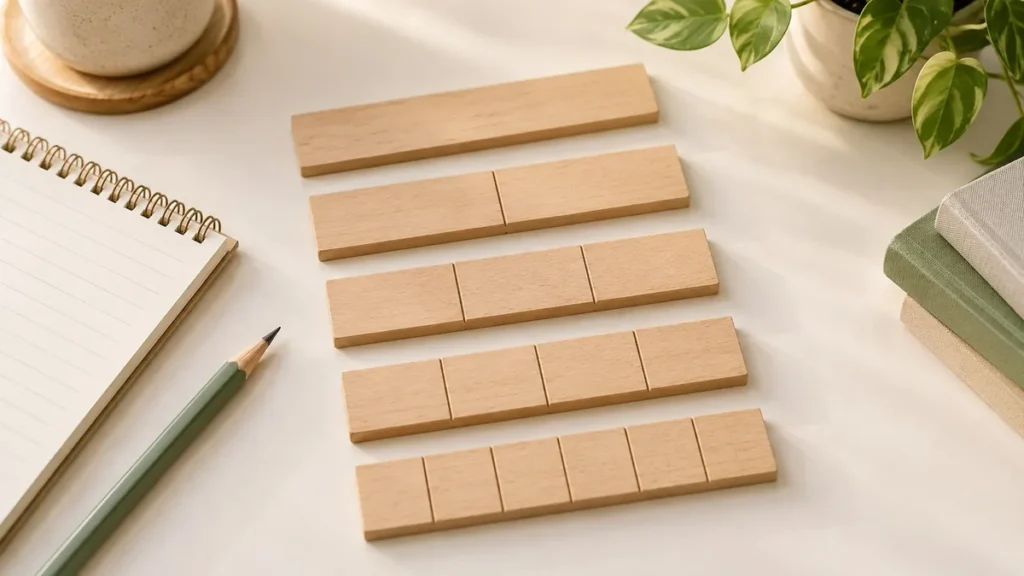
Fractions · Understanding the Pieces
The denominator tells you the size of one part of the whole. Addition works directly only after the parts you count have been made the same size.
You need a common denominator because unlike fractions count different-sized pieces. Convert them into equal-sized parts without changing their values, then add the numerators. For 1/2 + 1/3, write 1/2 as 3/6 and 1/3 as 2/6.
Five sixth-sized pieces make 5/6. The OpenStax fraction lesson uses equivalent fractions for the same reason.
What Does The Denominator Tell You?
The denominator specifies how many equal parts make one whole. One half is one of two equal parts; one third is one of three. Those parts are not interchangeable units.
Adding the numerators without first changing the units is like saying one meter plus one centimeter equals two of the same units. You can combine the amounts, but you must express them in a common unit first. The whole itself must also be the same size in both fractions for a fraction-strip picture to compare them meaningfully.
Why Does Multiplying Both Parts Of A Fraction Preserve Its Value?
Multiplying a numerator and denominator by the same nonzero number multiplies the fraction by 1. For example, 1/2 × 3/3 = 3/6 and 1/3 × 2/2 = 2/6. The notation changes, but the amount does not.
The equivalent forms reveal that both quantities are now counted in sixths. Add their numerators and keep the shared denominator: 3/6 + 2/6 = 5/6. The OpenStax visual-fractions section explains equivalent representations of the same amount.
Does The Common Denominator Have To Be The Least One?
No. Any positive common multiple of the nonzero denominators works. The least common denominator usually keeps the arithmetic smaller.
For 1/4 + 1/6, 12 is the least common denominator: 3/12 + 2/12 = 5/12. Using 24 also works: 6/24 + 4/24 = 10/24, which reduces to 5/12. Multiplying the denominators always gives a common denominator, but not always the smallest one.
Simplifying the final result is a separate step from finding the shared unit.
Does Subtraction Use The Same Reasoning?
Yes. Subtraction removes a number of equal-sized pieces from another amount. For 5/6 − 1/4, twelfths are a common unit.
Rewrite 5/6 as 10/12 and 1/4 as 3/12. Then 10/12 − 3/12 = 7/12. The denominator stays 12 because each counted part is still one twelfth.
A negative answer is possible when the second quantity is larger; a common denominator does not force the result to be positive.
How Do You Find A Common Denominator Efficiently?
Start by checking whether one denominator divides the other. For 3/8 + 1/4, eighths already fit both fractions. Keep 3/8 unchanged and rewrite 1/4 as 2/8, giving 5/8.
When neither denominator divides the other, list a few multiples or use prime factors. For denominators 6 and 8, the first shared multiple is 24. Six factors as 2 × 3, while eight is 2 × 2 × 2.
A shared multiple needs three factors of 2 and one factor of 3. That gives 24, not 48. The least common denominator helps avoid larger intermediate numerators, although either number would work.
- Choose a shared denominator.
- Divide it by each original denominator to find each scale factor.
- Multiply each numerator by its matching factor.
- Add or subtract the new numerators.
- Reduce the completed result.
For 5/6 + 3/8, the factors are 4 and 3. The fractions become 20/24 and 9/24, so the sum is 29/24. As a mixed number, that is 1 5/24.
How Do Common Denominators Work With Mixed Numbers?
Mixed numbers combine whole units with fractional parts. You can convert them into improper fractions before adding. This keeps every step in one fraction form.
For 1 1/2 + 2 1/3, rewrite the inputs as 3/2 and 7/3. In sixths, they become 9/6 and 14/6. Their sum is 23/6, or 3 5/6.
You can also add whole parts and fractional parts separately. The whole parts total 3, and the fractions total 5/6. Both methods agree because they preserve the same quantities.
Subtraction may require exchanging a whole unit for fractional pieces. In 2 1/4 − 1 1/2, rewrite the first amount as 1 5/4. Then 1 5/4 − 1 2/4 leaves 3/4.
Improper fractions avoid that borrowing step: 9/4 − 6/4 = 3/4. Choose the method you understand, then verify both denominators describe equal pieces. Do not subtract whole parts and fractional parts blindly when the latter would need regrouping.
What Changes When A Fraction Is Negative?
The common-unit requirement stays the same for negative fractions. The sign changes how you combine the numerators, not the size of the pieces. Keep the sign attached to the numerator during rewriting.
For −1/2 + 1/3, sixths give −3/6 + 2/6 = −1/6. The result is negative because the negative amount has greater magnitude. Both fractions still use the same whole unit.
For 1/3 − (−1/2), subtracting the negative becomes addition. The answer is 2/6 + 3/6 = 5/6. Parentheses help distinguish a negative fraction from the subtraction symbol before it.
A negative denominator can be moved to the numerator: 1/(−4) = −1/4. Keeping denominators positive makes common multiples easier to compare. A zero denominator remains invalid regardless of where the sign appears.
Why Does Fraction Multiplication Not Require This Step?
Multiplication asks for a fraction of a quantity rather than a sum of equal-sized pieces. For example, half of one third is one sixth. The denominator product describes the new partition created by that operation.
Thus 1/2 × 1/3 = 1/6, while 1/2 + 1/3 = 5/6. The operation determines which rule applies. Multiplying denominators during multiplication is correct; adding them during addition is not.
You may use equivalent fractions before multiplication, but matching their denominators is unnecessary. Cross-canceling common factors can reduce the arithmetic instead. Keep that simplification rule separate from finding a common denominator for a sum.
Can Three Fractions Share One Denominator?
Yes. Choose a common multiple of all three denominators, not only the first pair. For 1/2 + 1/3 + 1/4, twelfths work because 12 is divisible by 2, 3, and 4.
The rewritten fractions are 6/12, 4/12, and 3/12. Their sum is 13/12, or 1 1/12. All three numerators count the same-sized pieces, so you can combine them in one step.
You could add the first two fractions before adding the third. That gives 5/6 + 1/4, which still leads to 13/12. Using one shared denominator from the start avoids rewriting an intermediate result.
A denominator that fits only two inputs is not enough for the complete sum. Sixth-sized pieces fit halves and thirds, but one fourth is not a whole number of sixths. Check every input before doing the numerator arithmetic.
FAQs About Common Denominators
Can I Simplify The Inputs First?
Yes. Reducing 2/4 to 1/2 before adding 1/3 makes sixths an obvious choice. Simplifying first preserves each value and may reduce the least denominator needed for the rewritten inputs.
Does A Common Denominator Make Two Fractions Equal?
No. The fractions 2/7 and 5/7 count different numbers of the same pieces. A shared denominator makes their units comparable, not their amounts equal.
Can A Sum Be Greater Than One?
Yes. Three fourths plus two thirds becomes 9/12 + 8/12 = 17/12. That is 1 5/12, and the denominator still describes twelfths of one whole.
Practice Explaining The Shared Unit
Try 2/3 + 1/5, 3/4 − 1/6, and −1/3 + 5/6. Name the common unit before calculating. Then check whether the answer’s sign and size match the starting amounts.
The answers are 13/15, 7/12, and 1/2. The second uses twelfths because both fourths and sixths can be divided into twelfths. The last becomes −2/6 + 5/6 = 3/6 before reduction.
How Can You Catch An Incorrect Fraction Sum?
Estimate first. Because 1/2 + 1/3 is greater than 1/2 but less than 1, an answer such as 2/5 cannot be right. In fact, 2/5 is less than 1/2.
Do not add the denominators: 1/2 + 1/3 is not (1 + 1)/(2 + 3). Make sure you scale both numerator and denominator when forming an equivalent fraction. Check that no denominator is zero, and reduce the result if the numerator and denominator share a factor.
Test Another Fraction Pair
Predict a reasonable range for your answer, then compare it with the calculated result and steps.
Open the Fraction CalculatorBrowse Fraction Tools