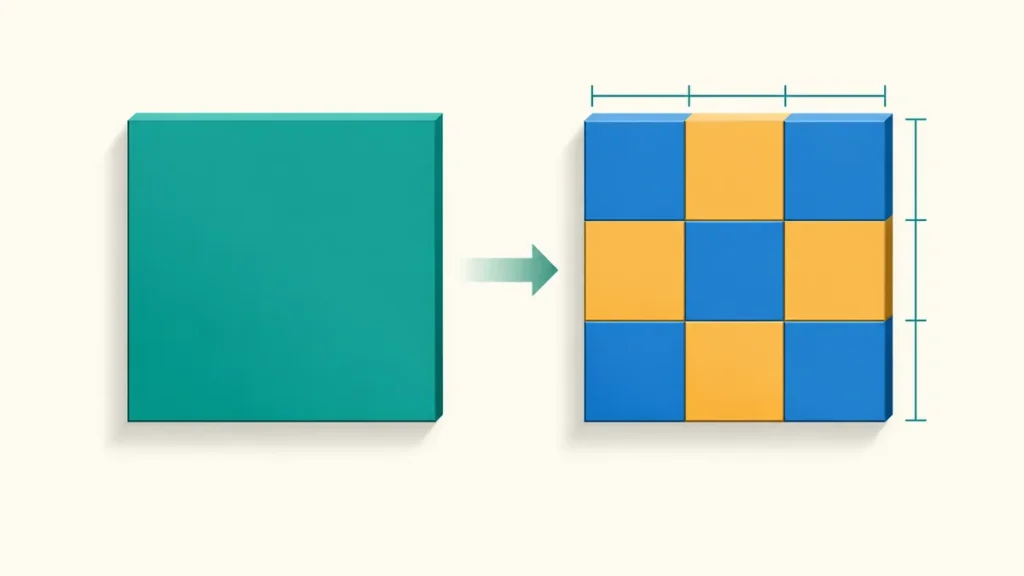
Measurement · Two dimensions change the factor
An area unit has two length dimensions. Converting its side unit changes the number of smaller units across and down, so the length factor appears twice.
If 1 large length unit equals k small length units, then 1 large square unit equals k² small square units. One meter equals 100 centimeters, so one square meter contains 100 × 100 = 10,000 square centimeters. The physical area stays unchanged.
What Does A Square Unit Mean?
A square centimeter is the area of a square with sides one centimeter long. A square meter is the area of a square with sides one meter long. The superscript 2 refers to two length dimensions being multiplied.
The surface being measured does not need to be square. A triangle, circle, or irregular region can be measured in square units. The unit defines the size of each area piece, not the shape of the whole region.
OpenStax defines square measures using unit-length sides. This definition explains why a length conversion alone is insufficient for area.
Why Does The Length Factor Appear Twice?
Imagine a square one meter across and one meter down. Each direction contains 100 centimeters. Its centimeter-sized grid therefore has 100 columns and 100 rows.
Each grid cell has area one square centimeter. The number of cells is 100 × 100 = 10,000. Counting only 100 would account for one row, not the complete surface.
For a smaller illustrative factor of 3, a large unit square contains three small units along each edge. Three columns times three rows give nine small square units. The same rule applies regardless of the chosen length factor.
How Does Unit Algebra Show The Same Result?
Write an area unit as a product of two length units. Since 1 m = 100 cm, multiplying that relationship by itself gives 1 m × 1 m = 100 cm × 100 cm. Therefore 1 m² = 10,000 cm².
In conversion-factor form, multiply by (100 cm/1 m)². The m² in the original area cancels with the m² in the factor’s denominator. The remaining unit is cm².
Using the length factor only once would leave an unwanted unit. For example, m² × cm/m leaves m·cm, not cm². Watching the units reveals the mistake before you accept the numerical result.
How Do You Convert Into Smaller Square Units?
Multiply by the squared length factor when moving into smaller units. A region of 2 m² becomes 2 × 10,000 = 20,000 cm². Smaller area units require a larger numerical count.
For centimeters to millimeters, the length factor is 10. The area factor is 100, so 3 cm² equals 300 mm². Multiplying by only 10 would undercount the area by a factor of 10.
State both the starting and ending unit. A bare number such as 300 does not identify whether you measured area, length, or another quantity. The exponent belongs in the final unit label.
How Do You Convert Back Into Larger Square Units?
Divide by the same squared factor when reversing the conversion. Thus 2,500 cm² becomes 2,500/10,000 = 0.25 m². The numerical count shrinks because each destination unit covers a larger area.
Converting 300 mm² into cm² gives 300/100 = 3 cm². It returns the starting amount from the earlier example. A round-trip check can catch a misplaced decimal point.
Do not divide by the factor twice in separate steps after already squaring it. Dividing by 100 is enough for mm² to cm². Another division by 100 would incorrectly apply the correction again.
Can You Convert The Dimensions First Instead?
Yes. For a rectangle 2 meters by 3 meters, the area is 6 m². Converting its dimensions gives 200 centimeters by 300 centimeters, whose area is 60,000 cm².
Converting the original area directly also gives 6 × 10,000 = 60,000 cm². The two methods agree because the dimension-first method applies the length factor to both factors in the area product.
Use one method consistently. Converting both dimensions and then multiplying the resulting area by 10,000 again would double-convert the measurement. Identify which units the intermediate result already has.
Does The Rule Change For Triangles Or Circles?
No. Area-unit conversion is separate from the formula used to calculate the area. A triangle with base 4 centimeters and height 3 centimeters has area 6 cm².
Its converted dimensions are 40 millimeters and 30 millimeters. The triangle formula gives (40 × 30)/2 = 600 mm². Direct conversion gives the same 6 × 100 = 600 mm².
For a circle of radius 3 centimeters, the area is 9π cm². Converting radius to 30 millimeters gives 900π mm². The constant π does not need its own unit conversion.
What If The Two Dimensions Use Different Units?
Convert them to a common length unit before multiplying when you want a familiar square unit. A rectangle 2 meters by 50 centimeters can be written as 2 meters by 0.5 meters. Its area is 1 m².
Alternatively, write 200 centimeters by 50 centimeters, giving 10,000 cm². Both descriptions cover the same region. Multiplying the original bare numbers to report 100 m² would be incorrect.
The product 2 m × 50 cm is a legitimate mixed-unit expression, but it is not already 100 m² or 100 cm². Finish the unit conversion before presenting the area as a standard square measure.
Is Unit Conversion The Same As Resizing A Shape?
No. Unit conversion changes the measurement language while preserving the physical region. Resizing changes the region itself. Those operations can involve similar factors but describe different actions.
If a drawing’s length dimensions are physically doubled, its area becomes four times as large. If you merely express the same drawing in smaller length units, its physical area does not grow. Only the numerical count of unit squares changes.
Label whether a factor describes a new size or a new unit. This distinction matters in scale drawings, maps, and material calculations. A larger numerical area is not by itself evidence of a larger object.
Why Do Cubic Units Need A Cubed Factor?
Volume has three length dimensions, so its length conversion factor appears three times. One meter cubed equals 100³ = 1,000,000 cubic centimeters. This is a different factor from the square-unit conversion.
Length, area, and volume therefore use k, k², and k³ respectively. Surface area remains an area even when it belongs to a three-dimensional object. Convert it with a squared factor, not a cubed one.
Which Quick Checks Catch A Conversion Error?
Ask whether the destination unit is smaller or larger. Smaller square units should give a larger numerical count for the same positive area. Larger units should give a smaller count.
Check that the unit exponent is still 2 after conversion. Then reverse the conversion to recover the starting value. These checks address scale, dimension, and arithmetic separately.
A conversion factor changes units, not uncertainty in the original measurement. Writing many decimal places does not improve a rough measured area. Round for the task after completing the conversion.
Why Does Perimeter Use Only The Length Factor?
Perimeter adds boundary lengths rather than multiplying two dimensions. A rectangle measuring 2 by 3 meters has perimeter 10 meters. In centimeters its perimeter is 1,000 centimeters, using the length factor 100.
The same rectangle’s area changes from 6 m² to 60,000 cm², using the factor 10,000. The physical boundary and surface have not changed. Their units differ because the formulas measure different kinds of quantity.
Check whether a question asks how far around or how much surface. Applying a squared factor to perimeter is as incorrect as using a length factor for area.
Practice Squaring The Length Factor
Convert 0.5 m² to cm², 800 mm² to cm², and 2 square yards to square feet. The answers are 5,000 cm², 8 cm², and 18 ft², using length factors 100, 10, and 3.
Explain why 2 square yards is not 6 square feet. A yard has three feet along each dimension, so its unit square contains nine square-foot pieces. The area factor is 3², not 3.
Check An Area Conversion
Choose area units, not length units, and compare the result with your squared-factor calculation.
Area converterBrowse measurement tools