Probability · Combine events without double-counting
You add probabilities when the event groups share no outcomes. Every qualifying outcome is then counted once. Overlapping events need a correction because simple addition counts their shared outcomes twice.
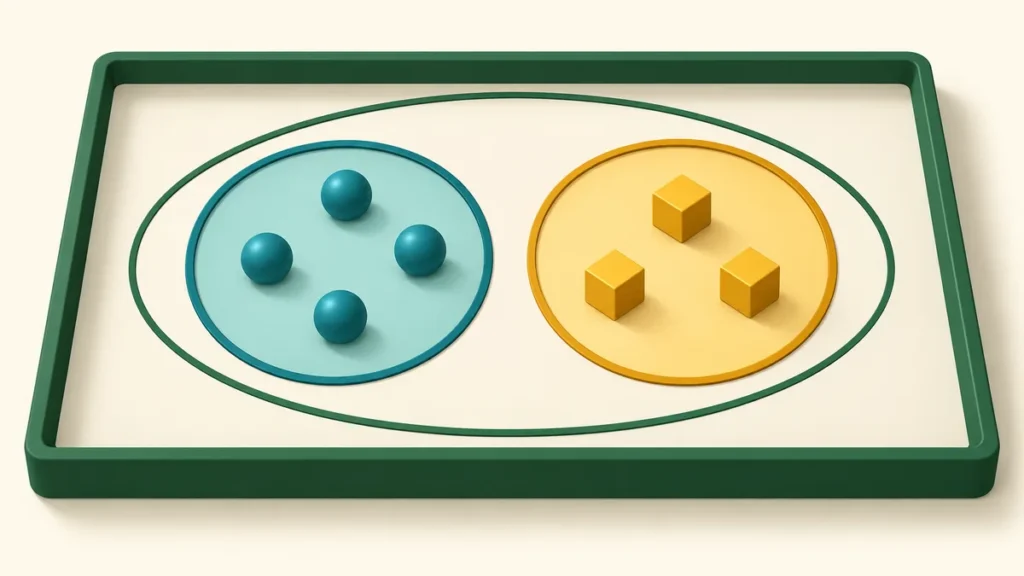
Mutually exclusive events cannot both occur in the same experiment. Their overlap is empty, so P(A or B) = P(A) + P(B). For one fair die roll, rolling 1 or 2 has probability 1/6 + 1/6 = 1/3 because no roll is both 1 and 2.
What Are An Outcome, An Event, And A Sample Space?
An outcome is a possible result of an experiment. An event is a set of outcomes that meet a condition. The sample space contains all outcomes being considered for that experiment.
For one ordinary six-sided die roll, the sample space is {1, 2, 3, 4, 5, 6}. The event rolling an even number contains {2, 4, 6}. Rolling 1 is an event with one outcome.
Define the experiment before discussing whether events can occur together. One die roll and two die rolls have different sample spaces. A phrase such as roll 1 needs a specified roll when more than one trial is involved.
What Does Mutually Exclusive Mean?
Two events are mutually exclusive when they have no shared outcome. On one die roll, the events roll 1 and roll 2 cannot both occur. Their intersection, written A ∩ B, is empty.
Rolling an even number and rolling 1 are also mutually exclusive. The even outcomes are 2, 4, and 6, none of which is 1. The events do not need to contain equal numbers of outcomes.
Check the actual event sets rather than their names. Rolling an even number and rolling a number greater than 3 are not mutually exclusive because both include 4 and 6. Two different descriptions can identify the same outcome.
Why Does Addition Work Without Overlap?
For equally likely outcomes, probability is the qualifying count divided by the total count. If two event sets are disjoint, their combined qualifying count is the sum of their separate counts. No outcome appears in both groups.
Suppose A is rolling 1 and B is rolling 2 on one fair die. Each event has probability 1/6. Their combined event contains two of the six outcomes, giving 2/6 = 1/3.
Adding 1/6 and 1/6 works because they use the same experiment and denominator. The numerator counts two different outcomes. This is not a rule that all probabilities can be added whenever a sentence contains the word or.
Does Probability’s Or Include Both Events?
The usual union A ∪ B means A occurs, B occurs, or both occur. This is inclusive or. For mutually exclusive events, the both case is impossible, so only the separate groups remain.
For overlapping events, the union still includes the shared outcomes, but only once. You do not exclude the overlap from the answer. You subtract one extra copy because adding the individual probabilities counted it twice.
Everyday language sometimes uses or to mean exactly one option. State the intended event clearly when that meaning matters. The usual probability addition rule refers to the inclusive union.
How Does The General Addition Rule Correct Double-Counting?
The general rule is P(A or B) = P(A) + P(B) − P(A and B). The overlap probability removes one duplicate count. When events are mutually exclusive, that subtraction is zero.
Take A = {2, 4, 6} and B = {4, 5, 6} on one fair die roll. Each event has probability 3/6, but their shared outcomes {4, 6} have probability 2/6. The union is {2, 4, 5, 6}.
Thus the answer is 3/6 + 3/6 − 2/6 = 4/6 = 2/3. Simple addition would incorrectly give 1 even though the listed union does not cover the sample space. Outcomes 1 and 3 satisfy neither event.
OpenStax explains the addition rule through mutually exclusive events and overlapping selections. Listing small event sets makes the reason for the correction visible.
Why Is Mutually Exclusive Different From Independent?
Mutually exclusive means no shared outcome. Independent means learning that one event occurred does not change the probability of the other. These conditions describe different relationships.
On one die roll, learning that 1 occurred makes the probability of 2 zero. Those positive-probability events are not independent. Their inability to occur together is exactly why the information changes the second probability.
For two independent fair die rolls, the event first roll is 1 and the event second roll is 1 can occur together. Their joint probability is 1/36, so they are not mutually exclusive. Independence concerns the probability relationship, not whether the events sound separate.
Two mutually exclusive events with positive probabilities cannot be independent. A zero-probability event is a special boundary, so keep the positive-probability condition in that statement. Do not replace a precise definition with a blanket slogan.
Does Addition Require Equally Likely Outcomes?
No. The disjoint-event addition rule works with unequal outcome probabilities too. Equal likelihood is needed for the simple count-over-total calculation, not for probability addition itself.
Imagine an illustrative single-spin model assigning probabilities 0.2 to green, 0.3 to amber, and 0.5 to blue. A spin cannot land in two distinct color categories at once. The probability of green or amber is 0.2 + 0.3 = 0.5.
These are assigned example probabilities, not observed data. Do not count the three color names and assume each has probability 1/3. A model must specify the probabilities or justify equal likelihood.
Do Mutually Exclusive Events Always Add To One?
Only when the selected events cover the whole sample space. Rolling 1 and rolling 2 are disjoint, but their sum is 1/3 because the other four outcomes remain. They are not exhaustive.
Rolling an even number and rolling an odd number on one die are both disjoint and exhaustive. Their probabilities add to 1. Every outcome belongs to one of those two groups.
An event and its complement also form a disjoint, exhaustive pair. If P(A) = 0.3, the complement has probability 0.7. This is a special complete partition, not the result for every two-event selection.
Can You Add More Than Two Mutually Exclusive Events?
Yes, when all the events are pairwise disjoint. That means no two selected event sets share an outcome. Their probabilities then add without an overlap correction.
For one fair die roll, the events roll 1, roll 3, and roll 5 have total probability 3/6 = 1/2. Each outcome is counted in one event only. The same counting idea scales to more disjoint categories.
Checking only one pair is insufficient. A third event may overlap either of the first two. List or diagram every selected event before applying the simple sum.
How Can You Catch An Invalid Probability Sum?
A probability must lie between 0 and 1. If supposedly mutually exclusive event probabilities sum above 1, the description or values are inconsistent. Recheck overlap and whether the probabilities refer to the same experiment.
Also keep the reference group consistent. A percentage from one sample cannot automatically be added to a percentage from a different sample. Matching units is not enough; the probabilities must describe events within the same model.
Write the event definitions before entering numbers into a calculator. A tool can perform addition, but it cannot infer whether your events overlap. The model choice must come first.
How Do You Combine Events From Two Independent Rolls?
For two independent fair die rolls, let A mean the first roll is 1 and B mean the second roll is 1. Each probability is 1/6, but both occur at the ordered outcome (1, 1), with probability 1/36.
The union probability is therefore 1/6 + 1/6 − 1/36 = 11/36. Independence did not remove the overlap. The sample space contains 36 ordered pairs, and eleven have at least one 1.
Practice Checking Overlap Before Adding
For one fair die roll, compare rolling an odd number with rolling 2. They share no outcomes, so their union probability is 3/6 + 1/6 = 2/3. List the union {1, 2, 3, 5} to check.
Next compare rolling odd with rolling above 4. The shared outcome is 5. Their union probability is 3/6 + 2/6 − 1/6 = 4/6, again 2/3, but the reasoning is different.
Calculate After Defining The Events
Identify the sample space and overlap first, then check the numerical probability. A calculator result does not validate an event definition.
Probability calculatorBrowse statistics tools