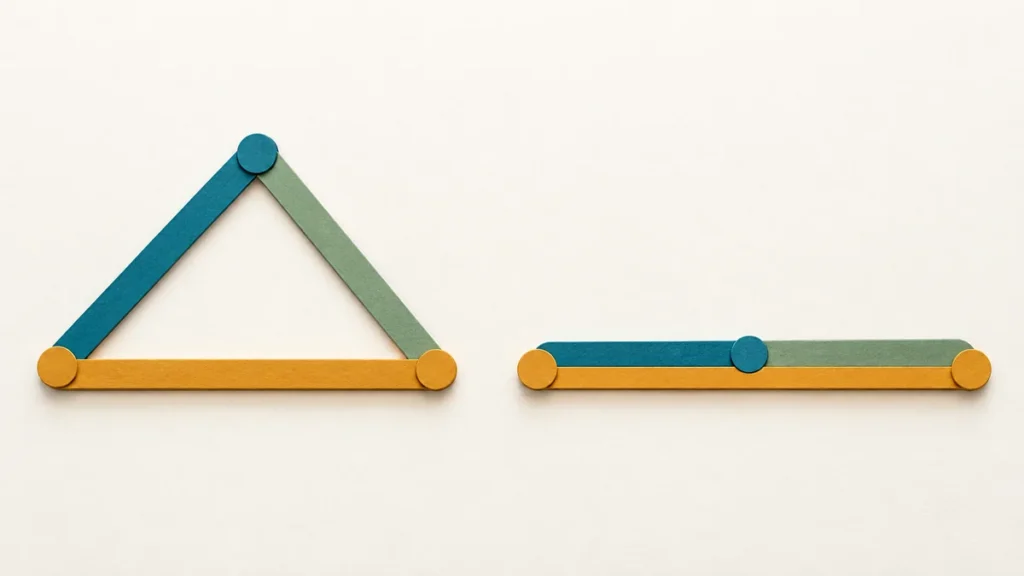
The triangle inequality decides whether three positive side lengths can close into a triangle. Any two sides must have a sum greater than the remaining side. If you sort the lengths, you only need to check whether the two shorter sides add to more than the longest side. Equality produces a flat shape, not a nondegenerate triangle.
This check belongs before calculating angles or choosing a triangle formula. Three plausible-looking measurements might not form a triangle at all. Understanding the strict inequality also helps you find a missing side’s allowed range, handle boundary cases, and avoid misleading conclusions from rounded measurements.
Why Must Two Triangle Sides Add To More Than The Third?
The route along two sides bends through a third corner, so it is longer than the straight side connecting the same endpoints. Euclid’s Elements, Book I, Proposition 20, states this relationship for every pair of sides. A genuine triangle needs a corner away from the straight connecting line.
Imagine two sticks joined at one end. Their free ends can move closer as you bend the joint. Their greatest separation occurs when the sticks point in opposite directions along a straight line. A third stick must be shorter than that total reach if the joint is to bend into a triangle.
For sides 3, 4, and 5, the first two sides have total length 7, which exceeds 5. The other sums also work: 3 + 5 > 4 and 4 + 5 > 3. These lengths can close into a triangle with positive area.
The inequality does not require the two-side route to be much longer. It only requires a positive excess. A triangle can be very thin and still valid. That makes the distinction between “greater than” and “equal to” essential near the boundary.
Why Can You Check Only The Two Shorter Sides?
Once the lengths are positive and sorted, the sum of the two shorter sides is the only sum that might fail. The other sums each include the longest side plus another positive length. They must therefore exceed the remaining shorter side. Sorting reduces three checks to one without changing the rule.
Write 0 < a ≤ b ≤ c. Then a + c > c ≥ b, so a + c > b. Likewise, b + c > c ≥ a, so b + c > a. Only a + b > c remains uncertain.
- Confirm that every length is positive.
- Put the three lengths in increasing order.
- Add the first two.
- Compare that sum with the third.
- Accept only a strict greater-than result.
For the list 9, 4, and 6, sort it as 4, 6, and 9. Since 4 + 6 = 10 > 9, it works. Checking the supplied order without identifying the longest side could lead you to test an easy inequality while missing the decisive one.
Zero and negative values must be rejected before the shortcut. A zero-length side does not create a third corner. A negative number is not an ordinary side length. The positivity condition is part of the test, not an optional detail.
Another equivalent check compares the longest side with half the perimeter. Since a + b > c, the total a + b + c must exceed 2c. For positive lengths, the longest side therefore must be less than half the perimeter. Use this form only when the individual longest length is known.
What Happens When The Sum Equals Or Falls Below The Longest Side?
Equality means the sides can meet only along one straight line, giving zero area. A smaller sum means the shorter sides cannot reach far enough to close the shape. Neither case gives a nondegenerate triangle, even if a sketch can be made to look roughly triangular.
| Lengths | Decisive comparison | Result |
|---|---|---|
| 3, 4, 5 | 3 + 4 > 5 | Valid triangle |
| 2, 3, 5 | 2 + 3 = 5 | Flat, zero-area boundary |
| 2, 3, 6 | 2 + 3 < 6 | Cannot close |
For 2, 3, and 5, the shorter sides fill the entire longest side when laid end to end. Bending their joint reduces the separation between their free ends, so it no longer matches 5. There is no nonzero bend angle that keeps all three stated lengths.
For 2, 3, and 6, even the straight arrangement reaches only 5. No rotation can stretch the sticks into length 6. The failure comes from the lengths themselves, not from an incorrect angle choice.
How Do You Find The Allowed Range For A Third Side?
With two fixed sides, the third must be longer than their absolute difference and shorter than their sum. For lengths 5 and 8, the allowed interval is 3 < x < 13. The lower and upper bounds describe two different flat arrangements, so neither endpoint is included.
The upper bound follows from 5 + 8 > x. The other two inequalities give x + 5 > 8 and x + 8 > 5. Together they require x > 3. Using the absolute difference lets the same formula work whichever known side is larger.
If the question asks for integer lengths, the possibilities are 4 through 12, inclusive. If it allows real lengths, values such as 3.1, 6.75, and 12.99 also work. Do not turn a continuous interval into an integer list unless the problem asks for that restriction.
When the two known sides are equal, their difference is zero. Two sides of length 6 allow a third side strictly between 0 and 12. This does not permit a zero-length third side. It means every positive length below 12 can make some nondegenerate triangle with those two sides.
You can picture the construction using circles. Put two endpoints x units apart and draw circles with radii 5 and 8 around them. A third corner occurs where the circles cross. The strict sum and difference bounds allow two intersections, one on each side of the endpoint line.
At either bound, the circles touch at one point along the line rather than forming a corner away from it. Outside the interval, they do not cross. This construction explains why both bounds matter, even though the sorted three-side test needs only one sum check.
Why Should You Check Triangle Existence Before Its Type?
Side lengths must form a triangle before you classify it as acute, right, or obtuse. Squared-side comparisons describe angle type only after existence is established. Otherwise, you can assign a triangle label to three lengths that cannot form any triangle.
For example, 3, 3, and 7 fail because 3 + 3 < 7. Comparing 3² + 3² with 7² might tempt you to call it obtuse, but no triangle exists. The angle classification never becomes applicable.
The valid lengths 3, 4, and 5 satisfy 3² + 4² = 5², so they form a right triangle. Other valid sets need not satisfy that equality. The Pythagorean equation is a right-triangle relationship, not a general requirement that every triangle must pass.
Use the types of triangles guide after validating the sides. For a right-triangle task, the Pythagorean theorem calculator handles a different calculation from the initial existence check.
How Do Units, Scaling, And Rounding Affect The Test?
Put every side in the same length unit before comparing sums. Converting all lengths by the same positive factor preserves whether the inequality is true. Rounding can be different: it changes the supplied numerical lengths and may turn a thin triangle into an apparent boundary case.
A list containing 3 cm, 4 cm, and 50 mm becomes 3 cm, 4 cm, and 5 cm. It is valid. Comparing the bare numbers 3, 4, and 50 would incorrectly reject it because the units were mixed.
Scaling 3, 4, and 5 by a positive factor of 2 gives 6, 8, and 10. The decisive inequality scales from 7 > 5 to 14 > 10. Uniform enlargement preserves the proportions and triangle existence, though the physical triangle becomes larger.
Near the boundary, use the stated precision. Exact lengths 1.999, 3.001, and 5 sum to equality and are degenerate. But rounded measurements reported as 2, 3, and 5 do not necessarily prove the physical object is perfectly flat. Their unrounded values and measurement uncertainty could change the comparison.
Report that limitation instead of adding invented extra digits. The triangle calculator can support calculations from supplied lengths, but a calculator cannot recover precision that the measurements do not provide.
FAQs About The Triangle Inequality For Sides
Can Equal Sides Form A Triangle?
Yes. Three equal positive lengths pass because twice one length exceeds that length. Two equal sides can also work when the third is shorter than their combined length. Equality between sides is allowed; equality in the decisive side-sum comparison is not.
Does Passing The Test Determine Every Angle?
Three valid side lengths determine a triangle’s shape and size up to congruence. You can calculate its angles using appropriate formulas, but the inequality alone does not display them. Reflected drawings can place the third corner on opposite sides of a baseline while representing congruent triangles.
Can A Perimeter Alone Establish A Triangle?
No. A perimeter gives a total but not how it is divided among sides. The sets 3, 4, 5 and 2, 3, 7 both total 12. The first is valid; the second fails. You need enough information about the individual lengths.
Start with positive lengths, consistent units, and the longest side. Check the strict sum before using angle formulas. For a missing side, exclude both interval endpoints. The trigonometry hub connects this existence check with the next triangle calculation.